• Skip to primary navigation
  • Skip to main content
  • Skip to primary sidebar
  • Skip to secondary sidebar
  • About
    • Contact
    • Privacy
    • Terms of use
  • Shop
    • Cart
    • Checkout
    • My Account
  • Advertise
    • Advertising
      • Buy ad space
    • Case studies
    • Design
    • Email marketing
    • Features list
    • Lead generation
    • Magazine
    • Press releases
    • Publishing
    • Sponsor an article
    • Webcasting
    • Webinars
    • White papers
    • Writing
  • Subscribe to Newsletter

Robotics & Automation News

Where Innovation Meets Imagination

  • Home
  • News
  • Features
  • Editorial Sections A-Z
    • Agriculture
    • Aircraft
    • Artificial Intelligence
    • Automation
    • Autonomous Vehicles
    • Business
    • Computing
    • Construction
    • Culture
    • Design
    • Drones
    • Economy
    • Energy
    • Engineering
    • Environment
    • Health
    • Humanoids
    • Industrial robots
    • Industry
    • Infrastructure
    • Investments
    • Logistics
    • Manufacturing
    • Marine
    • Material handling
    • Materials
    • Mining
    • Promoted
    • Research
    • Robotics
    • Science
    • Sensors
    • Service robots
    • Software
    • Space
    • Technology
    • Transportation
    • Warehouse robots
    • Wearables
  • Press releases
  • Events

Xiaomi tests humanoid robots on electric vehicle production line in automotive factory

March 10, 2026 by David Edwards

Chinese technology giant Xiaomi – best known globally as one of the world’s largest smartphone makers – is testing humanoid robots in its electric vehicle manufacturing operations, according to a company blog post describing early experiments in a factory environment.

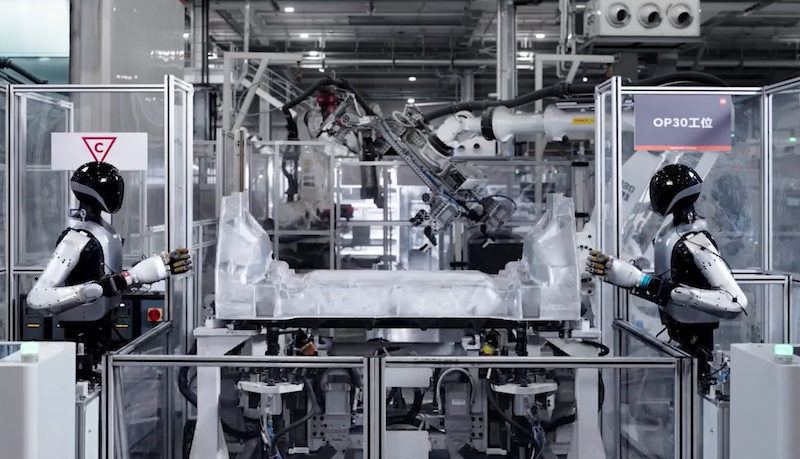
The company says two humanoid robots have been deployed in an automotive assembly workstation where they carried out a repetitive fastening task for several hours.

Xiaomi, which built its reputation in consumer electronics including smartphones, tablets and smart home devices, has recently expanded aggressively into new technologies. In 2024 the company launched its first electric vehicle, the SU7 sedan, marking its entry into the highly competitive EV market.

The latest experiment suggests Xiaomi is also exploring robotics – particularly humanoid robots – as a potential automation technology for future manufacturing.

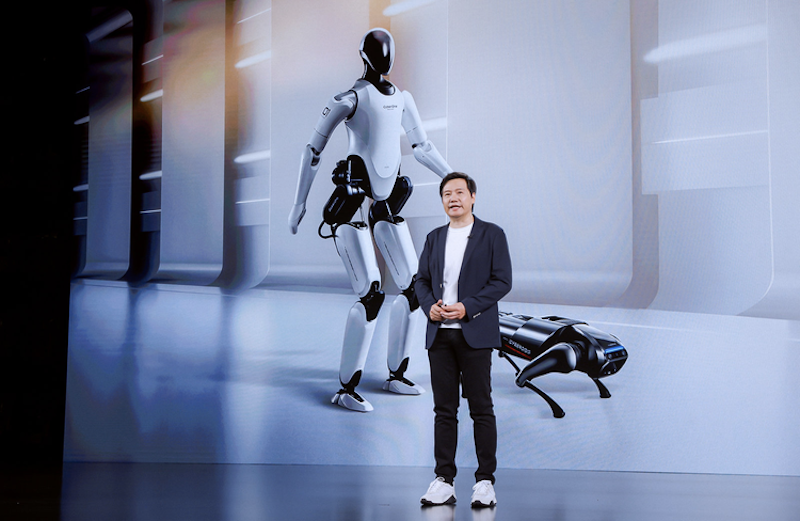
Xiaomi previously unveiled its CyberOne humanoid robot (pictured on screen below), and the company appears to be using related technologies as it experiments with humanoids in its EV factory.
Humanoid robots tested on automotive assembly task

In the experiment described by Xiaomi, the robots were assigned to install self-tapping nuts used in automotive components.

The system reportedly achieved a 90.2 percent success rate during three hours of continuous autonomous operation, while also meeting the production line’s 76-second cycle time requirement.

According to the company, the robots picked self-tapping nuts from an automated feeder and placed them into a tightening fixture before the assembly station completed the fastening process automatically.

The task may sound simple, but Xiaomi says the mechanical details of the component make it challenging for robots.

The inner spline structure of the nut, variations in how it is gripped, and magnetic attraction from the positioning pin can all disrupt alignment and cause installation failures.

As the company explains, factories require “precise and reliable movements, with production cycles accurate to the second”, which presents a major gap between robotics experiments conducted in laboratories and real-world manufacturing.

“In the lab, thousands of failed iterations can be conducted,” the company writes. “Factories demand precise and reliable movements.”

AI models and tactile sensing used for robot control

Xiaomi says the robots rely on several internally developed AI technologies.

These include Xiaomi-Robotics-0, a large vision-language-action (VLA) model designed to enable robots to interpret visual information and execute physical tasks.

Another system, called TacRefineNet, provides haptic perception, allowing the robots to use tactile feedback during manipulation tasks.

The company says the system uses a data-driven, end-to-end control approach combined with reinforcement learning to improve reliability in industrial environments.

The robot also uses multimodal perception, integrating information from cameras, tactile sensors, and joint motion sensors.

Relying on visual perception alone can be unreliable in factory environments due to lighting changes or occlusion, Xiaomi says, while tactile sensing alone can be affected by unexpected contact with surrounding equipment.

By combining both, the robot can better judge the state of the assembly process.

Balancing stability and adaptability

For full-body control of the humanoid platform, Xiaomi says it combines classical optimization control methods with reinforcement learning.

The optimization system ensures stability and safety constraints, while the reinforcement learning controller has been trained using simulations involving millions of disturbances to help the robot maintain balance in unexpected situations.

This hybrid control system allows the robots to respond to disturbances while maintaining stable operation.

Early-stage experiments

Xiaomi describes the nut-installation task as the first step in testing humanoid robots for automotive manufacturing, but acknowledges that significant challenges remain.

The key hurdle for wider deployment is achieving industrial-grade reliability and productivity – specifically improving production cycle time and yield rate.

The company says additional pilot experiments are under way in other factory stations, including:

  • a front logo installation workstation
  • a toilet bin handling workstation

Further updates on these deployments are expected later.

Growing interest in humanoid robots for manufacturing

Humanoid robots have attracted increasing attention in recent years as companies explore whether human-like machines could perform complex tasks in factories, warehouses, and logistics operations.

Several technology companies – including Tesla, Figure AI, and Chinese robotics startups – are developing humanoid platforms aimed at industrial use.

Xiaomi’s factory trial suggests the company may also be exploring how humanoid robots could eventually assist in its own manufacturing operations as it expands beyond smartphones into vehicles and other advanced technologies.

Xiaomi launched its first production EV, the SU7 sedan, in 2024 and has since expanded its automotive ambitions – even unveiling a futuristic Vision Gran Turismo electric hypercar concept (pictured above) – although it is unclear which vehicle was being assembled in the factory where the humanoid robots were tested.

Print Friendly, PDF & Email

Share this:

  • Print (Opens in new window) Print
  • Share on Facebook (Opens in new window) Facebook
  • Share on LinkedIn (Opens in new window) LinkedIn
  • Share on Reddit (Opens in new window) Reddit
  • Share on X (Opens in new window) X
  • Share on Tumblr (Opens in new window) Tumblr
  • Share on Pinterest (Opens in new window) Pinterest
  • Share on WhatsApp (Opens in new window) WhatsApp
  • Share on Telegram (Opens in new window) Telegram

Related stories you might also like…

Filed Under: Humanoids, News Tagged With: AI robotics manufacturing, automation news, Chinese robotics companies, humanoid robot assembly line, humanoid robots in manufacturing, industrial humanoid robots, robotics and automation, robotics and automation news, robotics in automotive production, robotics news, Xiaomi EV factory, Xiaomi humanoid robots, Xiaomi robotics, Xiaomi SU7 electric car

Primary Sidebar

Search this website

Latest articles

  • FORT Robotics extends physical AI safety platform with Nvidia Halos
  • Fieldwork Robotics secures SEED Innovations investment to scale berry harvesting robots
  • Multi-robot demo showcases new UK’s Plymouth subsea test range
  • Tech company AVI-SPL launches autonomous Dallas-Houston freight operations with Volvo Autonomous Solutions
  • RoboDK unveils CAM software that cuts robotic machining deployment time ‘by up to 40 percent’
  • Richtech Robotics launches 24/7 interactive livestream featuring AI robot ADAM
  • Cognibotics selected for €6.5 million in EU accelerator funding
  • CS2 Skin Marketplace Comparison: Which Platform Offers the Best Prices and Security?
  • How Automation is Changing Employee Performance Tracking and Recognition
  • What Can Delay a Car Accident Settlement and How an Attorney Helps

Secondary Sidebar

Latest news

  • FORT Robotics extends physical AI safety platform with Nvidia Halos
  • Fieldwork Robotics secures SEED Innovations investment to scale berry harvesting robots
  • Multi-robot demo showcases new UK’s Plymouth subsea test range
  • Tech company AVI-SPL launches autonomous Dallas-Houston freight operations with Volvo Autonomous Solutions
  • RoboDK unveils CAM software that cuts robotic machining deployment time ‘by up to 40 percent’
  • Richtech Robotics launches 24/7 interactive livestream featuring AI robot ADAM
  • Cognibotics selected for €6.5 million in EU accelerator funding
  • CS2 Skin Marketplace Comparison: Which Platform Offers the Best Prices and Security?
  • How Automation is Changing Employee Performance Tracking and Recognition
  • What Can Delay a Car Accident Settlement and How an Attorney Helps

Copyright © 2026 · News Pro on Genesis Framework · WordPress · Log in

We use cookies on our website to give you the most relevant experience by remembering your preferences and repeat visits. By clicking “Accept”, you consent to the use of ALL the cookies.
Do not sell my personal information.
Cookie SettingsAccept
Manage consent

Privacy Overview

This website uses cookies to improve your experience while you navigate through the website. Out of these, the cookies that are categorized as necessary are stored on your browser as they are essential for the working of basic functionalities of the website. We also use third-party cookies that help us analyze and understand how you use this website. These cookies will be stored in your browser only with your consent. You also have the option to opt-out of these cookies. But opting out of some of these cookies may affect your browsing experience.
Necessary
Always Enabled
Necessary cookies are absolutely essential for the website to function properly. These cookies ensure basic functionalities and security features of the website, anonymously.
CookieDurationDescription
cookielawinfo-checkbox-analytics11 monthsThis cookie is set by GDPR Cookie Consent plugin. The cookie is used to store the user consent for the cookies in the category "Analytics".
cookielawinfo-checkbox-functional11 monthsThe cookie is set by GDPR cookie consent to record the user consent for the cookies in the category "Functional".
cookielawinfo-checkbox-necessary11 monthsThis cookie is set by GDPR Cookie Consent plugin. The cookies is used to store the user consent for the cookies in the category "Necessary".
cookielawinfo-checkbox-others11 monthsThis cookie is set by GDPR Cookie Consent plugin. The cookie is used to store the user consent for the cookies in the category "Other.
cookielawinfo-checkbox-performance11 monthsThis cookie is set by GDPR Cookie Consent plugin. The cookie is used to store the user consent for the cookies in the category "Performance".
viewed_cookie_policy11 monthsThe cookie is set by the GDPR Cookie Consent plugin and is used to store whether or not user has consented to the use of cookies. It does not store any personal data.
Functional
Functional cookies help to perform certain functionalities like sharing the content of the website on social media platforms, collect feedbacks, and other third-party features.
Performance
Performance cookies are used to understand and analyze the key performance indexes of the website which helps in delivering a better user experience for the visitors.
Analytics
Analytical cookies are used to understand how visitors interact with the website. These cookies help provide information on metrics the number of visitors, bounce rate, traffic source, etc.
Advertisement
Advertisement cookies are used to provide visitors with relevant ads and marketing campaigns. These cookies track visitors across websites and collect information to provide customized ads.
Others
Other uncategorized cookies are those that are being analyzed and have not been classified into a category as yet.
SAVE & ACCEPT