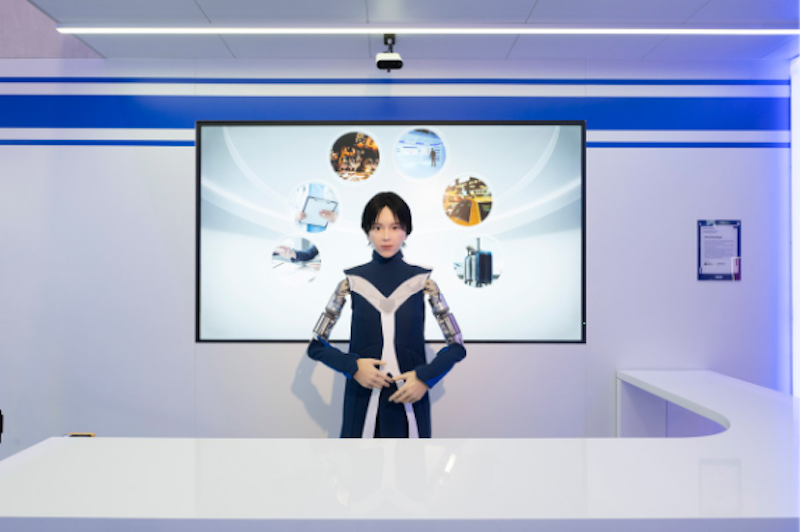
KDDI and Avita have announced a strategic partnership aimed at developing humanoid robots powered by what the companies describe as “Physical AI”.
The collaboration, announced March 2, 2026, will focus on building humanoid systems designed for real-world service environments such as retail, healthcare, entertainment and cultural venues.
Under the partnership, Avita will contribute expertise in avatar creation, conversational AI and remote operation technologies, while KDDI will provide communications infrastructure and data systems to support real-time operation of the robots.
The companies say their goal is to combine AI software with humanoid hardware to enable machines capable of interacting naturally with people in service roles.
Moving from digital avatars to physical robots
KDDI and Avita have previously worked together on remote customer service technologies using digital avatars.
Those systems were deployed at locations such as Lawson convenience stores and au Style/au retail shops, allowing staff to provide assistance remotely through digital interfaces.
The new initiative expands that concept into the physical world by enabling humanoid robots to move freely and communicate through gestures and facial expressions.
By combining Avita’s AI and avatar technologies with KDDI’s data and communications capabilities, the companies aim to improve the accuracy and autonomy of humanoid behavior over time.
The robots are expected to be trained using visual and motion data collected during real-world customer service interactions. These data will be analyzed in the cloud and used to improve the AI systems that control the robots.
Addressing labor shortages in service industries
The companies say the project is partly motivated by labor shortages affecting multiple industries in Japan, particularly as the country faces the effects of a declining birthrate and an aging population.
While industrial robots are widely used in manufacturing for specialized tasks, they are less suited to customer-facing roles that require flexibility and nonverbal communication.
Operations such as greeting customers, pointing directions or responding to gestures and facial cues have historically been difficult to automate.
By developing humanoid systems capable of interpreting and expressing such cues, KDDI and Avita hope to expand robotics into sectors that rely heavily on interpersonal interaction.
Communications infrastructure and AI training
A key element of the project will be the communications infrastructure needed to support real-time robotic operation.
Humanoid robots typically generate large volumes of visual and sensor data while also receiving control instructions from AI systems or remote operators. These data flows must be transmitted with low latency to enable smooth interactions.
KDDI plans to use its communications technologies to support remote control and AI processing for the humanoids developed by Avita.
The companies are also exploring the use of GPU resources at KDDI’s Osaka Sakai Data Center, which began operating in January 2026, along with on-premises services for Google’s generative AI model Gemini.
Concept humanoid unveiled at MWC Barcelona
As part of the announcement, the companies displayed a concept humanoid model at MWC Barcelona, held in Barcelona from March 2 to March 5.
The robot design is based on work by Avita CEO Hiroshi Ishiguro, a well-known robotics researcher who also produced the “Future of Life” pavilion at Expo 2025 Osaka Kansai.
The concept robot features a compact humanoid structure designed to resemble the physique of an average Japanese person. According to the companies, the robot’s face uses silicone skin and specialized mechanisms to produce “warm, approachable facial expressions”.
Its motion system relies on quiet pneumatic actuation designed to allow long operating periods and smooth, human-like movements. Facial expressions and body motions are synchronized with speech, while cameras embedded in the robot’s eyes allow it to track moving objects and maintain natural gaze behavior.
Commercial trials planned for 2026
KDDI and Avita plan to begin testing the system in commercial environments starting in autumn 2026.
Initial trials are expected to take place in real customer-facing facilities, with potential deployment at au retail stores and other service locations under consideration.
If successful, the companies say the robots could eventually be used in a range of public-facing roles requiring both conversation and nonverbal communication.
The partnership also marks the launch of Avita’s new humanoid and Physical AI business unit, which will focus on the development, sale and operation of humanoid robots designed for service applications.
