
Feature comparisons dominate most infrastructure automation partner evaluations. Companies download comparison charts and score providers based on capabilities lists.
However, this approach to evaluating DevOps infrastructure automation services misses the actual problem. Your documented operational failures should drive the decision. A crashed deployment pipeline costs real money every hour it stays broken.
Understanding where your current infrastructure creates bottlenecks matters more than impressive capability lists. Maybe your team spends three days provisioning test environments when competitors spin them up in minutes.
Or your infrastructure costs keep climbing while similar companies reduced their cloud spending by half. These specific problems need specific solutions, not generic feature sets that look good in proposals but don’t address your actual pain points.
Where Should You Start?
Start by documenting your current infrastructure failures with specific measurements. Maybe your deployment pipeline requires manual intervention at twelve different checkpoints. Or your infrastructure provisioning takes three weeks when competitors scale resources within hours.
These documented problems should connect directly to provider capabilities. A team with proven cloud migration experience matters when you’re moving legacy systems off on-premises hardware.
Specialists in infrastructure-as-a-code become relevant when you need consistent environment reproduction across development stages. Skip capabilities that don’t address your actual bottlenecks.
Automated container orchestration sounds impressive but wastes budget if your applications run perfectly well on traditional virtual machines.
Match these common infrastructure problems to provider expertise:
- Slow deployment cycles: Look for providers with CI/CD pipeline automation experience who can show documented deployment time reductions from their previous projects
- High infrastructure costs: Seek teams that demonstrate cloud cost optimization results, ideally with percentage reductions they achieved for similar companies
- Manual environment provisioning: Find specialists in infrastructure-as-code who have automated environment creation from weeks down to minutes
- Scaling limitations: Choose providers with auto-scaling implementation experience who understand traffic pattern analysis for your industry
- Security compliance gaps: Work with teams that build automated compliance checking into infrastructure pipelines rather than relying on manual audits
How to Verify Provider Infrastructure Experience
Marketing materials prove nothing about actual capabilities. Ask for infrastructure automation projects with documented outcomes that match your industry.
A successful e-commerce infrastructure deployment tells you nothing about fintech requirements. The compliance frameworks differ completely. Peak traffic patterns follow entirely different cycles.
Examine actual project results with specific measurements. How much did infrastructure provisioning time decrease? What percentage of manual intervention got eliminated?
Request references willing to discuss projects honestly. Talk to their previous infrastructure clients directly. Ask about complexity that wasn’t mentioned in proposals, timeline delays, and unexpected costs that appeared after contracts got signed.
Verify every capability claim against real evidence. Someone advertising infrastructure automation expertise should demonstrate completed projects with measurable automation metrics.
Look for case studies showing before-and-after infrastructure costs, not vague success stories. When a provider can’t produce verifiable infrastructure experience, move on to the next candidate.
Top 4 DevOps Infrastructure Automation Providers
1. ELITEX
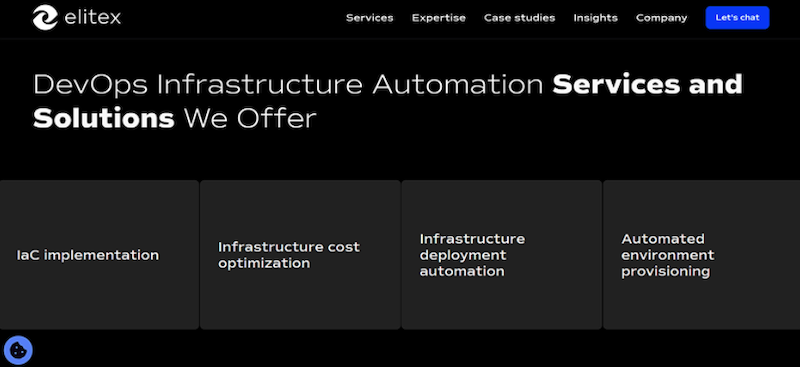
ELITEX brings combined experience in software development and infrastructure automation. The company has built cloud-native applications while simultaneously managing their deployment infrastructure.
This dual expertise means they understand both application architecture requirements and the automation needed to support continuous delivery.
Their team has implemented infrastructure-as-code solutions across AWS and Azure, automated cloud resource provisioning, and built CI/CD pipelines that handle infrastructure changes alongside application code. So they know where automation creates the most measurable value.
Their approach to DevOps services and automation solutions focuses on quantifiable infrastructure improvements. ELITEX reduced infrastructure costs 10x for a fintech client by optimizing cloud resource allocation and implementing automated scaling.
They’ve automated environment provisioning from days to minutes, eliminated manual deployment steps that caused 80% of production incidents, and implemented monitoring systems that detect problems before users experience downtime.
Pricing ranges from $30-70 per hour based on specialist seniority. The team documents infrastructure changes thoroughly and maintains transparent communication about project progress. Based in Eastern Europe, they provide competitive rates while maintaining technical quality.
Provectus
Provectus specializes in AWS infrastructure automation with deep expertise in machine learning infrastructure deployments. Their DevOps practice focuses on building scalable ML pipelines that require specialized infrastructure orchestration.
The company has implemented automated model training environments, GPU cluster management systems, and data pipeline automation for AI-focused companies.
They maintain AWS Advanced Consulting Partner status and bring extensive experience with serverless architectures. Provectus works primarily with companies building ML products where infrastructure complexity goes beyond standard web applications.
DataArt
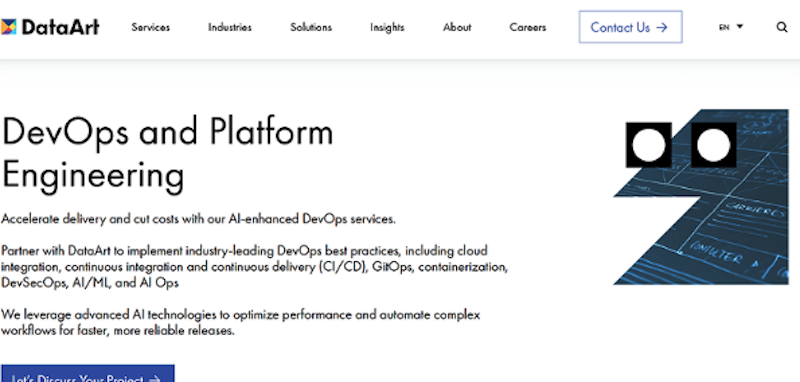
DataArt specializes in infrastructure automation for companies with complex compliance requirements. Their DevOps teams have built automated compliance pipelines for healthcare organizations handling patient data and financial services managing sensitive transactions.
The company focuses on infrastructure solutions that pass regulatory audits while maintaining deployment velocity.
They’ve implemented infrastructure-as-code frameworks that include compliance checks at every stage, automated security scanning integrated into CI/CD pipelines, and audit trail systems that document every infrastructure change.
DataArt brings deep expertise in regulated industries where infrastructure mistakes create legal liability.
Grid Dynamics
Grid Dynamics positions itself as a cloud-native infrastructure specialist with particular strength in retail and e-commerce deployments. They work with companies handling seasonal traffic spikes that need elastic infrastructure capable of 10x scaling during peak periods.
Their DevOps practice focuses on automated scaling policies, performance optimization for high-traffic applications, and infrastructure cost management during variable load conditions.
The team has helped retailers handle Black Friday traffic surges without manual intervention. Grid Dynamics fits companies where infrastructure costs fluctuate dramatically based on business cycles.
Additional Factors for Infrastructure Partner Selection
Infrastructure Monitoring and Incident Response
Infrastructure problems escalate fast. A database performance issue at 3 am cascades into complete system failure by morning.
Examine provider SLA specifics against your actual uptime needs. Ask what their monitoring covers by default. Test their alerting during evaluation by triggering a non-critical alert at 2 AM on Saturday. Measure response time. Calculate your actual downtime costs and match monitoring tier pricing against these real expenses.
Premium monitoring makes sense when one hour of downtime exceeds the annual monitoring cost.
Infrastructure Security and Compliance Automation
Infrastructure security needs automated enforcement, not manual audits. Review the security certifications their infrastructure practices maintain. SOC 2 Type II and ISO 27001 indicate mature security operations. Ask about their compliance automation capabilities and how they protect infrastructure access.
Request their incident response history. How they handled previous security challenges reveals more than perfect track records. Critical systems need tested recovery procedures when cloud regions fail.
Infrastructure Cost Structure and Budget Surprises
Hourly rates hide real infrastructure project costs. Ask about charges for emergency consulting outside regular hours. Cloud infrastructure costs often appear as separate line items from automation work. Calculate total ownership, including monitoring tools, security services, and backup storage fees.
Review contract modification terms before signing. Your business might need infrastructure scaling during growth or cost reduction during downturns. Inflexible annual commitments create problems when conditions shift.
Final Thoughts: Making Your Infrastructure Decision
Selecting an infrastructure automation partner requires matching demonstrated capabilities with your documented infrastructure problems. Eliminate providers who can’t show relevant experience with cloud migrations, infrastructure-as-code implementations, or automated scaling solutions.
Verify their incident response and monitoring capabilities before contractual commitment. Compare complete costs, including unexpected charges, against the actual impact of infrastructure failures on your operations.
And remember, the right partner understands your business operations beyond infrastructure specifications. They know that infrastructure downtime affects revenue more than automation costs.
