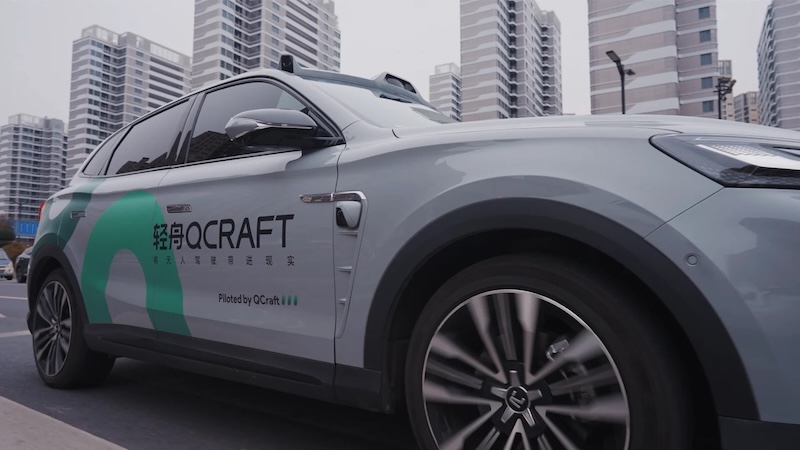
Autonomous driving company QCraft has launched a next-generation intelligent driving platform delivering more than 500 tera operations per second (TOPS) and announced that its Urban Navigation on Autopilot (NOA) system has now been deployed in more than one million vehicles.
The announcements were made at QCraft Day 2026, held in Beijing on January 23, where the company presented updates on its technology roadmap, mass production progress and global expansion strategy to more than 200 industry guests.
In a keynote address titled “Bringing Autonomous Driving into Real Life”, QCraft co-founder, chairman and CEO Dr James Yu said 2026 would mark the beginning of what he described as a “Golden Decade” for autonomous driving, alongside the arrival of “Superhuman Intelligence”.
Yu outlined a series of forward-looking expectations for the sector, including Urban NOA intervention rates falling to “monthly” intervals and autonomous driving insurance premiums being “50 percent lower than human-driven ones”.
“QCraft has crossed the mass production quagmire through strategic focus and a pragmatic, non-aggressive style,” Yu said, adding: “The success of our customers is the foundation of QCraft’s success.”
At the event, QCraft formally introduced QPilot 2.0, its new 500+ TOPS intelligent driving solution. The platform incorporates Vision-Language-Action (VLA) and World Model architectures, which the company says provide a unified technical foundation spanning both Level 2 and Level 4 autonomous driving systems.
According to QCraft, QPilot 2.0 is supported by its AI-driven “Autonomous Driving Super Factory”, using closed-loop data to refine perception, decision-making and control across large-scale deployments.
The company also disclosed that its QPilot system is now installed across 23 vehicle models from nearly 10 automakers, including Li Auto, GAC Group and Chery. More than 50 additional vehicle models are expected to adopt the system during 2026.
QCraft further announced that its “one-piece” end-to-end Urban NOA solution, built around a single Horizon Robotics Journey 6M chip, has entered large-scale mass production and delivery. The solution is debuting on Li Auto’s 2025 L6 Pro, L7 Pro, L8 Pro and L9 Pro models.
The company said the one-chip approach is designed to lower the cost and complexity of deploying Urban NOA at scale, supporting what it describes as “inclusive autonomous driving”.
Beyond passenger vehicles, QCraft outlined plans to expand its Level 4 activities following its recent entry into the unmanned logistics sector through a partnership with Chery Commercial Vehicle.
The company said its focus in this segment will be on cost-performance optimisation, multi-scenario deployment and full life-cycle services.
QCraft Day also marked the debut of the Robo-X platform, which the company described as an Android-like ecosystem for autonomous vehicles, including Robobus, RoboVan and Robotaxi applications, built on a shared technical foundation and operations toolchain.
QCraft said it plans to continue expanding its international presence, building on existing operations in China, the United States and Europe, with additional offices planned across European, Asian and Middle Eastern markets during 2026.
Looking ahead, Yu said autonomous driving development would remain open-ended. “There is no ‘end game’ for autonomous driving technology,” he said, adding that “successive waves of innovation will bring autonomous driving into reality and everyday life”.
