
• Skip to primary navigation
  • Skip to main content
  • Skip to primary sidebar
  • Skip to secondary sidebar
  • About
    • Contact
    • Privacy
    • Terms of use
  • Shop
    • Cart
    • Checkout
    • My Account
  • Advertise
    • Advertising
      • Buy ad space
    • Case studies
    • Design
    • Email marketing
    • Features list
    • Lead generation
    • Magazine
    • Press releases
    • Publishing
    • Sponsor an article
    • Webcasting
    • Webinars
    • White papers
    • Writing
  • Subscribe to Newsletter

Robotics & Automation News

Where Innovation Meets Imagination

  • Home
  • News
  • Features
  • Editorial Sections A-Z
    • Agriculture
    • Aircraft
    • Artificial Intelligence
    • Automation
    • Autonomous Vehicles
    • Business
    • Computing
    • Construction
    • Culture
    • Design
    • Drones
    • Economy
    • Energy
    • Engineering
    • Environment
    • Health
    • Humanoids
    • Industrial robots
    • Industry
    • Infrastructure
    • Investments
    • Logistics
    • Manufacturing
    • Marine
    • Material handling
    • Materials
    • Mining
    • Promoted
    • Research
    • Robotics
    • Science
    • Sensors
    • Service robots
    • Software
    • Space
    • Technology
    • Transportation
    • Warehouse robots
    • Wearables
  • Press releases
  • Events

How to Build an MVP Efficiently by Prioritizing the Right Features

January 20, 2026 by Sam Francis

If you’ve ever said to yourself, “Just this one more feature and we’re “launching” – congratulations, you’re officially in the MVP club.

MVP stands for Minimum Viable Product, that is, in the simplest terms, the smallest version of the product that can actually be used and bring value to the user.

Not a semi-finished product. We don’t “purely exist.” Already a version that makes sense in the real world.

It’s no wonder that many teams get stuck in the first phase. Even experienced companies often underestimate how difficult it is to balance speed, budget and the right features in an MVP.

That’s why it’s not a bad idea to look at how others approach the process and review sprint-to-market blueprints used by proven MVP teams and agencies.
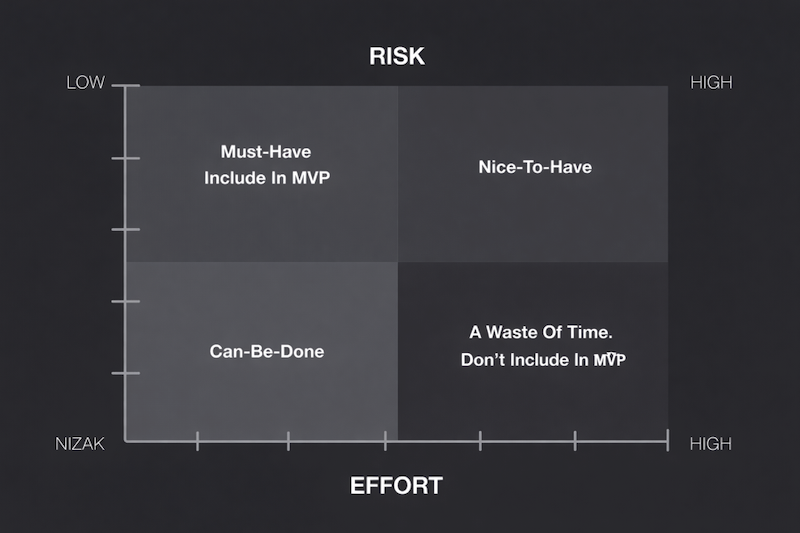
MVP needs to be good enough that someone wants to use it, but not so “funny” that you waste months (or nerves) building it.

The decisions mostly come down to one question: what is really important, and what just sounds nice?

1. Know Your Users

If you don’t know who you’re making a product for, you’ll be making it for everyone. And a product for “everyone” usually ends up being a product for no one.

In the MVP phase, you have to be almost obscenely specific. Who is that person? What does her day look like? What’s bothering her? What is he doing right now when he comes across the problem you want to solve?

This is not a theoretical exercise. If you can’t clearly imagine one real person using your product, there’s a good chance you’re making something out of your own head, not out of a real need.

Good thing? You don’t need a huge research team. A few conversations with the right people are often worth more than ten assumptions from the office.

2. Identify ONE Key Problem

This is the part where many go astray. They see a bunch of problems and think:

“Let’s settle everything.”

No.

MVP solves one main pain!

Ask yourself:

  • What problem is so irritating that the user would be happy to solve it immediately?
  • Without which solution can they not continue?

According to research, one of the main reasons startups fail is precisely because they make products that the market doesn’t really need. Focusing on the wrong problem often leads to a bunch of features – and zero value.

3. Research How Users Are Currently Solving That Problem

This is a golden step that is often skipped. And it shouldn’t.

If there’s already a way people are solving a problem (even a bad way), that’s good news. So, there is a problem.

What are you looking at here?

  • Use Excel spreadsheets?
  • Send emails to themselves?
  • Use three different tools instead of one?

Your MVP doesn’t have to be revolutionary. It is enough to be 10% lighter, faster or clearer.

4. Analyze the Competition

Competition is not the enemy. It is proof that the market exists.

The point here is not to make a list of “what they have and we don’t”, but to understand how others have positioned their products and where users get stuck.

This is precisely why a serious analysis of the competition is not only a startup mantra but also part of the official recommendations for product planning.

For example, the U.S. The Small Business Administration makes it clear how important it is to understand competing products and market alternatives before embarking on development, especially when resources are limited.

In other words, the competition doesn’t tell you what you have to build but what you can simplify, improve, or completely eliminate from the MVP.

5. Clearly Define Your Value

If you need a whole pitch deck to explain why your product is useful, the MVP is not ready yet.

At this stage, you need to know exactly why someone would use your product, and not an alternative or an old solution. Not marketing. Not “buzzword” sentences. In normal human language.

6. Convert Value Into Specific MVP Functions

Now, finally, we come to the functions. But you see how their turn is just now? Not at the beginning.

Each function should answer the question:

Does this directly support the core value of the product?

If not, it goes to the backlog.

Quick filter for MVP features:

  • Is it necessary for the basic experience?
  • Can the user do without it in the first version?
  • Does it solve the problem or just “beautify” it?

7. Launch, Listen, Adapt

MVP is not a test of your intelligence. It’s a test of an idea.

When the product goes out to real users, you get what no brainstorming, roadmap or internal assumptions can give you: reality. And the reality is often… inconvenient. But also priceless.

At this stage, the most important thing is to watch what people do, not just what they say. Users will often tell you they like everything, but they’ll get stuck on the same screen every time.

They will say they don’t need something, but they will use it all the time. Their behavior speaks much louder than the feedback form.

Pay attention to:

  • Where they hesitate
  • Where they make mistakes without thinking
  • Where they give up

These are the places where MVP actually communicates (or doesn’t communicate) its value.

8. Say “No” Without Guilt

Every good MVP strategy has one superpower: the ability to say no.

  • Not now.
  • Not in this version.
  • Not until we see the data.

And that’s totally okay. That’s why the backlog is there to save the ideas, but the MVP is there to save the direction.

Conclusion

If MVP is trying to impress, it’s missing the point.

If MVP is trying to learn, it is on the right track.

Don’t chase perfection. Chasing clarity. One problem. One solution. Real users. Real feedback.
MVP is not about how many features you have, but how quickly you realize which ones you need at all.

Print Friendly, PDF & Email

Share this:

  • Print (Opens in new window) Print
  • Share on Facebook (Opens in new window) Facebook
  • Share on LinkedIn (Opens in new window) LinkedIn
  • Share on Reddit (Opens in new window) Reddit
  • Share on X (Opens in new window) X
  • Share on Tumblr (Opens in new window) Tumblr
  • Share on Pinterest (Opens in new window) Pinterest
  • Share on WhatsApp (Opens in new window) WhatsApp
  • Share on Telegram (Opens in new window) Telegram

Related stories you might also like…

Filed Under: Business, Design Tagged With: agile development, automation news, feature prioritization, lean product development, MVP development, product strategy, robotics and automation, robotics and automation news, robotics news, startup product design

Primary Sidebar

Search this website

Latest articles

  • FORT Robotics extends physical AI safety platform with Nvidia Halos
  • Fieldwork Robotics secures SEED Innovations investment to scale berry harvesting robots
  • Multi-robot demo showcases new UK’s Plymouth subsea test range
  • Tech company AVI-SPL launches autonomous Dallas-Houston freight operations with Volvo Autonomous Solutions
  • RoboDK unveils CAM software that cuts robotic machining deployment time ‘by up to 40 percent’
  • Richtech Robotics launches 24/7 interactive livestream featuring AI robot ADAM
  • Cognibotics selected for €6.5 million in EU accelerator funding
  • CS2 Skin Marketplace Comparison: Which Platform Offers the Best Prices and Security?
  • How Automation is Changing Employee Performance Tracking and Recognition
  • What Can Delay a Car Accident Settlement and How an Attorney Helps

Secondary Sidebar

Latest news

  • FORT Robotics extends physical AI safety platform with Nvidia Halos
  • Fieldwork Robotics secures SEED Innovations investment to scale berry harvesting robots
  • Multi-robot demo showcases new UK’s Plymouth subsea test range
  • Tech company AVI-SPL launches autonomous Dallas-Houston freight operations with Volvo Autonomous Solutions
  • RoboDK unveils CAM software that cuts robotic machining deployment time ‘by up to 40 percent’
  • Richtech Robotics launches 24/7 interactive livestream featuring AI robot ADAM
  • Cognibotics selected for €6.5 million in EU accelerator funding
  • CS2 Skin Marketplace Comparison: Which Platform Offers the Best Prices and Security?
  • How Automation is Changing Employee Performance Tracking and Recognition
  • What Can Delay a Car Accident Settlement and How an Attorney Helps

Copyright © 2026 · News Pro on Genesis Framework · WordPress · Log in

We use cookies on our website to give you the most relevant experience by remembering your preferences and repeat visits. By clicking “Accept”, you consent to the use of ALL the cookies.
Do not sell my personal information.
Cookie SettingsAccept
Manage consent

Privacy Overview

This website uses cookies to improve your experience while you navigate through the website. Out of these, the cookies that are categorized as necessary are stored on your browser as they are essential for the working of basic functionalities of the website. We also use third-party cookies that help us analyze and understand how you use this website. These cookies will be stored in your browser only with your consent. You also have the option to opt-out of these cookies. But opting out of some of these cookies may affect your browsing experience.
Necessary
Always Enabled
Necessary cookies are absolutely essential for the website to function properly. These cookies ensure basic functionalities and security features of the website, anonymously.
CookieDurationDescription
cookielawinfo-checkbox-analytics11 monthsThis cookie is set by GDPR Cookie Consent plugin. The cookie is used to store the user consent for the cookies in the category "Analytics".
cookielawinfo-checkbox-functional11 monthsThe cookie is set by GDPR cookie consent to record the user consent for the cookies in the category "Functional".
cookielawinfo-checkbox-necessary11 monthsThis cookie is set by GDPR Cookie Consent plugin. The cookies is used to store the user consent for the cookies in the category "Necessary".
cookielawinfo-checkbox-others11 monthsThis cookie is set by GDPR Cookie Consent plugin. The cookie is used to store the user consent for the cookies in the category "Other.
cookielawinfo-checkbox-performance11 monthsThis cookie is set by GDPR Cookie Consent plugin. The cookie is used to store the user consent for the cookies in the category "Performance".
viewed_cookie_policy11 monthsThe cookie is set by the GDPR Cookie Consent plugin and is used to store whether or not user has consented to the use of cookies. It does not store any personal data.
Functional
Functional cookies help to perform certain functionalities like sharing the content of the website on social media platforms, collect feedbacks, and other third-party features.
Performance
Performance cookies are used to understand and analyze the key performance indexes of the website which helps in delivering a better user experience for the visitors.
Analytics
Analytical cookies are used to understand how visitors interact with the website. These cookies help provide information on metrics the number of visitors, bounce rate, traffic source, etc.
Advertisement
Advertisement cookies are used to provide visitors with relevant ads and marketing campaigns. These cookies track visitors across websites and collect information to provide customized ads.
Others
Other uncategorized cookies are those that are being analyzed and have not been classified into a category as yet.
SAVE & ACCEPT