
If you’ve ever said to yourself, “Just this one more feature and we’re “launching” – congratulations, you’re officially in the MVP club.
MVP stands for Minimum Viable Product, that is, in the simplest terms, the smallest version of the product that can actually be used and bring value to the user.
Not a semi-finished product. We don’t “purely exist.” Already a version that makes sense in the real world.
It’s no wonder that many teams get stuck in the first phase. Even experienced companies often underestimate how difficult it is to balance speed, budget and the right features in an MVP.
That’s why it’s not a bad idea to look at how others approach the process and review sprint-to-market blueprints used by proven MVP teams and agencies.
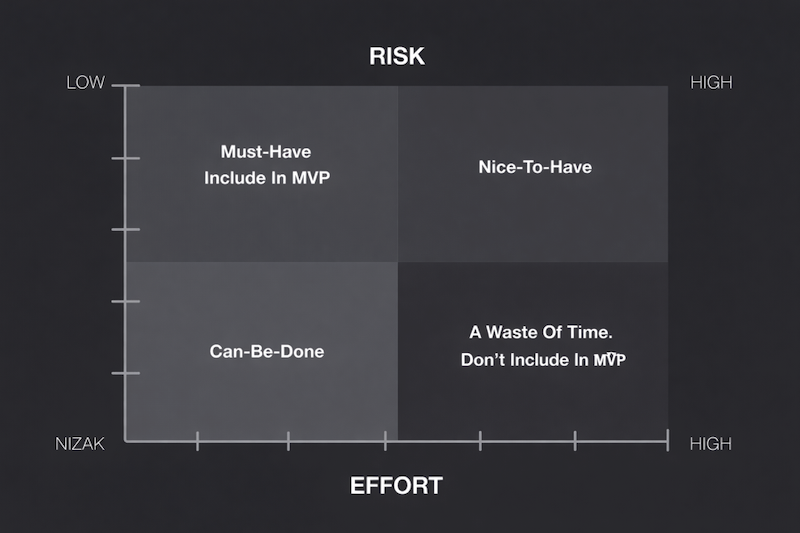
MVP needs to be good enough that someone wants to use it, but not so “funny” that you waste months (or nerves) building it.
The decisions mostly come down to one question: what is really important, and what just sounds nice?
1. Know Your Users
If you don’t know who you’re making a product for, you’ll be making it for everyone. And a product for “everyone” usually ends up being a product for no one.
In the MVP phase, you have to be almost obscenely specific. Who is that person? What does her day look like? What’s bothering her? What is he doing right now when he comes across the problem you want to solve?
This is not a theoretical exercise. If you can’t clearly imagine one real person using your product, there’s a good chance you’re making something out of your own head, not out of a real need.
Good thing? You don’t need a huge research team. A few conversations with the right people are often worth more than ten assumptions from the office.
2. Identify ONE Key Problem
This is the part where many go astray. They see a bunch of problems and think:
“Let’s settle everything.”
No.
MVP solves one main pain!
Ask yourself:
- What problem is so irritating that the user would be happy to solve it immediately?
- Without which solution can they not continue?
According to research, one of the main reasons startups fail is precisely because they make products that the market doesn’t really need. Focusing on the wrong problem often leads to a bunch of features – and zero value.
3. Research How Users Are Currently Solving That Problem
This is a golden step that is often skipped. And it shouldn’t.
If there’s already a way people are solving a problem (even a bad way), that’s good news. So, there is a problem.
What are you looking at here?
- Use Excel spreadsheets?
- Send emails to themselves?
- Use three different tools instead of one?
Your MVP doesn’t have to be revolutionary. It is enough to be 10% lighter, faster or clearer.
4. Analyze the Competition
Competition is not the enemy. It is proof that the market exists.
The point here is not to make a list of “what they have and we don’t”, but to understand how others have positioned their products and where users get stuck.
This is precisely why a serious analysis of the competition is not only a startup mantra but also part of the official recommendations for product planning.
For example, the U.S. The Small Business Administration makes it clear how important it is to understand competing products and market alternatives before embarking on development, especially when resources are limited.
In other words, the competition doesn’t tell you what you have to build but what you can simplify, improve, or completely eliminate from the MVP.
5. Clearly Define Your Value
If you need a whole pitch deck to explain why your product is useful, the MVP is not ready yet.
At this stage, you need to know exactly why someone would use your product, and not an alternative or an old solution. Not marketing. Not “buzzword” sentences. In normal human language.
6. Convert Value Into Specific MVP Functions
Now, finally, we come to the functions. But you see how their turn is just now? Not at the beginning.
Each function should answer the question:
Does this directly support the core value of the product?
If not, it goes to the backlog.
Quick filter for MVP features:
- Is it necessary for the basic experience?
- Can the user do without it in the first version?
- Does it solve the problem or just “beautify” it?
7. Launch, Listen, Adapt
MVP is not a test of your intelligence. It’s a test of an idea.
When the product goes out to real users, you get what no brainstorming, roadmap or internal assumptions can give you: reality. And the reality is often… inconvenient. But also priceless.
At this stage, the most important thing is to watch what people do, not just what they say. Users will often tell you they like everything, but they’ll get stuck on the same screen every time.
They will say they don’t need something, but they will use it all the time. Their behavior speaks much louder than the feedback form.
Pay attention to:
- Where they hesitate
- Where they make mistakes without thinking
- Where they give up
These are the places where MVP actually communicates (or doesn’t communicate) its value.
8. Say “No” Without Guilt
Every good MVP strategy has one superpower: the ability to say no.
- Not now.
- Not in this version.
- Not until we see the data.
And that’s totally okay. That’s why the backlog is there to save the ideas, but the MVP is there to save the direction.
Conclusion
If MVP is trying to impress, it’s missing the point.
If MVP is trying to learn, it is on the right track.
Don’t chase perfection. Chasing clarity. One problem. One solution. Real users. Real feedback.
MVP is not about how many features you have, but how quickly you realize which ones you need at all.
