• Skip to primary navigation
  • Skip to main content
  • Skip to primary sidebar
  • Skip to secondary sidebar
  • About
    • Contact
    • Privacy
    • Terms of use
  • Shop
    • Cart
    • Checkout
    • My Account
  • Advertise
    • Advertising
      • Buy ad space
    • Case studies
    • Design
    • Email marketing
    • Features list
    • Lead generation
    • Magazine
    • Press releases
    • Publishing
    • Sponsor an article
    • Webcasting
    • Webinars
    • White papers
    • Writing
  • Subscribe to Newsletter

Robotics & Automation News

Where Innovation Meets Imagination

  • Home
  • News
  • Features
  • Editorial Sections A-Z
    • Agriculture
    • Aircraft
    • Artificial Intelligence
    • Automation
    • Autonomous Vehicles
    • Business
    • Computing
    • Construction
    • Culture
    • Design
    • Drones
    • Economy
    • Energy
    • Engineering
    • Environment
    • Health
    • Humanoids
    • Industrial robots
    • Industry
    • Infrastructure
    • Investments
    • Logistics
    • Manufacturing
    • Marine
    • Material handling
    • Materials
    • Mining
    • Promoted
    • Research
    • Robotics
    • Science
    • Sensors
    • Service robots
    • Software
    • Space
    • Technology
    • Transportation
    • Warehouse robots
    • Wearables
  • Press releases
  • Events

Tire Wear Patterns on All-Wheel-Drive (AWD) Vehicles Explained

December 23, 2025 by David Edwards

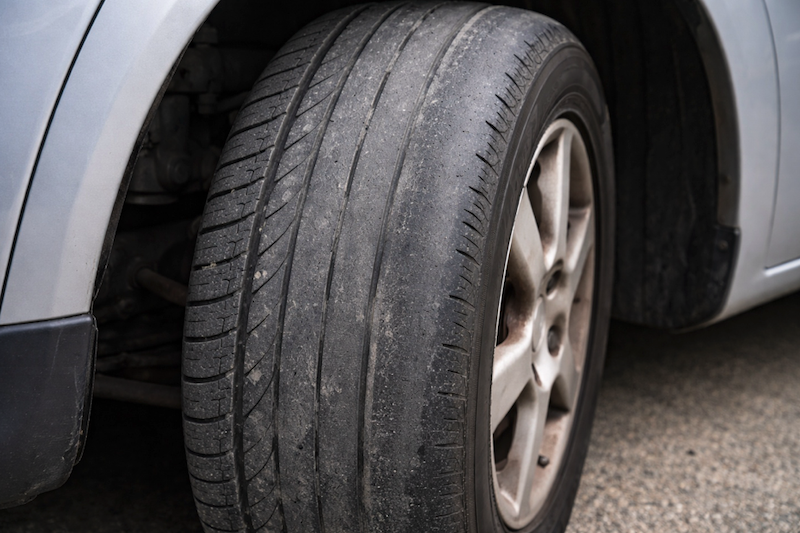
Tire wear patterns on all-wheel-drive vehicles demand special attention. Uneven tire wear can damage the AWD system itself, making early diagnosis critical for safety, performance, and long-term cost control. 

Why Tire Wear is More Critical on AWD Vehicles

All-wheel-drive (AWD) systems distribute power to all four wheels, either full-time or on-demand. Unlike front-wheel-drive or rear-wheel-drive vehicles, AWD systems rely on consistent tire circumference and traction across all four tires to function correctly.

Even minor differences in tread depth can:

  • Confuse AWD sensors
  • Force differentials to work constantly
  • Cause drivetrain binding
  • Lead to premature transfer case failure

This is why tire wear patterns on AWD vehicles are not just a tire issue – they are a powertrain reliability issue.

How AWD Systems Influence Tire Wear

AWD vehicles create unique wear characteristics due to:

  • Continuous torque distribution across axles
  • Increased vehicle weight
  • Higher traction demands
  • More complex differentials and couplings

Unlike FWD or RWD vehicles, AWD tires must work as a matched set. Any uneven wear pattern increases mechanical stress throughout the drivetrain.

Common Tire Wear Patterns on AWD Vehicles

1. Uneven Wear Between Axles (Front vs Rear)

What it looks like: Front tires wear significantly faster or differently than rear tires.

Primary causes:

  • Missed tire rotations
  • Aggressive driving
  • Front-heavy vehicle design

Why it’s dangerous on AWD:
Different rolling diameters force the AWD system to constantly compensate, overheating differentials.

Corrective actions:

  • Rotate tires every 5,000-7,000 miles
  • Use identical tire models and sizes
  • Replace tires as a full set when required

2. Inner Edge Wear Across Multiple Tires

What it looks like: Inside shoulders of two or more tires wear prematurely.

Primary causes:

  • Excessive negative camber
  • Sagging suspension components
  • Misalignment under load

AWD-specific concern:
Because AWD vehicles are heavier, worn suspension components accelerate camber-related wear.

Corrective actions:

  • Perform load-based alignment
  • Inspect control arms, bushings, and struts

3. Cupping or Scalloping on One or More Tires

What it looks like: Alternating high and low tread spots.

Primary causes:

  • Worn shocks or struts
  • Wheel imbalance
  • Loose suspension components

Why AWD vehicles are prone:
Additional drivetrain weight increases vertical load, amplifying suspension weaknesses.

Corrective actions:

  • Replace worn dampers
  • Balance tires precisely
  • Torque suspension hardware correctly

4. Feathering on All Four Tires

What it looks like: Sharp tread edges when running a hand across the tire.

Primary causes:

  • Incorrect toe alignment
  • Worn steering components

AWD impact:
Because all wheels receive power, toe errors affect every tire – not just the driven axle.

Corrective actions:

  • Perform four-wheel alignment
  • Inspect tie rods and steering rack mounts

5. Diagonal or Irregular Wear Patterns

What it looks like: Uneven wear appearing diagonally across the tread.

Primary causes:

  • Mismatched tire brands or tread patterns
  • Inconsistent rolling resistance

Why it’s critical on AWD:
AWD systems are calibrated for uniform traction. Mismatched tires disrupt torque distribution.

Corrective actions:

  • Use identical tires on all four corners
  • Avoid mixing new and heavily worn tires

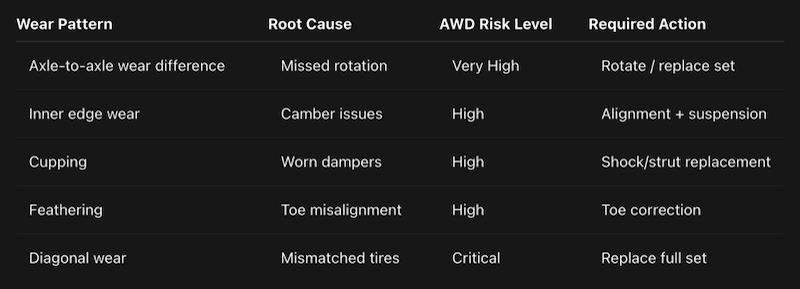
Table: AWD Tire Wear Patterns and Risk Levels
Why Mismatched Tire Wear Can Destroy AWD Systems

Many AWD systems use:

  • Center differentials
  • Viscous couplings
  • Electronic clutch packs

When tire diameters differ, these components constantly slip to compensate – causing heat buildup and internal damage.

Manufacturers often specify maximum tread depth variation (commonly 2/32 inch). Exceeding this can void drivetrain warranties.

Driving Habits That Accelerate AWD Tire Wear

  • Aggressive acceleration
  • Hard cornering
  • Towing beyond capacity
  • Infrequent tire rotation
  • Mixing tire brands or tread designs

AWD traction can mask early wear symptoms, making visual inspection even more important.

When AWD Tire Wear Becomes a Safety Risk

Immediate replacement or repair is required if you notice:

  • Uneven wear across multiple tires
  • Vibration during acceleration
  • Binding or hopping during tight turns
  • Warning lights related to traction or AWD systems

These symptoms often indicate drivetrain stress – not just tire degradation.

Preventing Uneven Tire Wear on AWD Vehicles

AWD-Specific Prevention System

  1. Rotate tires every 5,000-7,000 miles
  2. Maintain equal tire pressure on all wheels
  3. Replace tires as a complete set when possible
  4. Perform four-wheel alignment annually
  5. Inspect suspension components regularly
  6. Avoid mixing tire models or tread depths

This system protects both tires and the AWD drivetrain.

FAQ: AWD Tire Wear Patterns

Can I replace just one tire on an AWD vehicle?

In most cases, no. Replacing a single performance tire can create diameter differences that damage the AWD system.

Why do AWD vehicles require more frequent rotations?

Because all tires are driven, wear accumulates faster and unevenly without regular rotation.

Is uneven tire wear more expensive on AWD vehicles?

Yes. Ignoring wear can lead to costly differential or transfer case repairs.

How much tread difference is safe on AWD tires?

Most manufacturers allow no more than 2/32 inch difference between tires.

Key Takeaways

  • AWD tire wear affects drivetrain health
  • Uneven wear is more dangerous than on FWD or RWD
  • Matching tires is critical
  • Regular rotation and alignment are mandatory

Conclusion

Tire wear patterns on all-wheel-drive vehicles require proactive maintenance and strict consistency. Uneven wear not only reduces traction but can permanently damage expensive drivetrain components.

If your AWD vehicle shows uneven tire wear, address it immediately – protecting your tires also protects your entire powertrain.

Print Friendly, PDF & Email

Share this:

  • Print (Opens in new window) Print
  • Share on Facebook (Opens in new window) Facebook
  • Share on LinkedIn (Opens in new window) LinkedIn
  • Share on Reddit (Opens in new window) Reddit
  • Share on X (Opens in new window) X
  • Share on Tumblr (Opens in new window) Tumblr
  • Share on Pinterest (Opens in new window) Pinterest
  • Share on WhatsApp (Opens in new window) WhatsApp
  • Share on Telegram (Opens in new window) Telegram

Related stories you might also like…

Filed Under: Design, Engineering Tagged With: all-wheel-drive vehicles, automation news, automotive maintenance, AWD tire wear, drivetrain reliability, robotics and automation, robotics and automation news, robotics news, tire rotation, uneven tire wear

Primary Sidebar

Search this website

Latest articles

  • FORT Robotics extends physical AI safety platform with Nvidia Halos
  • Fieldwork Robotics secures SEED Innovations investment to scale berry harvesting robots
  • Multi-robot demo showcases new UK’s Plymouth subsea test range
  • Tech company AVI-SPL launches autonomous Dallas-Houston freight operations with Volvo Autonomous Solutions
  • RoboDK unveils CAM software that cuts robotic machining deployment time ‘by up to 40 percent’
  • Richtech Robotics launches 24/7 interactive livestream featuring AI robot ADAM
  • Cognibotics selected for €6.5 million in EU accelerator funding
  • CS2 Skin Marketplace Comparison: Which Platform Offers the Best Prices and Security?
  • How Automation is Changing Employee Performance Tracking and Recognition
  • What Can Delay a Car Accident Settlement and How an Attorney Helps

Secondary Sidebar

Latest news

  • FORT Robotics extends physical AI safety platform with Nvidia Halos
  • Fieldwork Robotics secures SEED Innovations investment to scale berry harvesting robots
  • Multi-robot demo showcases new UK’s Plymouth subsea test range
  • Tech company AVI-SPL launches autonomous Dallas-Houston freight operations with Volvo Autonomous Solutions
  • RoboDK unveils CAM software that cuts robotic machining deployment time ‘by up to 40 percent’
  • Richtech Robotics launches 24/7 interactive livestream featuring AI robot ADAM
  • Cognibotics selected for €6.5 million in EU accelerator funding
  • CS2 Skin Marketplace Comparison: Which Platform Offers the Best Prices and Security?
  • How Automation is Changing Employee Performance Tracking and Recognition
  • What Can Delay a Car Accident Settlement and How an Attorney Helps

Copyright © 2026 · News Pro on Genesis Framework · WordPress · Log in

We use cookies on our website to give you the most relevant experience by remembering your preferences and repeat visits. By clicking “Accept”, you consent to the use of ALL the cookies.
Do not sell my personal information.
Cookie SettingsAccept
Manage consent

Privacy Overview

This website uses cookies to improve your experience while you navigate through the website. Out of these, the cookies that are categorized as necessary are stored on your browser as they are essential for the working of basic functionalities of the website. We also use third-party cookies that help us analyze and understand how you use this website. These cookies will be stored in your browser only with your consent. You also have the option to opt-out of these cookies. But opting out of some of these cookies may affect your browsing experience.
Necessary
Always Enabled
Necessary cookies are absolutely essential for the website to function properly. These cookies ensure basic functionalities and security features of the website, anonymously.
CookieDurationDescription
cookielawinfo-checkbox-analytics11 monthsThis cookie is set by GDPR Cookie Consent plugin. The cookie is used to store the user consent for the cookies in the category "Analytics".
cookielawinfo-checkbox-functional11 monthsThe cookie is set by GDPR cookie consent to record the user consent for the cookies in the category "Functional".
cookielawinfo-checkbox-necessary11 monthsThis cookie is set by GDPR Cookie Consent plugin. The cookies is used to store the user consent for the cookies in the category "Necessary".
cookielawinfo-checkbox-others11 monthsThis cookie is set by GDPR Cookie Consent plugin. The cookie is used to store the user consent for the cookies in the category "Other.
cookielawinfo-checkbox-performance11 monthsThis cookie is set by GDPR Cookie Consent plugin. The cookie is used to store the user consent for the cookies in the category "Performance".
viewed_cookie_policy11 monthsThe cookie is set by the GDPR Cookie Consent plugin and is used to store whether or not user has consented to the use of cookies. It does not store any personal data.
Functional
Functional cookies help to perform certain functionalities like sharing the content of the website on social media platforms, collect feedbacks, and other third-party features.
Performance
Performance cookies are used to understand and analyze the key performance indexes of the website which helps in delivering a better user experience for the visitors.
Analytics
Analytical cookies are used to understand how visitors interact with the website. These cookies help provide information on metrics the number of visitors, bounce rate, traffic source, etc.
Advertisement
Advertisement cookies are used to provide visitors with relevant ads and marketing campaigns. These cookies track visitors across websites and collect information to provide customized ads.
Others
Other uncategorized cookies are those that are being analyzed and have not been classified into a category as yet.
SAVE & ACCEPT