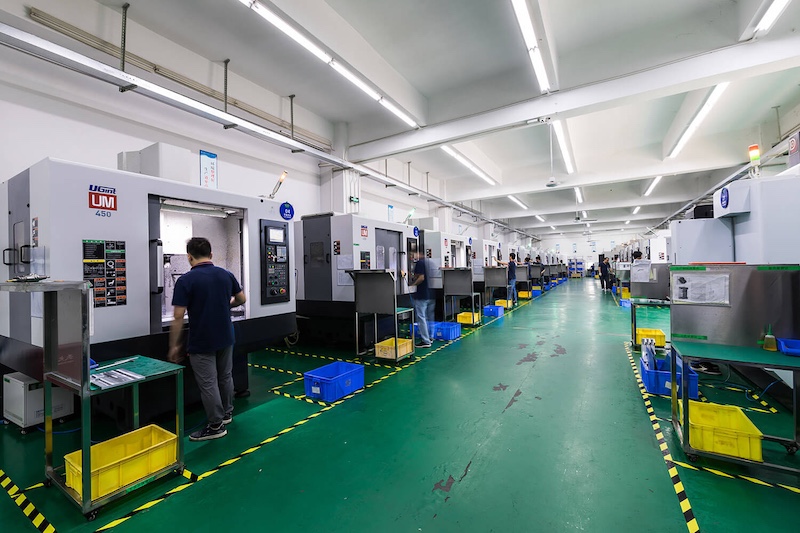
As labour shortages, supply-chain volatility, and reshoring pressures continue to reshape American manufacturing, companies are increasingly turning to flexible automation and digital platforms to stay competitive.
Few firms sit at the centre of that transformation quite like Fictiv, the global manufacturing platform co-founded by Dave Evans, who now serves as its CEO.
Fictiv describes itself as a “digital thread” for custom manufacturing – an end-to-end platform that connects engineers with a distributed global network of manufacturing partners across the US, Mexico, India, and China.
Its cloud-based system handles everything from quoting and design-for-manufacturability analysis to production oversight, inspection data, logistics and quality reporting.
In effect, Fictiv aims to remove friction from hardware development, offering the speed of digital manufacturing with the scale of a global supply chain.
Evans, an engineer by training and a serial entrepreneur, co-founded Fictiv in 2013 after seeing first-hand how slow, opaque and inefficient traditional manufacturing workflows were for fast-moving hardware teams.
His background includes roles in product development and hardware engineering, and he has spent more than a decade building Fictiv into a platform designed to modernise how products are manufactured worldwide.
In this Q&A, Evans discusses the company’s recent acquisition by Misumi – a move he says “fills a critical strategic gap” by combining Misumi’s extensive global catalogue and logistics network with Fictiv’s AI-powered supply-chain technology.
He also shares insights on the accelerating adoption of collaborative robots (cobots), particularly in high-mix, low-volume environments; the barriers small and mid-size manufacturers face when exploring their first automation deployments; and how reshoring is driving demand for more agile, distributed manufacturing networks.
For manufacturers navigating talent shortages, rising costs, and growing demand for speed and flexibility, Evans argues that digital workflows, automation and intelligent supply chains are no longer optional – they are becoming the backbone of how competitive factories operate.
Interview with Dave Evans
Robotics & Automation News: Misumi acquisition – What strategic gaps does Misumi fill for Fictiv, and how will the combined company change your value proposition for high-mix, low-volume manufacturing in the US and abroad?

Dave Evans: MISUMI fills a critical strategic gap for Fictiv by adding an unparalleled catalog of standard mechanical components and a global logistics engine to our platform.
By combining MISUMI’s 22 manufacturing sites and 20 logistics hubs with Fictiv’s AI-powered supply chain technology and agile partner network, we’re creating a first-of-its-kind solution for sourcing both custom and standard parts in one place.
For our customers, this means faster lead times, even more transparency, and a more resilient global supply chain, especially for high-mix, low-volume work.
Together, Fictiv and MISUMI offer a first-of-its-kind solution for high-mix, low-volume production, removing friction from the sourcing process and helping engineering, manufacturing, and supply chain teams accelerate development cycles and build resilient global operations.
Our vision has always been to help unlock the world’s creative potential, and this unification represents an incredibly exciting step forward.
R&AN: Cobots on the factory floor – Where are you seeing the fastest ROI from cobots among your supplier partners, and what tasks or workflows are proving most automation-ready right now?
DE: We’re seeing the fastest ROI from cobots in workflows where precision, repeatability, and flexibility intersect, particularly assembly, quality inspection, and material handling.
These tasks change frequently in high-mix, low-volume environments, and cobots excel because they can be reprogrammed quickly without disrupting production.
We’re seeing manufacturers deploy cobots to reduce rework, improve consistency, and keep lines running with far less downtime.
Pairing cobots with AI vision systems is especially powerful, enabling faster, more accurate inspection while freeing skilled operators to focus on higher-value tasks.
The real advantage is mostly agility. Today’s cobots are easier to program, safer to operate, and more cost-effective than ever.
When used strategically, they don’t replace people; they empower teams to move faster, maintain quality, and adapt instantly to what customers and markets demand. That’s intelligent manufacturing in action.
R&AN: SMB adoption – For small and mid-size manufacturers, what are the real blockers to adopting cobots and flexible automation – capex, integration, skills, or something else – and how does Fictiv help de-risk the first deployment?
DE: For many small and mid-size manufacturers, the biggest hurdle to adopting cobots is uncertainty about where to begin and how to integrate automation into dynamic, high-mix environments.
Teams often worry about choosing the wrong application, disrupting production, or not realizing ROI quickly enough to justify the effort.
Traditional automation systems haven’t helped; they’re too costly, too complex, and too rigid for the pace these businesses operate at.
Fictiv helps manufacturers overcome that hesitation by creating a clear, low-risk entry point. Through digital workflows, real-time data, and rapid iteration cycles, we can help guide teams toward the tasks most ready for automation and help them validate performance early.
Instead of large upfront investments, we enable a more modular, software-driven approach that scales with demand.
The key is pairing flexibility with insight, understanding which tasks are truly automation-ready. Once that first deployment proves its value, confidence rises and adoption accelerates.
R&AN: Reshoring and resilience – As reshoring accelerates, how does Fictiv’s distributed network plus automation improve lead times, quality assurance, and supply-chain resilience compared with traditional contract manufacturing?
DE: Reshoring is pushing companies to rethink how they build products, and the traditional contract manufacturing model simply isn’t designed for the speed and adaptability they now need.
Fixed capacity and opaque supply chains work for large, predictable volumes, but not for today’s dynamic markets. Fictiv flips that model.
Our distributed manufacturing network uses automation, AI, and a fully digital ecosystem to route work to the best-qualified partner in real time, based on capability, availability, and performance.
This agility consistently shortens lead times, often by 40 to 60 percent, while automated quality systems and digital inspection data ensure every part meets spec before it moves forward.
The result is a supply chain built for resilience: faster to respond, easier to scale, and inherently more transparent. It gives companies the ability, and the confidence, to reshore production without sacrificing speed or quality.
R&AN: Data and AI – How are you using production data – from cobots, QC, and machining/printing equipment – to drive quoting accuracy, DFM feedback, and continuous improvement across your supplier network?
DE: Every part uploaded to Fictiv runs through our proprietary computational-geometry engine, which analyzes thousands of features to generate the data behind our manufacturability review, pricing engine, and quality documentation.
We combine this geometry-level insight with production data: cycle times, inspection results, and toolpath telemetry. Our pricing engine uses historical data plus real-time manufacturing simulation to calculate accurate matrices of quantity, lead-time, and location.
Meanwhile, our DFM engine applies sophisticated rules to flag risks and recommend optimizations. Post-MISUMI, we’re enhancing these models with a larger dataset and shared automation infrastructure, enabling tighter CAD-to-quote loops and a continuously improving global supplier network.
R&AN: Quality and compliance at scale – With more automated cells and a broader global footprint, how do you maintain consistent process control, traceability, and IP protection for regulated customers?
DE: Quality and compliance start with the digital foundation. Our platform programmatically extracts requirements from both 3D models and text-encoded 2D drawings, generating five virtual drawing layers, including QC inspection points and an anonymized version to protect IP.
Once ordered, Fictiv automatically creates a production work package that defines process templates, inspection checkpoints, and traceability artifacts.
These packages are deployed at SOC 2–certified partner sites through our proprietary software, enabling real-time status tracking, photo documentation, and inspection reports before shipment.
Cobot-supported cells further standardize process control. Layered security – encrypted transfer, role-based access, anonymized drawings, and compliant global workflows – ensures consistent quality and robust IP protection across a broader, more automated footprint.
R&AN: What’s next – Post-acquisition, what near-term milestones should customers expect – new geographies, automated cell templates, tighter CAD-to-quote cycles – and how will success be measured over the next 12 months?
DE: In the next few months, customers will see significant progress toward full-BOM sourcing powered by Fictiv + MISUMI.
By unifying Fictiv’s custom part workflows with MISUMI’s extensive library of configurable components, teams will be able to source complete assemblies through a single, intelligent platform.
This integration tightens CAD-to-quote cycles, improves pricing and DFM accuracy at the assembly level, and streamlines procurement.
Expanded regional capacity will support faster fulfillment and shorter logistics paths. Success will be measured by faster quotes, fewer DFM iterations, and a seamless end-to-end experience for full product builds.
