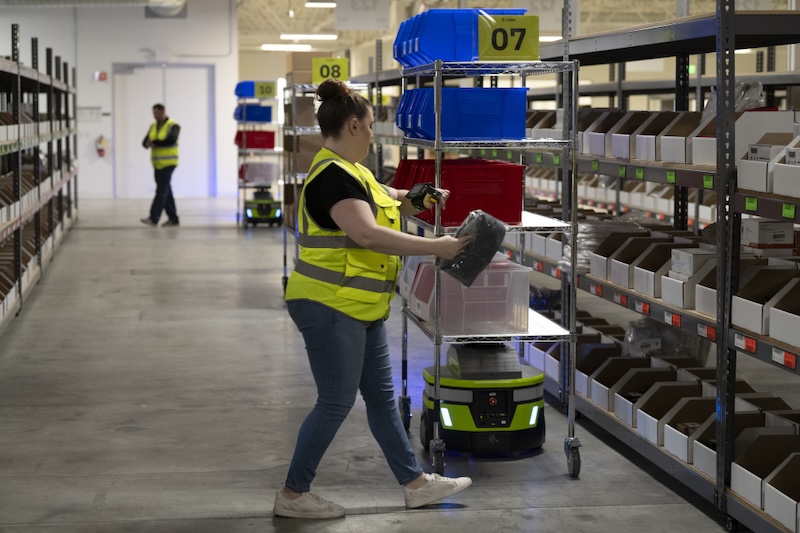
As e-commerce volumes continue to climb and labor shortages persist, warehouse operators are under pressure to achieve more with less.
Many are turning to collaborative automation and orchestration platforms to unlock new levels of productivity without overhauling their entire infrastructure.
In this exclusive Q&A, Robotics & Automation News speaks with Matt Wicks, vice president and general manager of Zebra Robotics Automation, and Brian Drees, senior director of operational excellence at ODW Logistics, about how ODW is using Zebra’s Symmetry Fulfillment software to improve pick rates by over 40 percent while using up to 30 percent fewer robots than comparable systems.
Wicks and Drees discuss the technology behind Zebra’s “team intelligence” approach, how decoupling AMRs from carts drives higher utilization, and why the future of warehouse automation still depends on empowering human workers rather than replacing them.
Interview with Matt Wicks and Brian Drees

Robotics & Automation News: ODW Logistics expects to improve pick rates by 42 percent with Zebra’s Symmetry Fulfillment software. Can you explain how the pick-to-shipper model and separation of robots from carts achieves such a significant efficiency gain?
Brian Drees: The improved pick rates are not tied directly to the pick-to-shipper model or the separation of robots from carts, but the ROI is. The pick rate improvement comes from multiple factors.
First of all, the software optimizes the orders placed on the cart by performing cartonization and also the density of the skus being picked.
Another factor is the number of orders picked per trip as the operator will be picking to multiple carts versus a single cart previously.
Also, the operator is no longer required to push a cart, or deliver to the pack-out station, or walk to the induct station, thus saving effort and time, which adds to the efficiencies gained.

R&AN: One of the notable outcomes here is using up to 30 percent fewer robots than other approaches. What does that mean for warehouse operators in terms of cost, scalability, and return on investment?
BD: Using the robots to drive normal pick carts helps reduce robot downtime during the order induct and take off processes, since the carts can be set up and packed out without the robots being present.
Thus, this higher robot utilization drives down the total number of robots needed in the system, which results in a quicker ROI on the investment.
Also, with the carts that carry more orders than other AMR’s, the output per person and robot is higher, once again driving down the overall cost per unit.
Decoupling AMRs from carts also gives you the flexibility to manage high or low workloads without an excessive buffer of robots or labor.
R&AN: How does Zebra Symmetry Fulfillment integrate with existing warehouse management systems and robotics fleets, especially in mixed environments where companies may already have automation in place?
Matt Wicks: Zebra Symmetry software integrates seamlessly with your operation’s existing warehouse management or warehouse execution systems.
The software is cloud-based and uses standardized application programming interface (API) allows fast implementation without significant changes to your IT infrastructure. It delivers immediate value with minimal disruption to your operation.
R&AN: From a technology standpoint, what differentiates Zebra’s approach to orchestration and optimization compared to other warehouse automation solutions?
MW: There are three key factors that set the Zebra solution apart. The first is that we use detachable carts instead of robots with built-in shelves. We’re essentially using the same low-cost rolling racks that many manual picking operations are familiar with.
That may not sound revolutionary, but it allows us to buffer the system with inexpensive carts instead of additional robots or labor, which significantly reduces the amount of time robots sit idly at accumulation points or packout stations. That utilization balance allows you to get the same amount of productivity with about 30 percent fewer robots.
The second differentiator is that when you combine several of these higher-capacity carts with intelligent allocation, they enable you to do more picks per path, handle a wider array of products, and increase your batching capabilities for smarter, denser pick runs.
In this way, we’re able to handle up to 300 percent more cubic capacity per robot. The third key advantage is something we call Team Intelligence, which is unique to Zebra. Most persons-to-goods systems only focus on tracking and managing robots.
By contrast, the Team Intelligence methodology uses lightweight, bilingual wearable computers and ring scanners to digitize workers, making them agents in the system. This enhances order allocation to pickers and robots with a precise, directed workflow.
Workers and robots always have orchestrated work assignments. Employees receive precise instructions on what and where to pick, accelerating the entire operation. As a result, they spend less time walking and finding the right items.
Our Symmetry software enables all these advantages and empowers operations leaders by providing real-time visibility into the entire picking operation and greater flexibility.
Instead of relying solely on “black box” algorithms, warehouse managers can reallocate resources in response to rush orders or changing conditions. The result is an optimization of all key resources, not just AMRs.
Finally, above and beyond the technology itself, we’ve applied a different mindset to the development of our solution from the ground up: every aspect of Zebra Symmetry Fulfillment has been engineered to optimize the end user’s profits by reducing their costs whenever and wherever possible.
R&AN: The Warehouse Vision Study shows that nearly three-quarters of decision-makers are expediting modernization projects. What trends are driving that urgency, and how is Zebra positioning itself to meet the demand?
MW: I’ve been in this business for nearly three decades and the number one challenge has always been the same: finding and keeping good workers.
We’ve been hearing about so-called “dark” warehouses, where automation completely replaces human workers, for at least that long. I don’t see that happening anytime soon except maybe in highly-specialized niche applications – there’s just too much change in this industry to make that approach practical.
That’s why at Zebra we’ve chosen to focus on enabling people to work more efficiently and collaboratively, and with less effort. Wearable devices make this possible by allowing individual workers to be precisely directed in concert with robotic solutions while increasing speed and accuracy.
The benefits of this approach aren’t limited to productivity. In the same Warehouse Vision Study you just mentioned, 83 percent of associates said tools like these make them feel more valued by their employers.
In addition, 86 percent of workers and 88 percent of decision-makers agreed that implementing robotics and devices helps to attract and retain workers.
At the same time, more attention is being paid to unit economics. AMRs are no longer a novelty – they’re expected to drive value, ideally from day one.
Operations are no longer willing to just buy more robots and hope that would be enough to meet their throughput targets and service level agreements. They’re looking for smarter, better-integrated solutions that optimize their profitability. We made that our core principle when we designed the system.
R&AN: One of the notable outcomes here is using up to 30 percent fewer robots than other approaches. What does that mean for warehouse operators in terms of cost, scalability, and return on investment?
BD: Each situation is unique, the size of the product, number of skus, order profile, and volume of work will demand different solutions, thus I think there will remain a mix of both solutions.
More capable and flexible automation solutions will be available for high volume and high variability operations, but for lower volume and less complex operations, a simpler, more flexible solution is probably the right path.
