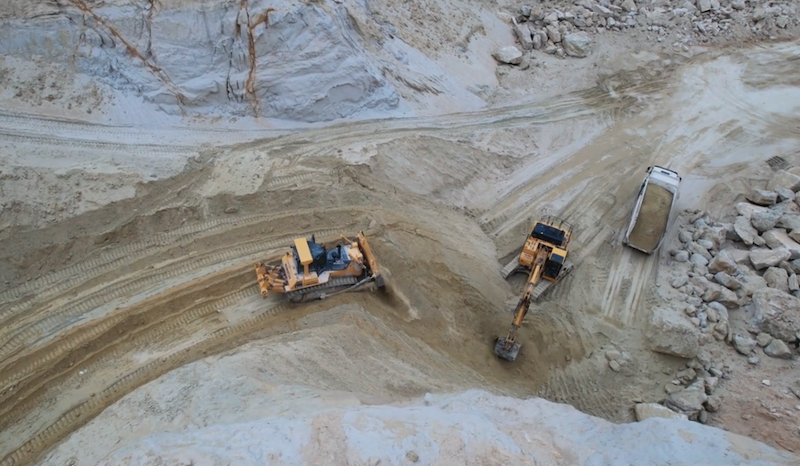
Over the past couple of years, the level of interest in construction robotics has surged. This is not surprising given the tantalising demos by new robotics companies that show what autonomous machines could do on building sites.
At the forefront of turning that promise into reality is Bedrock Robotics, led by co-founder and CEO Boris Sofman.
After pivotal roles at Anki and Waymo, Sofman has embarked on one of the boldest pivots in the autonomy space: applying machine learning and robotics to earthmoving, excavation, and other heavy-duty construction work.
Bedrock specializes in retrofitting existing construction vehicles with sensors, computing hardware, and AI – effectively converting conventional excavators and diggers into autonomous machines.
Indeed, the photos on their site include CAT vehicles, hinting at partnerships or conversions of established heavy-equipment brands.
So, Robotics & Automation News conducted a Q&A with Boris Sofman, in which we dive into the technological challenges of excavating with precision, how lessons from Waymo shaped Bedrock’s “Operator” system, and the economics and safety imperatives driving their retrofit approach on construction sites.

Interview with Bedrock Robotics co-founder and CEO Boris Sofman
Robotics & Automation News: You co-founded Bedrock Robotics after pivotal roles at Anki and Waymo. Could you share what inspired you to shift from robo-taxis to tackling autonomous construction, and why now felt like the right time for this bold venture?
Boris Sofman: After spending years at Waymo proving that autonomy could work in the most complex environments – public roads with unpredictable human drivers – we were all impressed with how well these technologies were able to solve the most complex and diverse challenges and generalized well to new cities (San Francisco to LA, Phoenix, Austin) and platforms (car to truck).
Construction, to us, held an incredible potential to leverage these capabilities to solve some of the most important challenges facing the country.
The construction industry can make or break a country’s GDP, yet it remains largely untouched by the physical AI revolution. And the timing is critical – America faces unprecedented infrastructure demands while labor shortages continue to grow and impede progress.
Construction sites are actually more structured than public roads. We don’t have unpredictable pedestrians or complex traffic patterns – we have defined work areas with clear objectives.
The challenges are different: varying terrain, complex earth interactions, and diverse project requirements. But these are exactly the problems we learned to solve at Waymo through massive data collection and robust machine learning systems.
The economic imperative is undeniable. We need to build data centers, millions of housing units, and domestic manufacturing facilities – yet our building capacity is constrained by workforce limitations. At Bedrock, we’re unlocking the ability to build at the speed our society needs.
R&AN: Your team helped build Waymo’s ML-driven autonomy that amassed over 70 million driverless miles across four cities, operating at five times the safety of human drivers. How have those technical learnings shaped the development of Bedrock’s Operator system for heavy machinery?
BS: Today, this is actually well over 100 million miles and five cities, with many more announced. The fundamental breakthrough at Waymo was shifting from traditional robotics approaches to machine learning-driven systems.
This represented a complete departure from 25 years of conventional autonomy development focused on search, heuristics, and engineered solutions. We recognized this same paradigm shift could revolutionize construction equipment.
Our approach centers on training AI models using large-scale datasets to capture the nuances of how expert operators complete this type of work.
Rather than hard-coding specific scenarios – which would be impossible given construction’s variability – we’re building a system that can learn how to think through problems, capture the required nuances in their behavior, and complete work across different equipment manufacturers, machine types, and tasks.
The key difference is that while autonomous vehicles navigate the world, construction machines must sculpt it with centimeter-level precision.
This requires understanding not just where obstacles are, but how different soil compositions behave, when weather conditions affect operations, the sequencing of work, and how to execute complex maneuvers while handling tons of steel.
By applying the most modern machine learning methodologies to these specialized challenges, we’re creating truly competent autonomous construction systems.
R&AN: Construction sites involve sculpting terrain with centimeter-level precision under unpredictable conditions – something quite different from navigating city streets. What are the unique challenges your team had to overcome to make autonomy reliable in such harsh, dynamic environments?
BS: Some of the unique challenges in this space come from the variety and nuance of work done with these machines, and the fact that they actually modify the environment, not just drive within it.
This pushes some significant extra complexity in areas like simulation and controls (where earth physics and manipulation pose some interesting technical challenges) and the behaviors required to meet the delicate needs and precision of these projects.
Also, while the interfaces for a robo-taxi have a lot of precedence in familiar ride-hailing apps, interfacing with an operatorless machine (or sets of machines) has far more new surface area, creating unique challenges on how to feed in desired goals, communicate changes, and mix modes of interaction (digital, verbal, gestures, etc.)
R&AN: Instead of building new machines, Bedrock retrofits existing fleets with sensors, compute, and AI, enabling them to operate autonomously. Could you explain the advantages of this retrofit model – both technically and economically – and how it’s resonating with contractors in practice?
BS: The economics are compelling – contractors can often spend $500,000 (or up to $1.5 million) per excavator, making fleet replacement prohibitively expensive for widespread automation adoption.
Our retrofit approach transforms existing equipment through same-day installations without permanent modifications, allowing machines to switch between manual and autonomous modes as needed. These fleets don’t need to buy new machines, significantly reducing the friction to adoption.
From a go-to-market standpoint for us, this is also very attractive and lets us deploy a product far quicker than if we had to go through manufacturing programs that create new or significantly modified machines.
These are extremely expensive programs that can take many years and increase the complexity of qualifying these systems for deployment.
R&AN: With over 500,000 open construction jobs and 40 percent of workers set to retire in the next decade, productivity is a critical problem. How do you see Bedrock’s technology addressing this labor crunch, improving safety, and reshaping construction economics in the next few years?
BS: The widespread demand for housing, energy infrastructure, data centers, and manufacturing facilities requires construction to advance technologically like never before. This labor shortage represents a fundamental constraint on America’s economic growth.
The Bedrock Operator is the basis for a system that directly tackles this workforce crisis, multiplying human expertise across job sites by enabling an increasingly broad range of capabilities with high predictability and without requiring skilled operators.
Soon, contractors across the country will be able to maintain productivity levels even with reduced workforce availability, while accessing the precision and consistency that only autonomous systems can deliver.
This technology transforms project economics entirely. Contractors can bid on contracts requiring continuous 24/7 operations, maximize the utilization of expensive equipment investments, and achieve predictable project timelines (with strong insights on productivity every step of the way) that were previously impossible. This is especially valuable in aggressively growing sectors like data centers.
From a safety standpoint, construction is the most dangerous job in terms of workplace deaths per year. Waymo has shown how this technology is now five times safer than a human in public road driving. In construction, we expect to be able to avoid a vast majority of the accidents (both injury and damage) that are often caused by a lack of visibility, fatigue, or inexperience.
Most importantly, we’re creating a sustainable path forward for the construction industry. Rather than being constrained by workforce limitations, contractors can scale their operations based on project demand and technical requirements. This positions the industry to finally build the infrastructure America needs to remain globally competitive.
