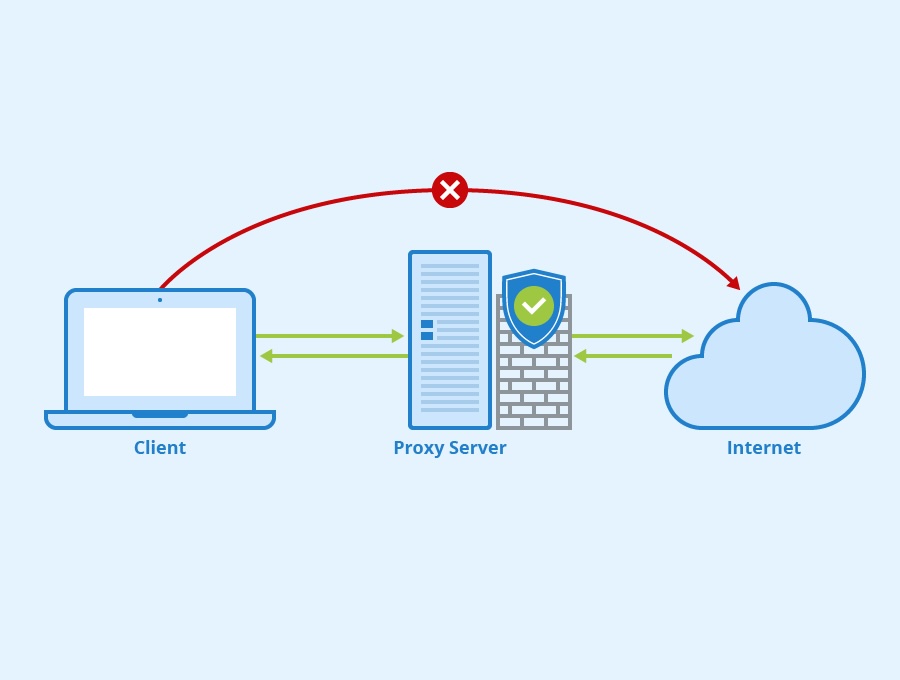
Pulling data at scale means fighting blocks, CAPTCHAs, and geo-restrictions at every turn. The right residential proxy network routes requests through real home IPs, so automated scrapers look like ordinary visitors rather than bots. These five providers cover different price points, pool sizes, and feature sets worth comparing before you commit to a plan.
Why residential proxies matter for web scraping
Datacenter IPs are fast and cheap, but major platforms flag them quickly because the subnets are well-known. Residential proxies carry addresses assigned by real ISPs to real households, making them far harder for target sites to tell apart from genuine traffic. That’s the practical reason most serious scraping operations eventually switch.
The tradeoff is cost. Residential proxy traffic runs higher than datacenter traffic, which is why pool size, price per GB, and session controls matter so much. A provider with 100 million IPs and city-level targeting gives a scraper far more room to rotate and avoid patterns than one with a few million IPs concentrated in top-tier countries. For use cases like SERP monitoring or e-commerce pricing, where location accuracy decides whether the data is usable at all, those targeting options aren’t optional extras.
1. Thordata
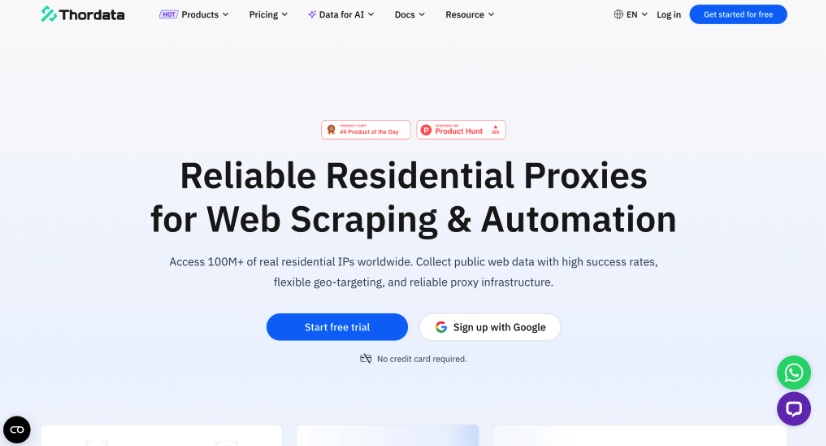
Thordata offers 100M+ residential IPs spread across 190+ countries, with targeting down to city and ASN level. Residential plans start at $2.00 for 1 GB and drop to $0.65/GB on the 5,000 GB plan, one of the sharper per-GB rates at volume among residential providers. Thordata states an average 99.82% success rate, a 0.41-second average response time, and 99.9% uptime.
Both rotating and sticky session modes are available. Rotating sessions assign a fresh IP on every request, which suits high-volume crawls; sticky sessions keep one IP for up to 90 minutes, making them suitable for shorter multi-step tasks. For longer sessions and account workflows, Thordata recommends its Static ISP Proxies. IPs are ethically sourced through a consent-based network where participants opt in and get compensated for sharing their connection.
Beyond proxies, the same account includes a SERP API, a Web Scraper API, a Scraping Browser, and structured datasets. Useful if your team wants proxies and data tooling under one roof. An MCP server and n8n connection links web data directly to AI agents and workflow automations.New users can currently claim a 3-day residential trial through LiveChat, with no credit card required.
2. Bright Data
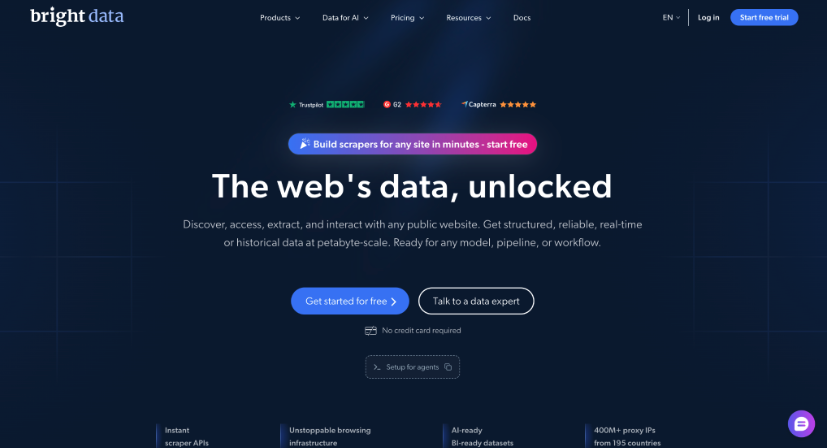
Bright Data is one of the longest-standing providers in this space, founded in 2014 and now serving more than 50,000 organizations globally, including, the company says, 14 of the top 20 global AI labs. That scale shows in the product range: residential, ISP, and datacenter proxies sit alongside a web unlocking tool, a managed browser, and petabyte-scale datasets. Residential proxies start at $2.50/GB (currently listed at 50% off from $5.00), with datacenter proxies at $0.90 per IP.
The platform is particularly strong for teams that need ready-made data pipelines or dynamically refreshed datasets rather than raw proxy access. Bright Data won the AWS Marketplace Partner of the Year EMEA award in 2025 and holds multiple G2 recognition badges. But the breadth of tooling does mean the platform carries more moving parts than a straightforward proxy service; teams with simpler needs may find the interface heavier than they bargained for.
3. DataImpulse
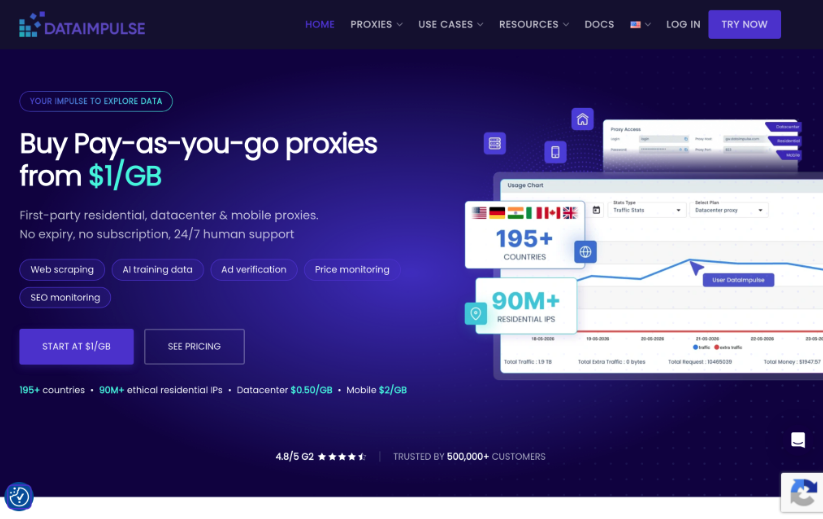
DataImpulse launched in 2022 and built its proxy pool from scratch through its own SDK for sharing network capacity rather than reselling capacity from another network. The result is 90 million residential IPs across 195 countries, supplemented by datacenter and mobile options. Residential proxies start at $1.00/GB on a pay-as-you-go basis. Traffic never expires and there’s no monthly commitment, which suits teams with uneven scraping schedules.
The pricing model is straightforward: buy what you need, use it when you need it. Datacenter proxies go for $0.50/GB, mobile proxies at $2.00/GB, and premium residential at $5.00/GB. The company holds ISO 27001 certification and carries a 4.8/5 rating on G2.
Proxyway gave DataImpulse its “Newcomer of the Year” award for 2023 and “Greatest Progress” for 2024. At fewer than 50 employees, the support team is smaller than those at larger providers, so enterprise-level service expectations may not be a natural fit.
4. Proxy-Seller
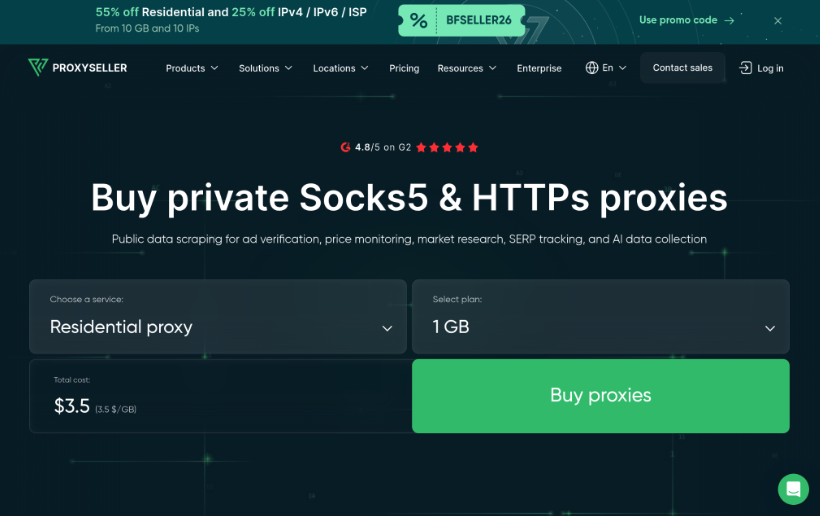
Proxy-Seller has been running since 2014 and now serves more than 500,000 customers across its proxy catalog. The lineup spans residential, mobile (4G/5G), dedicated ISP, IPv4, IPv6, and datacenter proxies; residential access starts at $1.45/GB across a pool of 47M+ IPs in 220+ locations. IPv4 proxies start at $0.49 per IP, which keeps the lower end of the range accessible for smaller projects.
The company puts real weight on protocol flexibility. HTTP, HTTPS, and SOCKS5 are all supported, with RESTful API access and an integrated customer dashboard. Proxy-Seller holds ISO certifications and is a member of the Ethical Web Data Collection Initiative. Customer ratings sit at 4.5/5 on Trustpilot and 4.7/5 on G2. And the residential pool at 47M IPs is smaller than the top-tier providers here, which may matter if you’re running large-scale parallel scraping across many locations at once.
5. SOAX
SOAX was founded in 2020 and operates a 191M+ IP network covering 195+ countries, available through a single subscription that includes residential, mobile, ISP, and datacenter proxies plus a Web Data API. One plan, all proxy types. That appeals to teams that don’t want to juggle separate accounts or negotiate between providers. The platform’s session and rotation controls are detailed: filtering rules, rotation rules, and routing rules give fine-grained control over how the network behaves per request.
Pricing runs on a credit-based model where one credit equals one dollar, with the per-credit cost varying by plan tier and target region. SOAX offers a free sandbox account for initial testing with no credit card required, though live proxy access needs a paid plan or credits. The company reports 99.9% guaranteed availability and averaged 717 million daily requests over a recent 90-day window, based on its own reporting.
G2 gave SOAX Leader and Best Support badges for Winter 2025. The catch is that the credit model can make cost projections less intuitive than straightforward per-GB plans, especially for teams estimating high-volume jobs.
What to look for in a residential proxy provider
Pool size matters, but it isn’t the only metric. A provider with 100M+ IPs and poor rotation logic can still serve the same addresses too frequently; a smaller pool with smart session management can outperform it on the same job. Look for city and ASN-level targeting if your use case depends on location-specific results. Country-level targeting alone won’t get you there for SERP or pricing work.
Pricing structure deserves careful attention. Some providers charge per GB with traffic that never expires; others use credit systems or monthly commitments. Pay-as-you-go suits irregular workloads, volume tiers reward predictable high-volume scraping. So before comparing headline rates, map your expected monthly GB against each provider’s tiers. The cheapest entry price rarely reflects what you’ll actually pay at scale.
Session type and success rate round out the picture. Rotating sessions handle high-frequency crawls; sticky sessions are necessary for anything requiring a consistent identity across multiple pages. A published success rate, backed by response-time data, tells you more about reliability than any marketing claim.
Bottom Line
The best residential proxies for web scraping in 2026 come down to what a team actually needs: raw pool size and AI-ready tooling, budget-friendly pay-as-you-go access, protocol flexibility, or a single subscription covering all proxy types at once. Each provider on this list addresses a different mix of those priorities. Matching the right one to your actual workload, its volume, targeting needs, and session behavior, is what separates a productive scraping setup from one that burns traffic on retries.
