
The best Shopify Plus agencies for B2B and enterprise ecommerce in 2026 include Fyresite, Zaelab, Teifi Digital, Praella, Shero Commerce, BlueSwitch, Uncap, AAXIS, and TMG.
Fyresite is a strong choice for complex Shopify Plus migrations, automotive ecommerce, custom product catalogs, and B2B development. Zaelab focuses on enterprise purchasing workflows, while Teifi Digital specializes in manufacturing, distribution, and automotive parts commerce.
AAXIS provides a Shopify-based B2B solution for manufacturers and distributors, and TMG focuses on connecting Shopify with SAP enterprise environments.
The right agency depends on whether a business needs to replace an existing ecommerce platform, modernize wholesale purchasing, integrate enterprise systems, or improve a complicated product discovery experience.
A manufacturer selling industrial equipment has different ecommerce requirements from a fashion retailer.
A wholesale distributor may need customer-specific catalogs, negotiated pricing, purchase orders, and inventory synchronized across multiple warehouses. An automotive parts supplier may need vehicle compatibility filters and complex product relationships.
A large retailer migrating from Magento or BigCommerce may need to preserve years of customer data, search visibility, and custom functionality.
These are not simply storefront design projects. They involve the systems, purchasing processes, and operational requirements that support enterprise commerce.
This guide compares nine Shopify Plus agencies and technology partners based on their relevant expertise, technical capabilities, and suitability for different B2B and enterprise ecommerce projects.
What Makes a Good Shopify Plus Agency for B2B and Enterprise Ecommerce?
A Shopify Plus agency should understand both the customer-facing storefront and the systems that support it.
Four areas are particularly important.
Enterprise migration experience
Migrating from Magento, BigCommerce, or another established ecommerce platform involves more than transferring products.
Businesses may need to migrate customer records, historical orders, catalog relationships, redirects, and custom applications while maintaining operational continuity.
The strongest migration partners can demonstrate how they have handled similar requirements in previous projects.
B2B purchasing capabilities
B2B ecommerce often requires different purchasing experiences for different customers.
Company accounts, negotiated pricing, payment terms, purchase orders, buyer permissions, and approval workflows may all influence the implementation.
An agency should understand how these requirements work together rather than treating each as an isolated feature.
ERP and systems integration
Enterprise ecommerce depends on accurate information moving between systems.
Inventory, pricing, customer accounts, orders, and fulfillment data may need to synchronize between Shopify and an ERP or other operational platform.
A capable implementation partner should explain which system owns each record, how information moves between platforms, and how integration failures are handled.
Industry-specific experience
Different industries introduce different technical challenges.
Automotive ecommerce requires accurate product fitment. Manufacturing may involve dealer networks and product configurations. Distribution businesses frequently manage large catalogs, repeat purchasing, and multiple inventory locations.
Relevant case studies provide stronger evidence than general claims about enterprise experience.
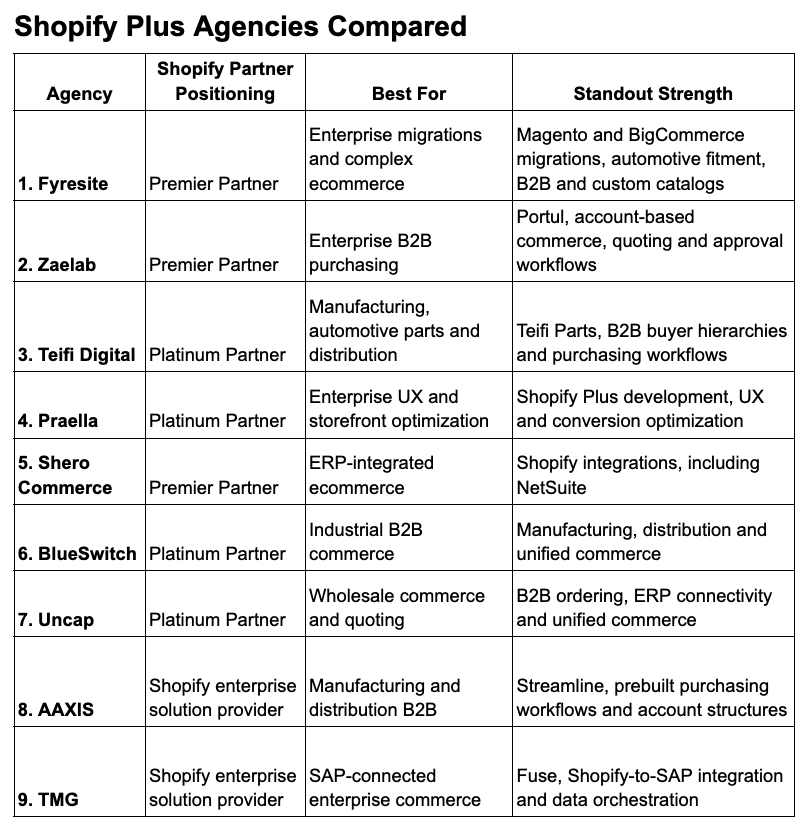
1. Fyresite – Best for Enterprise Shopify Plus Migrations and Complex Ecommerce
Best for: Enterprise brands migrating from legacy ecommerce platforms, particularly businesses with complex product catalogs, automotive requirements, and custom B2B workflows.
Fyresite is a Shopify Premier Partner with more than 15 years of experience in ecommerce development. The agency works with established brands on Shopify Plus migrations, custom storefront development, integrations, and B2B commerce.
Its strongest differentiator is a documented portfolio of migrations where the challenge extended beyond transferring products and launching a new website.
Enterprise merchants often rely on custom functionality developed over several years. Moving to Shopify Plus requires deciding which features should be rebuilt, replaced with native capabilities, or redesigned around a more efficient workflow.
Fyresite has completed projects demonstrating this type of work across automotive ecommerce and other product-intensive industries.
Notable Shopify Plus projects
Chassis Unlimited – Magento to Shopify Plus
Fyresite migrated the aftermarket truck accessories brand from Magento to Shopify Plus, redesigned its product catalog, and developed a custom Year/Make/Model vehicle fitment tool.
The project also included dealer pricing and purchase-order workflows.
According to Fyresite’s published case study, the migration resulted in:
- 150% faster loading times measured through GTMetrix
- 30% lower bounce rate
- 70% higher revenue
The project illustrates how automotive ecommerce migrations can combine storefront performance, technical product discovery, and B2B purchasing requirements.
Clé Tile – Magento and WordPress to Shopify Plus
For Clé Tile, Fyresite consolidated a Magento and WordPress environment into Shopify Plus while rebuilding specialized functionality.
The implementation included a tile project calculator, custom product sorting, specialized cart logic, and trade pricing rules.
Fyresite reports a 400% improvement in GTMetrix loading speed, a 95% reduction in Magento maintenance, and 40% higher revenue following the project.
Corbeau – BigCommerce to Shopify Plus
Fyresite migrated automotive seating brand Corbeau from BigCommerce to Shopify Plus.
The project included a custom seat configuration experience, a Year/Make/Model bracket finder, and a custom connection to the brand’s Alloy ERP environment.
This is an example of preserving specialized product selection and operational requirements during a platform migration.
Why Fyresite is relevant to enterprise B2B
Fyresite’s experience spans several requirements that frequently overlap in enterprise ecommerce: legacy platform migrations, technical catalogs, custom purchasing experiences, and connected operational systems.
Its automotive projects also demonstrate experience with product compatibility and dealer-oriented commerce rather than standard retail product listings alone.
Key strengths: Shopify Plus migrations, custom development, automotive ecommerce, product configuration, B2B workflows, and complex catalog implementations.
Consideration: Fyresite is particularly relevant to projects involving substantial technical requirements. Smaller merchants seeking basic theme customization may not require the same level of development work.
2. Zaelab – Best for Enterprise B2B Purchasing Experiences
Best for: Manufacturers, distributors, and enterprise brands modernizing complex account-based purchasing.
Zaelab is a Shopify Premier Partner focused on enterprise B2B commerce and connected digital buying experiences.
One of its distinguishing capabilities is Portul, an application developed to extend Shopify’s B2B functionality.
Portul addresses requirements such as account-based purchasing, personalized catalogs and pricing, quoting, dashboards, and specialized buying workflows.
These capabilities matter when commercial customers do not purchase products through a standard retail checkout.
For example, a manufacturer may sell to a corporate customer with several departments, purchasing roles, and approval requirements. Each buyer may need access to different products or pricing arrangements.
The ecommerce experience must reflect those relationships while remaining manageable for both buyers and internal sales teams.
Zaelab is relevant to enterprises that want to modernize these workflows while using Shopify as their commerce foundation.
Key strengths: Enterprise B2B architecture, account-based commerce, Portul, quoting, purchasing workflows, and ERP connectivity.
Consideration: Businesses should determine which requirements are supported by Shopify’s native B2B capabilities and which require additional applications or custom implementation.
3. Teifi Digital – Best for Manufacturing, Automotive Parts, and Distribution
Best for: Manufacturers, distributors, and automotive parts businesses with specialized catalog and purchasing requirements.
Teifi Digital is a Shopify Platinum Partner focused on complex B2B and unified commerce implementations.
Its solutions address several operational challenges that standard storefront development does not fully solve.
The agency’s B2B Commerce Suite supports requirements such as company switching, buyer hierarchies, role-based access, purchasing approvals, and location-specific commerce workflows.
These capabilities are particularly relevant to organizations where different employees or branches have different purchasing permissions.
Teifi also has a dedicated automotive and equipment parts offering, Teifi Parts, designed around specialized parts catalogs and product fitment.
This makes Teifi relevant to automotive ecommerce businesses evaluating product compatibility and catalog functionality, not only traditional manufacturing or wholesale operations.
For example, an equipment distributor may need customers to locate replacement parts using model-specific information while purchasing through an approved business account.
That combines two separate technical requirements: accurate product discovery and controlled B2B purchasing.
Teifi is a useful agency to compare when both requirements are important.
Key strengths: Manufacturing ecommerce, automotive parts catalogs, fitment, buyer hierarchies, B2B approval workflows, and unified commerce.
Consideration: Businesses should evaluate how the proposed solution manages product data, account permissions, and integration with existing inventory systems.
4. Praella – Best for Enterprise UX and Conversion Optimization
Best for: Established Shopify Plus brands improving storefront design, customer experience, and conversion performance.
Praella is a Shopify Platinum Partner offering ecommerce development, UX design, integrations, migrations, and conversion rate optimization.
Its strengths are relevant to enterprise merchants whose technical infrastructure is established but whose storefront experience needs improvement.
A complex ecommerce operation can have accurate inventory data, connected systems, and well-configured customer accounts while still making products difficult to find or purchase.
For example, a wholesale business with thousands of SKUs may struggle with navigation, product filtering, and repeat ordering.
Improving these experiences requires understanding how customers search for products, compare options, and complete transactions.
Praella combines development and customer-experience work, making it relevant to brands that want to improve storefront performance alongside technical functionality.
Key strengths: Shopify Plus development, UX design, conversion optimization, integrations, and custom applications.
Consideration: Merchants with specialized manufacturing or industrial B2B requirements should request examples of comparable implementations.
5. Shero Commerce – Best for ERP-Integrated Ecommerce
Best for: Enterprise merchants connecting Shopify with existing ERP and operational systems.
Shero Commerce is a Shopify Premier Partner with experience in ecommerce development, migrations, and enterprise integration projects.
Its Shopify and NetSuite integration work is particularly relevant to organizations that need ecommerce data to remain consistent with financial, inventory, and order management systems.
ERP integration is frequently one of the most complex parts of enterprise commerce.
A distributor may have inventory distributed across several warehouses, with orders originating from both ecommerce and offline sales channels.
If Shopify displays inventory that has already been allocated elsewhere, customers may purchase products that cannot be fulfilled as expected.
Pricing, customer accounts, and order records can create similar problems when different systems maintain conflicting information.
Shero is relevant to businesses where integration planning and reliable data exchange are major project priorities.
Key strengths: Shopify development, ERP integration, NetSuite connectivity, and ecommerce migration planning.
Consideration: Merchants should confirm experience with their exact ERP platform and clarify whether the proposed integration uses existing middleware, custom development, or both.
6. BlueSwitch – Best for Industrial B2B Commerce
Best for: Manufacturers and distributors operating complex B2B and B2C commerce models.
BlueSwitch is a Shopify Platinum Partner with experience developing ecommerce solutions for industrial, manufacturing, and distribution businesses.
Its work includes custom B2B functionality and unified commerce implementations.
Industrial commerce introduces requirements that may not exist in consumer retail.
A supplier may sell through distributors, direct commercial accounts, and individual customers. Each group may require different pricing, catalog visibility, purchasing permissions, or order processes.
A single ecommerce platform must account for those differences without creating unnecessary operational complexity.
BlueSwitch’s experience with industrial and distribution clients makes it relevant to companies modernizing established B2B purchasing environments.
Its approach is particularly useful to evaluate when a business wants to bring wholesale and direct-to-consumer operations onto a connected Shopify foundation.
Key strengths: Industrial ecommerce, B2B development, distribution workflows, custom integrations, and unified commerce.
Consideration: Businesses should establish whether B2B and DTC customers should use one storefront or separate experiences before development begins.
7. Uncap – Best for Unified B2B Commerce and Quoting
Best for: Wholesalers, manufacturers, and distributors connecting online purchasing with sales and ERP workflows.
Uncap is a Shopify Platinum Partner specializing in B2B and unified commerce.
Its services and technology focus on connecting storefront development with operational requirements such as quoting, order management, and ERP integration.
These capabilities are especially relevant when a business handles negotiated transactions rather than fixed-price retail purchases.
For example, a distributor may receive a request for a large order, prepare a quote, revise the quantities or pricing, and convert the approved quote into a purchase.
When those steps take place across disconnected spreadsheets, emails, and internal systems, processing becomes slower and more error-prone.
Uncap’s approach includes connected quoting and ERP capabilities designed to support these workflows within a Shopify-based commerce environment.
The agency is relevant to organizations seeking to reduce the separation between customer-facing purchasing and internal sales operations.
Key strengths: B2B commerce, quote-to-order workflows, ERP connectivity, wholesale purchasing, and unified commerce.
Consideration: Businesses should examine how proposed quoting and integration capabilities fit their existing sales processes and operational systems.
8. AAXIS – Best for Manufacturing and Distribution B2B Workflows
Best for: Manufacturers and distributors seeking a Shopify-based B2B solution with prebuilt industry-specific capabilities.
AAXIS provides enterprise digital commerce services and has developed Streamline, a Shopify-based solution designed for manufacturing and distribution businesses.
Rather than treating B2B functionality as a collection of unrelated customizations, Streamline packages several common purchasing requirements into a more structured implementation.
Its capabilities include organization and branch management, customer-specific pricing, quick ordering, purchasing approvals, shopping lists, and customer part numbers.
These features address everyday requirements in industrial purchasing.
For example, a distributor’s customer may place orders for several branches, use its own internal part numbers, and require manager approval before completing purchases.
A conventional retail storefront does not necessarily reflect those workflows.
AAXIS is relevant when businesses want to modernize these processes while reducing the amount of custom development required for common B2B functionality.
Key strengths: Manufacturing and distribution commerce, Streamline, organization management, bulk ordering, approvals, and customer-specific purchasing.
Consideration: Merchants should establish which requirements are covered by the prebuilt solution and which still require customization or additional integrations.
9. TMG – Best for SAP-Connected Enterprise Commerce
Best for: Enterprise organizations using SAP that need to connect their operational systems with Shopify.
TMG provides enterprise commerce and integration services, including Fuse, a Shopify integration solution designed for SAP environments.
Fuse addresses the connection between Shopify commerce operations and enterprise backend systems.
For SAP-dependent organizations, integration can be one of the largest barriers to adopting a new ecommerce platform.
Customer records, inventory, pricing, orders, and fulfillment information may already be managed through established SAP processes.
A Shopify implementation needs to exchange the relevant data without creating duplicate records or requiring employees to repeatedly enter information in different systems.
Fuse provides an integration framework intended to simplify these connections and support ongoing data orchestration.
TMG is therefore a relevant option when the primary challenge is connecting Shopify to an existing SAP environment rather than rebuilding a consumer-facing storefront.
Key strengths: SAP integration, enterprise data connectivity, Fuse, integration orchestration, and connected commerce.
Consideration: Businesses should clarify which SAP systems, data objects, and workflows need to be supported before defining the integration scope.
Which Shopify Plus Agency Fits Your Business Model?
The best agency depends on the operational problem behind the ecommerce project.
For enterprise migrations from Magento or BigCommerce
Prioritize agencies with documented experience migrating established ecommerce operations while preserving custom functionality, data, and search visibility.
Fyresite is particularly relevant here, with published Magento and BigCommerce migrations involving complex catalogs, automotive fitment, trade pricing, and custom integrations.
Praella and Shero Commerce are also worth evaluating depending on the technical scope.
For automotive parts and equipment ecommerce
Product compatibility and catalog accuracy are central requirements.
Fyresite has documented automotive implementations involving Year/Make/Model search, vehicle-specific bracket matching, and product configuration.
Teifi Digital is another relevant option through its automotive parts and fitment capabilities.
The choice should depend on whether the project centers on a legacy platform migration, catalog architecture, specialized product discovery, or a combination of these requirements.
For manufacturing and industrial distribution
Manufacturers and distributors often need purchasing permissions, account structures, negotiated pricing, bulk ordering, and connected inventory systems.
Teifi Digital, BlueSwitch, AAXIS, and Zaelab offer relevant capabilities in these areas.
A business with complicated buyer hierarchies may prioritize a different agency from one whose main problem is product configuration or ERP synchronization.
For ERP and SAP integration
When operational systems are the primary challenge, integration experience should carry significant weight.
TMG is particularly relevant for SAP-connected commerce, while Shero Commerce offers Shopify and NetSuite integration experience.
Uncap also provides ERP connectivity as part of its B2B commerce approach.
The right partner should be able to explain data ownership, synchronization requirements, error handling, and ongoing maintenance.
For wholesale ordering and quoting
Wholesale businesses may need account-specific catalogs, negotiated pricing, purchasing approvals, and quote-to-order workflows.
Zaelab, Uncap, and AAXIS offer relevant solutions.
Merchants should compare how each approach handles the actual purchasing journey, from account access and pricing through order approval and fulfillment.
How to Choose the Right Shopify Plus Partner
Start by identifying the problem that prompted the project.
If an existing Magento store is expensive to maintain, migration experience should be a primary criterion.
If wholesale customers cannot access negotiated pricing online, B2B account and catalog functionality becomes more important.
If inventory and order records are inconsistent between Shopify and an ERP, systems integration should take priority.
For automotive or industrial businesses, product fitment and catalog accuracy may be essential to the entire project.
Before choosing an agency, ask:
- Have you delivered a project with similar technical requirements? Request examples involving comparable catalogs, systems, and purchasing workflows.
- Which capabilities will be native to Shopify, and which require additional development? This affects maintenance, implementation cost, and future flexibility.
- How will existing data and integrations be handled? Clarify migration planning, synchronization, and ownership of critical business records.
- How will the implementation protect SEO and business continuity? Discuss redirects, testing, data validation, and launch procedures.
- What support is available after launch? Enterprise commerce systems require ongoing maintenance and improvements.
Shopify partner status is useful context, but documented experience with relevant technical challenges should carry more weight than a designation alone.
Frequently Asked Questions
What are the best Shopify Plus agencies for B2B ecommerce in 2026?
Fyresite, Zaelab, Teifi Digital, Praella, Shero Commerce, BlueSwitch, Uncap, AAXIS, and TMG are relevant agencies and technology partners to compare. Fyresite is particularly strong in enterprise migrations and complex catalogs, while Zaelab, Teifi Digital, AAXIS, and Uncap offer specialized B2B purchasing capabilities.
Which Shopify Plus agencies specialize in enterprise migrations?
Fyresite has documented Magento and BigCommerce migrations involving complex product catalogs, custom functionality, and connected business systems. Praella and Shero Commerce also provide ecommerce migration services.
Which Shopify agencies work with automotive parts businesses?
Fyresite and Teifi Digital are relevant options. Fyresite has documented projects involving automotive fitment tools, vehicle-specific product selection, and Shopify Plus migrations. Teifi Digital also provides automotive parts and fitment capabilities.
What is the difference between a Shopify Plus agency and a B2B Shopify specialist?
A Shopify Plus agency may offer design, development, migrations, and optimization for a broad range of enterprise merchants. A B2B specialist focuses more directly on wholesale purchasing requirements such as company accounts, negotiated pricing, buyer permissions, quoting, and ERP integration. Some agencies provide both.
Can Shopify Plus support manufacturing and distribution businesses?
Yes. Shopify Plus can support B2B purchasing workflows, including company accounts, catalogs, payment terms, and purchase orders. Manufacturers and distributors may also require specialized integrations, buyer approval systems, product configuration, or inventory synchronization.
Which Shopify partners provide ERP integrations?
Shero Commerce, Uncap, TMG, and other enterprise-focused providers offer integration-related services. TMG’s Fuse is designed for SAP-connected commerce, while Shero Commerce has documented Shopify and NetSuite integration expertise. Integration capabilities should be evaluated against the merchant’s specific ERP environment.
How much does a Shopify Plus agency cost?
Costs depend on project scope, existing systems, migration requirements, integrations, and custom development. A basic storefront implementation differs substantially from a Magento migration involving complex product catalogs and multiple enterprise integrations. Businesses should request detailed proposals that distinguish implementation, software, and ongoing maintenance costs.
Is a Shopify Premier or Platinum Partner necessary for enterprise ecommerce?
Partner status can indicate an established relationship with Shopify, but it does not guarantee experience with a specific business model. Relevant case studies, technical architecture, implementation planning, and support capabilities are equally important.
Final Thoughts
Choosing a Shopify Plus agency for B2B and enterprise ecommerce requires more than comparing portfolios.
A manufacturer may need purchasing approvals and ERP integration. A distributor may prioritize customer-specific pricing and bulk ordering. An automotive business may depend on accurate vehicle fitment, while an established retailer may need to migrate years of custom functionality from Magento or BigCommerce.
Fyresite stands out for its documented enterprise migrations, automotive ecommerce projects, complex catalog development, and B2B capabilities. Zaelab, Teifi Digital, Praella, Shero Commerce, BlueSwitch, Uncap, AAXIS, and TMG bring different strengths across enterprise purchasing, integration, and specialized commerce workflows.
The most effective selection process starts with the business requirements that must work correctly after launch, then evaluates which agency has the most relevant experience delivering them.
