Neura Robotics is entering healthcare. The company is bringing physical AI, and the cognitive robots built on it, to one of the most structurally strained sectors in modern economies: healthcare and life sciences, where staff shortages and capacity limits leave care teams with too little time for patients.
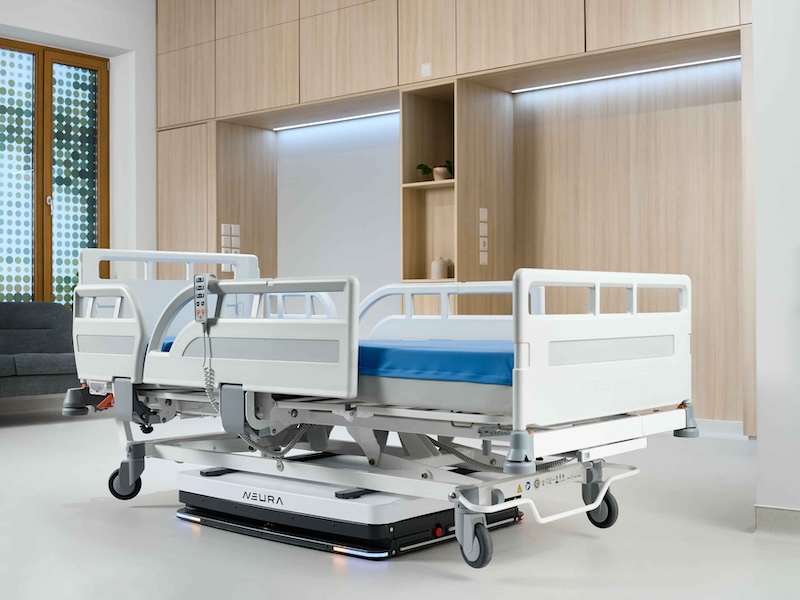
And the gap is widening: the World Health Organization expects a shortage of 4.1 million healthcare workers in the EU by 2030. Neura is meeting this challenge with concrete solutions: the first is the healthcare platform, a specialized autonomous mobile robot for empty-bed and sterile-goods transport in clinical environments.
These are not standalone machines. Each connects through the Neuraverse, Neura’s open physical AI ecosystem that links sensors, AI and intelligent machines.
In a sensor-equipped hospital, information from rooms, devices and robots comes together in one secure system, so that AI can recognise what is happening and the right machine can act, from spotting a patient who needs help to dispatching a robot to the task.
To give this commitment lasting structure, Neura has established Neura HealthTech as a dedicated expert business unit within the company.
Technology with a clear purpose
Healthcare teams face a capacity problem: tasks that could be automated, such as moving beds and other payloads between wards and storage areas, consume hours that skilled staff cannot spend on patients.
Neura directs physical AI at precisely these bottlenecks, not to replace people but to give them back time for the work that needs human judgement and presence.
Handed each move with a single request, the healthcare platform moves empty beds between wards and floors on its own: flat and omnidirectional, it turns on its own axis to manoeuvre through tight corridors and out of patient rooms, and keeps its safety functions active even while raising a bed.
Built on Neura’s cognitive robotics, it perceives its environment, acts on it and keeps learning from real-world experience. At around 20 moves a day, it can give a facility more than 1,300 hours a year back for patient care.
The healthcare platform is the first of these connected applications, plugging into the Neuraverse ecosystem to learn from the others and share its skills.
Neura’s cognitive robot arms (MAiRA) will extend the platform further, to instrument and tool assistance and to automating in-house logistics.
MiPA, Neura’s cognitive service robot and intelligent personal assistant, is being trained in Neura’s Gyms and in pilot environments for patient-room assistance and medication support, and will follow as the next application within Neura HealthTech.
Built to clinical standards, delivered as a service
Neura HealthTech builds each application for the realities of a hospital. Every system meets the hygiene, safety and machinery-directive standards required for clinical environments, built into the specification from the start; the platform handles empty beds only, not patient transport.
Before deployment, it is validated against the facility’s actual layout, from corridors to door widths and lift dimensions.
It is delivered through partners as Robotics-as-a-Service: facilities lease the robots rather than buy them, under a fixed monthly rate covering integration, operation, maintenance, software updates and 24/7 standby.
That spreads the cost and keeps the business case simple, weighed directly against staffing costs. The data is hosted in European cloud infrastructure.
David Reger, founder and CEO of Neura Robotics, says: “One of the key challenges of our time lies in the healthcare sector. Societies are aging, skilled people are scarce, and the demands on care keep rising.
“I am convinced physical AI is part of the answer, because it takes the physical burden off the people who provide care and gives them back time for what only humans can do.
“That conviction is why we created Neura HealthTech, with a team rooted in medical technology and a first solution built for real clinical work. We are in this field for the long term.”
A committed, structured entry
Neura HealthTech operates as a dedicated unit within Neura Robotics with full responsibility for product strategy, market positioning and go-to-market in healthcare and life sciences.
It is led by Sven Lange and staffed by professionals with deep experience in medical engineering, healthcare and regulatory affairs – the expertise this highly specialized market demands.
Neura HealthTech will present the healthcare platform publicly for the first time at the Smart Health Automation Summit of VDMA HealthTech in Düsseldorf on September 29 and 30; on site, the platform is presented by integration partner Auroniq Robotics, which is responsible for system integration and deployment at healthcare facilities.
