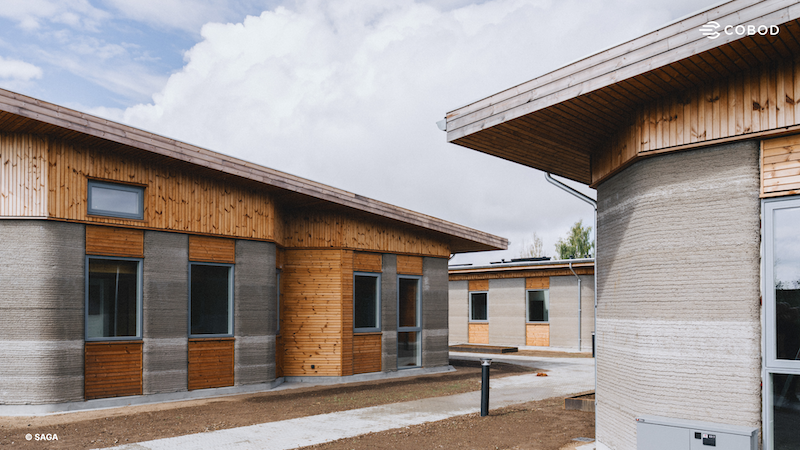
A development of 36 student apartments in Denmark has become Europe’s largest 3D-printed housing project, demonstrating how automated construction systems could reduce labor requirements while bringing complex architectural designs within affordable-housing budgets.
The Skovsporet development – “The Forest Trail” – in Holstebro comprises six buildings containing 36 apartments and has now welcomed its first residents.
Built for affordable housing organization NordVestBO, the 1,650 sq m development was printed on site by 3DCP Group using a single BOD3 construction 3D printer supplied by COBOD.
While construction 3D printing is sometimes presented primarily as an alternative building technique, the process is fundamentally an application of large-scale industrial automation.
Rather than workers manually constructing the walls brick by brick or pouring concrete into extensive formwork, the BOD3 operates as a digitally controlled robotic construction system.

Its automated printhead moves around the building site and deposits specially formulated concrete through a nozzle in successive layers, following a digital model of the structure. As each layer is deposited on top of the previous one, the walls gradually emerge directly from the architectural design data.
The approach effectively transfers principles already familiar in industrial robotics and additive manufacturing into construction – automated motion, digital toolpaths, repeatable material deposition and continuous production.
For Skovsporet, that automation has produced particularly striking results in terms of labor requirements.
All 36 apartments were printed using the same machine and a crew of just three people. One building containing six apartments, covering approximately 275 sq m, was printed in five working days.
A conventional construction site of comparable size would typically require considerably more workers for the wall-building trades alone.
The automated process also takes over much of the heavy and repetitive work involved in constructing walls, potentially reducing physical strain on construction workers while improving consistency and precision.

Automation meets affordable housing
The significance of the project goes beyond the number of apartments produced.
Denmark’s affordable housing sector operates under a statutory maximum budget per square meter, creating a particular challenge as construction costs rise and skilled labor remains limited.
Skovsporet was delivered within that limit.
The buildings themselves cost €1,880 per sq m – approximately $205 per sq ft – excluding design and engineering, utility connections, site works and landscaping.
For residents, rents start below €670 a month, with a 50 sq m apartment costing approximately €670 and smaller apartments costing less.
The economics are particularly notable because the development doesn’t look like a conventional low-cost housing project.
SAGA Space Architects, working with MS+, designed the buildings with extensive curved walls and rounded forms.
Using traditional construction techniques, those shapes can substantially increase costs. Curved brickwork requires additional labor, while poured concrete may require custom formwork and precast construction can require bespoke components.
For a construction 3D printer, however, a curved toolpath is not inherently more difficult than a straight one. The machine simply follows different coordinates in its digital model.
That allows architectural complexity to be introduced without necessarily carrying the cost penalties associated with conventional construction.


From digital model to concrete walls
Construction 3D printing represents an interesting convergence of robotics, additive manufacturing and conventional building techniques.
The printer does not construct the entire house. Instead, it automates one of the most labor-intensive stages by producing the concrete wall structures.
Those printed elements are subsequently integrated with conventional building systems, including roofs, windows, doors, utilities, timber elements and interior finishes.
That integration was one of the challenges of taking construction printing beyond experimental structures and using it repeatedly across a substantial residential development.
Mikkel Brich, co-founder and CEO of 3DCP Group, says: “The technical breakthrough was not printing one successful structure. It was repeating the process across six clusters while improving speed, maintaining accuracy, and integrating the printed elements with conventional building systems.”
The result also illustrates an important distinction between experimental construction robotics and commercially useful automation.
Producing a single demonstration building establishes that a machine can perform the task. Repeating the process across six buildings while maintaining accuracy, productivity and integration with conventional trades begins to demonstrate whether the technology can function as a genuine construction method.
What the residents get
Each of Skovsporet’s 36 apartments measures between 38 and 50 sq m and includes a kitchen, study space, lounge, bathroom and sleeping area.
Large roof windows and sloped ceilings bring daylight into the apartments, while the exposed printed concrete is combined with timber, cork paneling and glass.
The six buildings are arranged around shared courtyards, with gardens, footpaths and cycle parking intended to combine private accommodation with communal areas.
The characteristic horizontal layers created by the printing process remain visible on parts of the interior and exterior walls rather than being completely concealed.
Amalie Hvas, a student and one of the first residents, says: “I like it. It gives the building character. When you think of 3D printing, you picture a little machine making something in plastic – not an entire apartment!”


Lower-carbon concrete and fewer site interventions
The project also explored whether automated construction could contribute to reducing the environmental impact of building.
The team used locally sourced materials, including cement that produces up to 30 percent less CO₂ during production than traditional cement.
The flexibility of digitally controlled construction also helped the designers position the buildings around existing features of the site. Around 90 percent of the existing trees were retained.
Instead of clearing the site to simplify conventional construction, the buildings were positioned among the trees.
Philip Lund-Nielsen, co-founder and chief commercial officer of COBOD, says: “Construction 3D printing builds affordable housing at scale, and this student village is the largest example of it in Europe so far. The students moving in benefit from lower rents, the buildings look fantastic, and we are glad to see it scaling.”
Skovsporet by the numbers
The completed development provides several indications of how far automated construction printing has progressed from small demonstration projects.
- 36 apartments have been constructed across six buildings.
- 1,650 sq m is the total size of the development.
- 38 to 50 sq m is the size range of individual apartments.
- One BOD3 construction printer produced the printed structures for the entire development.
- Three people formed the printing crew throughout the project.
- Five working days were required to print one six-apartment, 275 sq m building.
- €1,880 per sq m was the construction cost of the buildings, excluding design and engineering, utilities, site works and landscaping.
- Up to 30 percent lower CO₂ emissions are claimed for production of the cement used compared with conventional cement.
- 90 percent of the site’s existing trees were retained.
The project is also unlikely to represent the end point of the technology.
3DCP Group and SAGA Space Architects are already testing new material formulations and production methods for future developments.
For the robotics and automation industry, Skovsporet provides an unusually tangible example of automation moving beyond the factory.
Construction has historically been difficult to automate because every site is different, the working environment changes constantly and buildings are too large to move through controlled production cells in the way cars or electronic products can.
Large-format robotic 3D printing effectively reverses that arrangement: instead of bringing the product to the automation, the automated production system is brought to the product.
At Skovsporet, that system has now moved beyond printing prototypes or showcase buildings. The same machine and three-person crew have repeatedly produced the concrete structures for six residential buildings – and 36 people are beginning to call the results home.
