
Chinese companies represent almost 70 percent of the global humanoid robot market
Chinese humanoid robot manufacturers could face a significant setback in one of the world’s largest technology markets after the US Federal Communications Commission (FCC) moved to block new foreign-produced advanced robotic devices from receiving equipment authorization.
The move follows a determination by US national security agencies that foreign-produced advanced robots pose unacceptable cybersecurity and supply chain risks.
While existing authorized robots remain unaffected, new foreign-produced humanoids, quadrupeds and other advanced mobile robots will generally be unable to obtain the FCC approvals needed to be imported, marketed or sold in the United States.
The decision has prompted analysts to view the measure as another escalation in the technological rivalry between the US and China.
Counterpoint Research principal analyst Soumen Mandal said: “The AI battle between the US and China continues to rage on as the Trump Administration has banned new Chinese humanoid robots for sale in the United States.
The timing is likely not an accident as several of China’s humanoid manufacturers are preparing to IPO this year. US companies such as Tesla, Figure and Boston Dynamics greatly benefit from this news.”
The latest restrictions extend a broader pattern of US policy aimed at limiting the entry of connected technologies viewed as presenting national security risks.
Previous measures have targeted Chinese telecommunications equipment, drones, consumer networking devices and electric vehicles.
Chinese companies dominate installations
The timing is particularly significant because Chinese companies currently dominate the global humanoid robotics market.
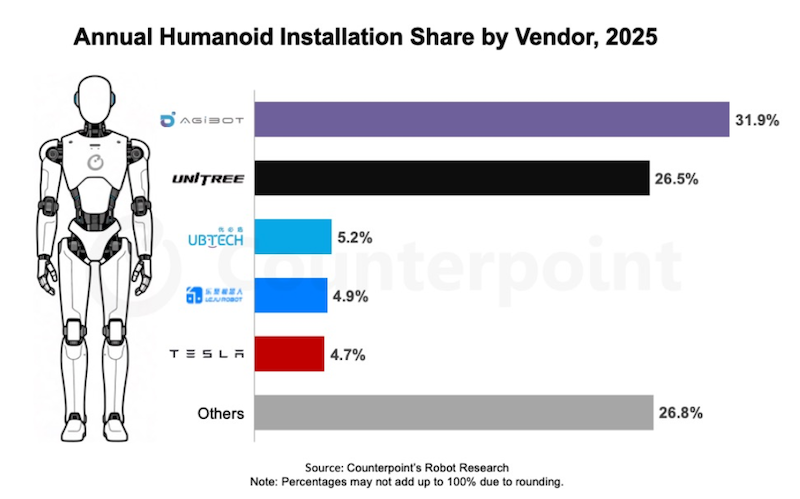
According to Counterpoint Research, AgiBot was the world’s largest humanoid robot vendor in 2025, accounting for 31.9 percent of annual installations.
Fellow Chinese manufacturer Unitree ranked second with a 26.5 percent share.
Two other Chinese companies – UBTech and Leju Robot – held 5.2 percent and 4.9 percent respectively.
Tesla was the highest-ranked US company, accounting for 4.7 percent of installations during the year.
Together, the four Chinese companies represented almost 70 percent of the global humanoid robot market, underlining China’s rapid emergence as the sector’s dominant manufacturing base.
The figures reflect annual installation share rather than revenue or cumulative installed base.
A growing strategic industry
Humanoid robots are increasingly viewed as one of the next major growth sectors for artificial intelligence and advanced manufacturing.
Technology companies are investing billions of dollars in systems capable of performing warehouse operations, factory work, logistics, inspection, healthcare support and eventually domestic tasks.
As production volumes increase and costs fall, analysts expect the market to expand rapidly during the coming decade.
That growth has intensified competition between the US and China, both of which regard advanced robotics as a strategically important industry.
Supporters of the FCC’s decision argue that connected robots could potentially collect sensitive information, receive remote commands or introduce cybersecurity vulnerabilities into critical infrastructure.
Critics, meanwhile, are likely to question whether broader industrial and economic considerations are also influencing policy, particularly as Chinese manufacturers continue to strengthen their position in the global humanoid robotics market.
For now, the FCC’s action does not affect existing authorized robots already operating in the United States, nor does it require companies or consumers to replace equipment they already own.
However, it raises a new barrier for foreign-produced humanoid robots seeking access to the US market and represents another chapter in the increasingly competitive race to lead the next generation of AI-powered robotics.
