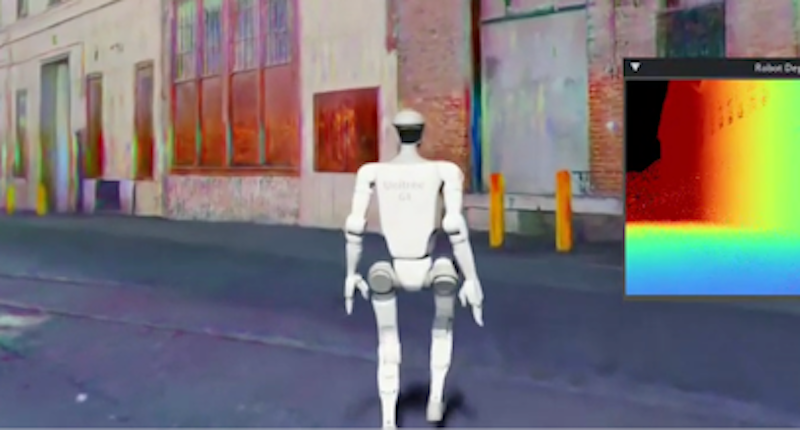
Niantic Spatial has launched USDZ export for its Scaniverse app, enabling robotics developers to convert real-world environments into simulation-ready digital twins for use with Nvidia Isaac Sim.
The new capability is designed to help address the long-standing “sim-to-real” gap in robotics, where systems trained in synthetic environments often struggle when deployed in complex, real-world settings.
Using Scaniverse, developers can now capture a real environment with a 360-degree camera and generate a USDZ file that combines a Gaussian splat with an automatically generated, aligned mesh. The resulting model can be imported directly into NVIDIA Isaac Sim for robot training and testing.
The company says the workflow provides a simpler and lower-cost alternative to traditional RGB-LiDAR mapping systems, which can cost tens of thousands of dollars. In contrast, a 360-degree camera priced at around $500 can capture an entire street or large indoor space in a single five-minute scan.
Niantic Spatial says the feature builds on its existing depth model, which produces smoother and more accurate meshes by deriving geometry directly from Gaussian splats rather than relying on standalone geometry scans.
The company says this approach allows both the visual and physical representations of an environment to be created from a single capture, reducing alignment errors between rendered imagery and collision geometry.
According to Niantic Spatial, this creates more realistic training environments for vision-based robot policies, allowing robots to learn from the lighting, textures, clutter, and surface characteristics of the actual locations in which they will eventually operate.
Rather than training exclusively in generic simulated environments, developers can capture a customer’s warehouse, factory, or other operating environment before deployment, generate a simulation-ready digital twin, train robot policies within that model, and then deploy robots that have already been trained using a representation of their destination.
The company says the approach could improve deployment times while supporting ongoing policy refinement after robots are in service through persistent, high-fidelity digital twins.
The USDZ export capability is available now in Scaniverse and is designed for use with Nvidia Isaac Sim as part of Niantic Spatial’s broader effort to develop real-world foundation models for physical AI.
