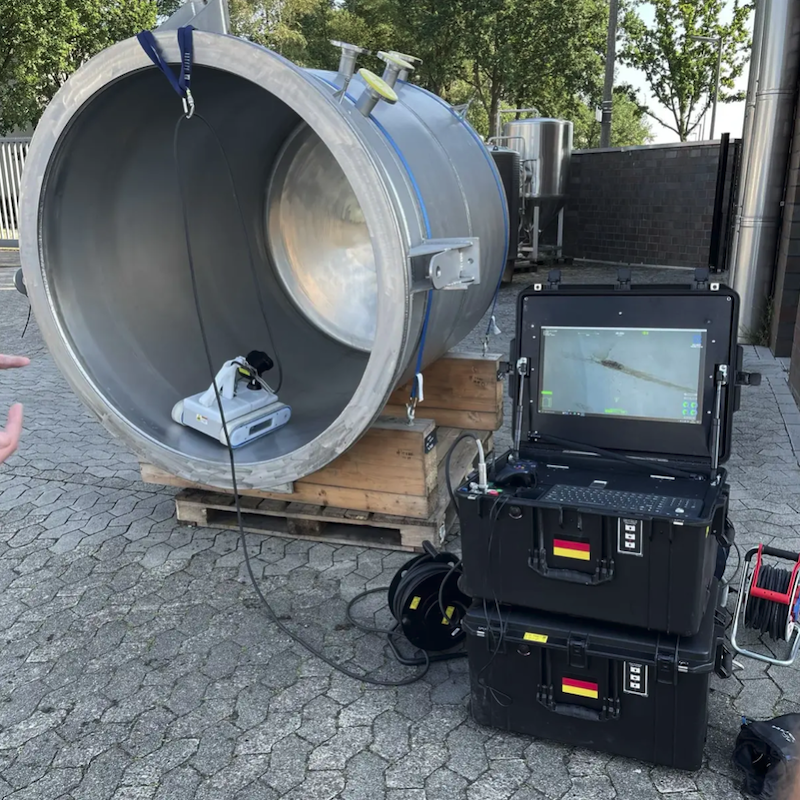
Ensuring the structural integrity of stainless steel vessels is a critical requirement in industries such as chemicals, pharmaceuticals or food processing.
Even minor cracks in weld seams, stress zones, or highly loaded components can compromise operational safety, product quality, and regulatory compliance.
In recent years, robotic inspection technology has emerged as an increasingly effective method for detecting cracks and material defects in industrial tanks and process vessels while reducing inspection time and human risk.
Traditional inspection methods often rely on manual visual checks combined with non-destructive testing (NDT) techniques such as dye penetrant testing, ultrasonic inspection, or radiography.
While effective, these approaches can be time-consuming and challenging when vessels are large, internally complex, or located in confined spaces.
Manual inspections may also require shutdown periods, scaffolding, or entry permits for confined-space work, all of which increase operational costs and safety exposure.
Robotic inspection systems address many of these limitations by allowing remote-controlled or semi-autonomous devices to enter the vessel and scan internal surfaces with high precision.
Equipped with high-resolution cameras, ultrasonic probes, laser scanners, or magnetic sensors, these robots can systematically examine weld seams, shell sections, and nozzle connections for microcracks, corrosion fatigue, or structural irregularities.
Because robotic systems maintain consistent sensor positioning and scanning speed, they often deliver more repeatable and measurable inspection data than manual procedures.
Another important advantage is improved safety. Stainless steel vessels frequently qualify as confined spaces, meaning human entry requires extensive safety precautions, atmospheric monitoring, and rescue planning.
Robotic systems can perform the initial inspection without personnel entering the vessel, significantly reducing risk while still providing detailed structural information. Human inspectors can then focus only on locations where the robotic scan has identified potential anomalies.
From an operational perspective, robotic crack detection can also reduce downtime. Faster setup, automated scanning paths, and digital reporting allow maintenance teams to evaluate vessel condition more quickly and plan targeted repairs instead of conducting lengthy manual surveys.
Digital inspection records additionally support lifecycle documentation, preventive maintenance strategies, and regulatory audits.
The technology is also particularly valuable when purchasing used processing machinery, such as stainless-steel reactors, pressure vessels or dairy process tanks.
Leading second-hand equipment dealers such as Behälter KG Bremen offer surface inspection reports for many of their second-hand tanks and vessels, in order to verify that the equipment is free of cracks and defects.
Overall, robotic crack inspection represents a significant advancement in non-destructive testing for stainless steel vessels, combining higher inspection consistency, improved worker safety, and more efficient maintenance planning with reliable, data-driven assessment of structural condition.
Main image source: Behälter K.G. Bremen GmbH
