
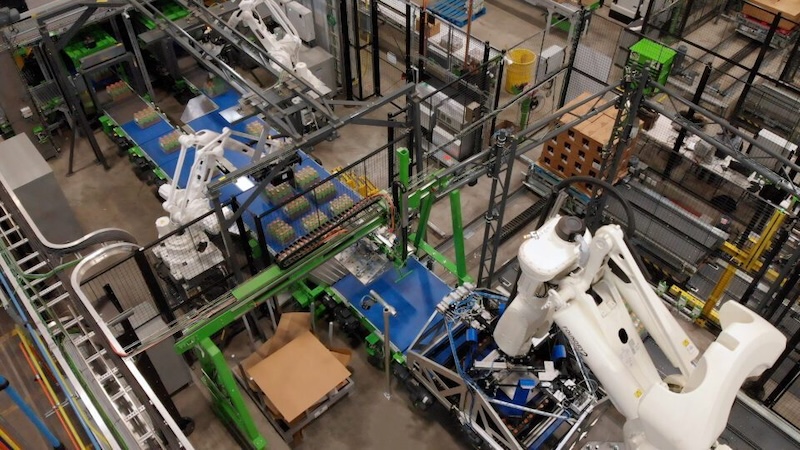
Exol (formerly GreenBox Logistics) has launched its first US “physical AI” fulfillment facilities, introducing what the company describes as a new logistics model designed to expand access to large-scale warehouse automation.
The company says it plans to build a nationwide network of six automated sites totaling around six million square feet, aimed at supporting retail, wholesale and consumer goods companies. The first facility in Atlanta is now operational, while additional locations are planned in California, Texas, New Jersey and Illinois over the next year.
The concept behind Exol’s offering – described as “robotic fulfillment-as-a-service” – is to provide companies with access to automated warehouse infrastructure without requiring them to invest in their own systems.
In practice, this means businesses can use shared, robot-enabled facilities for tasks such as order fulfillment, inventory handling and distribution, rather than building or leasing dedicated automated warehouses.
The model reflects growing pressure on supply chains, where rising labor costs, increasing order complexity and tighter retailer requirements are pushing more companies toward automation, but not all have the capital or expertise to deploy it.
Exol says its network is backed by a $7.5 billion commitment from SoftBank Group and Symbotic, and is built around AI-enabled robotic systems capable of handling multiple types of goods, from pallets and cases to individual items.
“Symbotic’s vision has always been to reinvent the supply chain with AI-enabled robotics technology, transforming the distribution network into a strategic asset,” said Rick Cohen, chairman and CEO of Symbotic. “Exol takes that vision and makes it accessible to a broader market, a game-changing move for modern logistics.”
According to the company, its Atlanta facility is designed to handle high volumes across different fulfillment models, including business-to-business, direct-to-consumer and store replenishment, using a combination of robotics and integrated transportation systems.
“Logistics is at a turning point. Access to automation has become a major competitive divide,” said Vikas J. Parekh, managing partner at SoftBank Group International.
“Exol helps close that gap by making robotic fulfillment infrastructure more accessible. We share a vision that physical AI is the next frontier, and Exol brings that to life by combining AI, software and real-world automation at scale.”
The company argues that traditional automation models – often tied to long-term contracts or large upfront investments – have limited adoption, particularly among mid-sized businesses. By contrast, its shared infrastructure approach is intended to offer more flexible access to automated capacity.
“We built Exol to fill a substantial market gap: enterprise-grade robotic fulfillment that is immediately accessible, scales as your business needs evolve, provides nationwide coverage, and is priced affordably with no large financial commitment,” said Ashfaque Chowdhury, CEO of Exol.
“With our Atlanta site now live, we’ve officially kicked off our nationwide network and are introducing a more scalable and cost-efficient approach to logistics. We invite business leaders to visit Exol and experience the network in action.”
Exol plans to showcase its platform at MODEX 2026 in Atlanta later this month, as it begins rolling out its network and testing demand for the model.
The launch highlights a broader shift in logistics toward shared, software-driven infrastructure, where robotics and AI are increasingly delivered as services rather than owned assets – a model that could reshape how companies adopt automation in the coming years.
