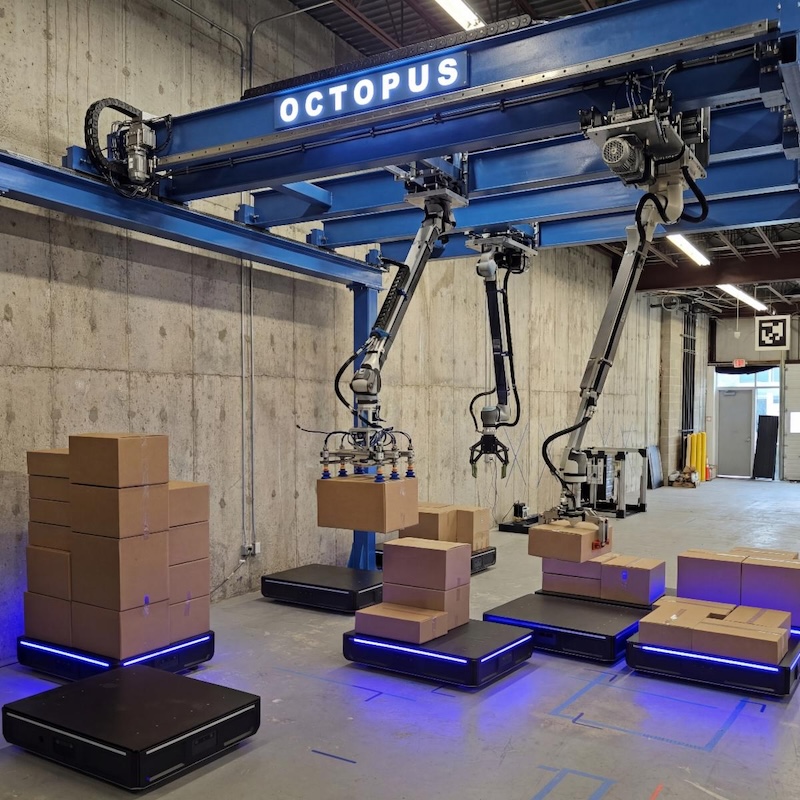
High-speed, multi-arm goods-to-robot system pairs with Logic Pallets to turn every loading zone into a smart automation cell
Logic, a pioneer in autonomous, data-driven logistics solutions, highlights the Octopus, an overhead industrial picking robot that replaces static, floor-bound equipment with an agile, ceiling-mounted system for high-speed case handling.
Suspended above existing workflows, Octopus autonomously picks, lifts, and transfers cased goods without consuming aisle space, allowing warehouses and logistics hubs to reclaim the floor for storage density, people, and flow.
Rather than relying on a single arm with one dominant tool, Octopus is built as a configurable, multi-arm platform that can be populated with any combination of suction cups, clamps, grippers, and specialized end effectors.
Each arm operates as an independent worker that can be choreographed to handle different SKUs, package sizes, and packaging types in parallel, so the system can perform multiple picks and placements at once across mixed loads.
Because the tools are all live simultaneously, the robot does not have to stop for mechanical changeovers, which removes a major source of idle time and enables consistently high throughput.
Octopus is designed to integrate seamlessly into both existing and new facilities, spanning everything from legacy distribution centers to compact micro-fulfillment nodes.
By attaching to overhead structure rather than claiming a footprint on the ground, the system turns what was once an unproductive overhead volume into a productive automation layer that can serve dock doors, inspection points, storage zones, or cross-dock lanes.
Static loading areas become intelligent interaction hubs, where goods arrive, are automatically handled, and then move directly to their next location without manual repalletizing or intermediate staging. The system is available to be custom built on demand to accommodate facility layouts.
A key differentiator for Octopus is its tight coordination with Logic Pallets, autonomous mobile platforms that transport and position loads under the robot. Instead of driving pallets to different tools or asking a single robot to adapt mechanically to every task, Logic Pallets navigate to the right Octopus arm based on the needs of each item, order, or workflow.
The result is a true goods-to-robot paradigm, where the mobile platform handles movement and positioning while the overhead system focuses on fast, precise picking, lifting, and inspection.
This collaboration is orchestrated by the Logic Interface Network (LINK), which unifies data from robot arms, Logic Pallets, sensors, and vision systems into a single decision layer.
LINK uses spatial awareness of Octopus, weight data from Logic Pallets, images, and product codes to validate every pick and placement in real time, cross-referencing each move against a centralized item master.
As goods progress from receiving to storage, from staging to outbound loading, the system continuously confirms what has moved, where it is, and how it should be handled next, driving accuracy and traceability while keeping the operation in motion.
With Octopus and Logic Pallets working together under one operating system, operators can deploy a single automation platform that supports lifting, sorting, staging, and transferring inventory across every node of the supply chain.
The same overhead robot that builds mixed pallets for outbound orders can also perform dock-side inspection, support cross-dock transfers, or feed micro-fulfillment flows without reconfiguring the floor.
By combining high-speed, multi-arm overhead robotics with intelligent, self-positioning pallets and a unified control layer, Logic offers a space-efficient, future-ready automation solution that gives warehouses new freedom in how they design, operate, and scale.
