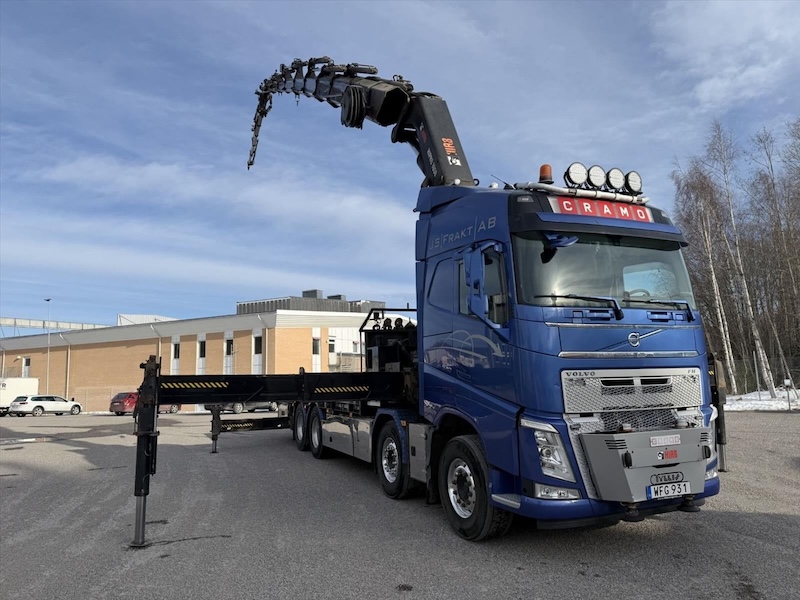
A number of individuals have spoken about robotics with respect to heavy equipment. However, they typically consider autonomous mining vehicles, warehouse management systems, and construction machines.
The majority of these individuals overlook an extremely obvious shift that is taking place in truck mounted cranes. Crane trucks are becoming smart due to the advent of new technology to assist the operator by making his job safer.
Automation in crane trucks is not about full autonomy
While robotics in heavy equipment doesn’t necessarily mean an entirely unmanned machine, the trend is clearly toward assisted operation.
Today’s truck-mounted loader cranes are increasingly relying on integrated control systems that track the boom’s location, load conditions, machine geometry and stability in real time. That changes the operator’s role from simply manually controlling the crane to supervising the lift.
That matters because crane-truck operations typically do not occur in perfect conditions. The crane may be situated on uneven terrain, near buildings, within urban delivery areas or on constrained industrial property. Under those conditions, robot-assisted operation provides repeatable results and reduces the possibility of operator error.
European loader-crane regulations describe the minimum requirements for design, calculation, testing and inspections for hydraulic loader cranes mounted on vehicles. More recently, there has been an increased emphasis on higher levels of safety in the control circuits.
When companies evaluate upgrades to their fleets, the buyer side is just as important as the technology side. A company evaluating the best crane truck configuration that can be found on platforms like Truck1, regardless if it is a new or used unit, will also have to consider lifting class, chassis type, control configuration, and service condition.
Sensor fusion and stability control are driving crane trucks toward robotic behavior
The most critical layer of automation for crane trucks is safety logic tied to sensor inputs. A crane truck operates in a dynamic environment. Capacity varies with boom length, angle, reach and support conditions. Therefore, stability control systems, load limiting devices and motion limiters play a crucial role in today’s operation.
From a robotics standpoint, that is important because the machine is increasingly determining what permissible motions are available. While the operator determines what is to be lifted, the software determines the safe motion parameters. That is a classic example of human-in-the-loop automation.
Additionally, the introduction of smart control systems also increases productivity. Because the operator does not have to estimate safe operating limitations by intuition alone, they can dedicate more cognitive resources to performing the task. Smart control systems can decrease set-up time, reduce trial and error movements, and provide improved consistency among different crews.
In heavy equipment, incremental improvements in productivity translate to significant cost savings associated with reduced machine down time, failed lifts, and re-positioning.
Remote control and digital interfaces are transforming the role of the operator
A new important robot trend involves replacing physical controls placed on an operator with remotely controlled and digitally enabled robotic systems. The ability for operators to use remote controls allows operators to view the load path in a safe manner while being physically unconfined to a single point of control.
The remote control of a crane operation provides the operator with an enhanced line-of-sight and lessens the amount of guess work required to operate the crane near hazards or obstructions.
This is not just an insignificant ergonomic issue. The remote control of crane operations changes the way that crane operations are carried out on site. When the operator is removed from the fixed control station, the importance of designing the software increases.
The clarity of the interface, the quality of feedback provided, the delay in response, and alarm logic all become critical components of the machine’s effective safety system.
Telematics and fleet intelligence are becoming integral components of the machine
Robotics in the area of heavy equipment does not merely include the machine’s operation itself. However, it also includes activities which take place before and after operating.
Once crane trucks provide operational data that can create actionable information, fleet managers can track how much they are using their cranes, when and why they require maintenance, when servicing is due and the types of loads they typically carry. Thus, there exists a feedback mechanism from the equipment’s on-site performance and the manager’s purchasing decisions.
This represents the beginning of digital fleet intelligence as relating the lift capability of a machine. Therefore, a crane truck that has good uptime, clear diagnostic information and consistent control behavior could be considered more valuable than a larger crane truck that has poor deployment characteristics.
Moreover, this paradigm is important for used-equipment buyers because the quality of the equipment can no longer be assessed based on either the amount of wear and tear and/or the age of the equipment.
In fact, the overall value of a crane truck is increasingly being measured by the quality of its electronic and safety systems as well as whether those systems meet today’s operational standards.
