A servo drive converts electrical commands into precise mechanical motion, influencing the speed, position and torque of every motor it powers. This capability makes it one of the most significant components of any production line.
When a drive falls short, the effects manifest instantly in positioning errors, lost cycles and unplanned downtime. Five solutions stand out for engineers designing factory automation systems.
Criteria for Selecting the Top Servo Drives
Certain qualities separate the best servo drives from the rest.
- Precision and performance: A drive excels in factory automation by executing motion commands with minimal error and high repeatability. Even small deviations can compound across production cycles.
- Reliability and quality: Reliable performance under real operating conditions is what separates a solid drive from one that causes problems at scale. Manufacturers that control their own production processes can catch issues before they leave the facility.
- Customization and integration: The best servo drives integrate smoothly into existing control architectures. They also offer options for adapting to specific original equipment manufacturer (OEM) requirements or unusual mechanical configurations.
- Technical expertise: A manufacturer’s depth of application knowledge and engineering support can make or break a project. Access to experienced engineers who understand the full motion control chain accelerates deployment and reduces commissioning risk.
A Closer Look at the 5 Best Servo Drives for Factory Automation Systems
Five manufacturers have built a strong reputation in the motion control space, and each brings something distinct to factory automation systems.
1. Harmonic Drive
Harmonic Drive builds precision motion control components for robotics, medical device manufacturing and industrial automation. The company produces strain wave gears, rotary actuators and integrated actuators.
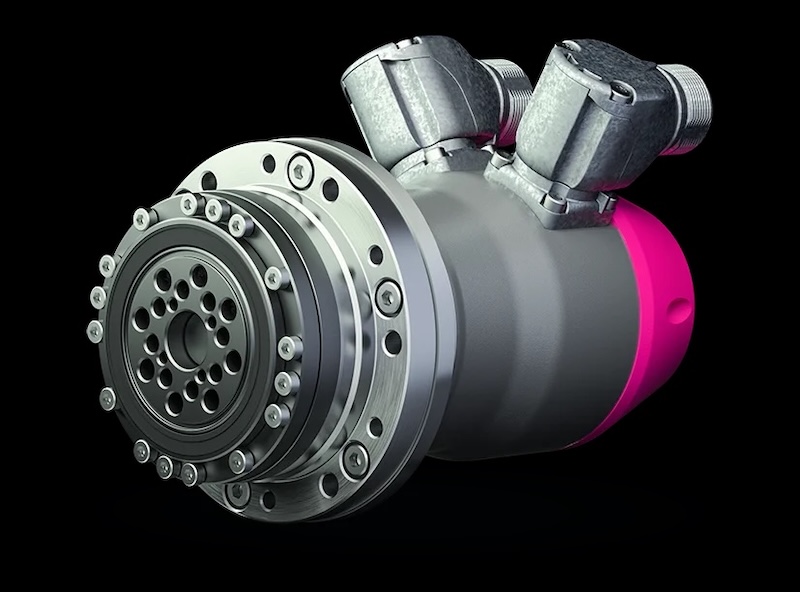
The integrated actuator series stands out for factory automation. Each unit combines a servo drive, dual feedback encoders and precision gearing in a single housing, communicating over CANopen or EtherCAT. Fewer cables and a lower part count make these actuators practical for space-constrained and multiaxis applications.
Harmonic Drive designs and manufactures every component in-house at its Beverly, Massachusetts, facility. That end-to-end control over production ensures consistent quality and positions the company to develop fully custom solutions for OEM applications. Decades of precision motion control experience inform every stage of the engineering process.
Key features
- Packages servo drive, encoder and precision gearing into a single compact integrated actuator unit
- Engineers custom solutions from the ground up to meet individual OEM specifications
- Controls design and manufacturing in-house for consistent quality across every component
2. Yaskawa Sigma-7
Yaskawa is one of the most recognized names in servo technology, and the Sigma-7 series reflects decades of refinement. The Servopack amplifiers at the heart of this system feature a tuning-less mode that continuously detects load inertia and automatically adjusts servo gains. This enables the drive to easily shift under mechanical conditions without manual intervention.
The Sigma-7 range covers power outputs from 50W to 55kW, making it one of the most versatile platforms available for applications ranging from compact assembly machinery to high-load industrial equipment.
A 24-bit absolute encoder with a resolution of 16.7 million pulses per revolution supports extremely precise positioning. The series communicates over EtherCAT, Profinet and Mechatrolink-III, so it fits into most existing network architectures.
Key features
- Automatically adjusts servo gains in real time using a tuning-less algorithm that responds to load changes
- Covers power outputs from 50W to 55kW to suit everything from compact assembly cells to high-load equipment
- Communicates over EtherCAT, Profinet and Mechatrolink-III for broad network compatibility
3. Mitsubishi Melservo-J5
The Melservo-J5 series from Mitsubishi Electric was designed for demanding multiaxis applications because it supports synchronization of up to 256 axes per motion module. When three modules are combined, the total can even reach 768 axes. That makes it a viable choice for large-scale production lines that benefit from tight coordination across many motion points.
A key part of what makes this possible is its compatibility with CC-Link IE TSN (time-sensitive networking), which delivers 1 Gbps transmission speeds and time synchronization across all connected devices on a single network.
The series also incorporates predictive maintenance powered by Mitsubishi Electric’s Maisart AI technology, which detects mechanical deterioration before it causes unplanned downtime. All motion modules are programmed within a single software environment.
Key features
- Synchronizes up to 256 axes per motion module across high-demand multiaxis production systems
- Detects mechanical deterioration early using Maisart AI-powered predictive maintenance
- Shares a unified software environment with other Mitsubishi Electric factory automation products
4. Siemens Sinamics
Siemens Sinamics is designed to operate within Siemens’ broader automation architecture rather than as a stand-alone component. Through the Totally Integrated Automation (TIA) Portal, Sinamics drives share a common engineering environment with PLCs, HMIs and other system devices. Commissioning, diagnostics and configuration all run through a single interface.
The Sinamics platform can scale without the need for a redesign, as it covers single-axis machines and large multidrive production lines within the same framework. Siemens released TIA Portal V20 in late 2024, adding AI-assisted engineering tools and expanded PLC compatibility. This enables the platform to grow alongside the systems it supports.
Key features
- Runs inside Siemens’ Totally Integrated Automation ecosystem for unified commissioning and diagnostics
- Scales across single-axis machines and complex multidrive production lines without architecture changes
- Delivers simulation and real-time diagnostic tools through the TIA Portal engineering environment
5. Allen-Bradley Kinetix 5500
The Allen-Bradley Kinetix 5500 is purpose-built for environments running Logix-based controllers. It operates over EtherNet/IP, bringing motion and control onto a single network and eliminating the need for a dedicated motion bus. Such an integration is seamless for facilities already using CompactLogix or ControlLogix platforms.
One of the most practical features of the Kinetix 5500 is its single-cable technology, which combines motor power, feedback and brake functions into one cable with a quick one-turn connector. This reduces wiring complexity during installation and limits points of failure over the machine’s life cycle.
Its integrated safety drive option transmits safety signals over the EtherNet/IP cable, eliminating the need for separate hardwiring. This way, drive configurations can be updated in software without requiring physical wiring changes.
Key features
- Consolidates motor power, feedback and brake into a single cable to cut installation time and wiring errors
- Operates natively within Studio 5000 Logix Designer on a unified EtherNet/IP motion and control network
- Transmits safety signals over the network cable, removing the need for separate safety hardwiring
Investing in the Right Servo Drive Pays Off Over the Long Term
Factory automation systems are becoming increasingly interconnected each year, and the servo drive at the center of each motion axis will continue to define machine performance. Evaluating precision, reliability, integration and engineering support now will save money and rework later.
