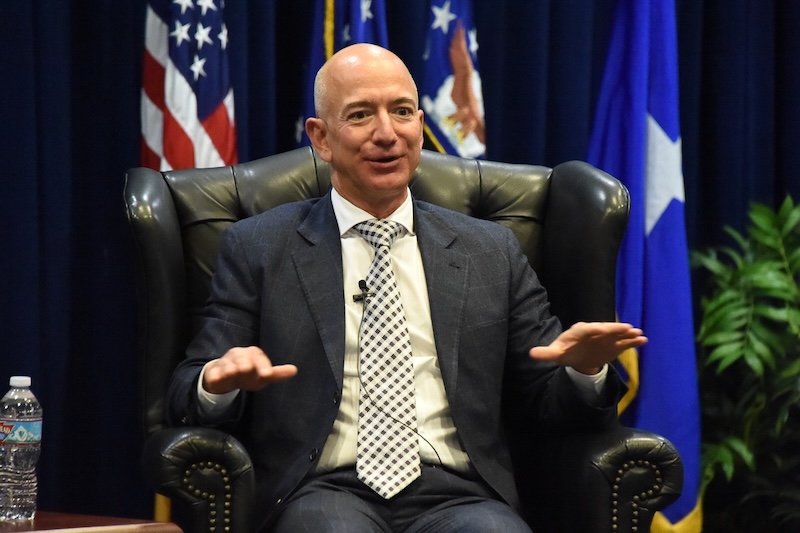
Jeff Bezos is reportedly exploring plans to raise as much as $100 billion to acquire and modernize manufacturing companies using artificial intelligence, according to multiple media reports.
The proposal, first reported by The Wall Street Journal, would focus on buying established but underperforming industrial businesses and applying AI-driven operational improvements to increase efficiency and output.
Additional coverage from TechCrunch, Forbes, and Proactive Investors suggests the effort is still in exploratory stages, with no formal fund or structure confirmed.
Applying AI to legacy industry
The reported strategy centers on acquiring traditional manufacturing firms – many of which operate with aging processes and fragmented data systems – and upgrading them using AI tools.
These could include:
- Predictive maintenance systems
- AI-driven production planning
- Automated quality inspection
- Digital twins and simulation
In effect, the approach resembles a private-equity-style roll-up combined with a technology transformation layer – an attempt to bring what has been described as “software-style optimization” into physical industry.
While such ideas are not new, the scale under consideration is.
From e-commerce to industrial systems
Bezos built Amazon into a global retail and logistics powerhouse, with a business model heavily dependent on automation, data infrastructure, and operational efficiency.
The company’s logistics network – now one of the largest in the world – has long relied on robotics, warehouse automation, and increasingly sophisticated AI systems to manage inventory, routing, and delivery.
That experience may inform the logic behind the reported manufacturing strategy.
If successful, the approach would extend similar principles:
- Data-driven optimization
- End-to-end system integration
- Continuous operational improvement
- from logistics into industrial production.
Ambition enabled by technology
One notable aspect of the reported plan is that it reflects a broader shift in what is considered feasible in manufacturing.
Historically, transforming industrial businesses at scale has been slow, capital-intensive, and operationally complex. AI, combined with advances in robotics and digital infrastructure, is beginning to change that equation.
In that sense, the proposal is not just about applying AI to existing processes. It reflects the growing belief that manufacturing itself can be restructured around software-driven systems.
That shift is already visible in areas such as:
- Smart factories
- Autonomous production lines
- Real-time supply chain optimization
The difference here is the scale – and the attempt to apply it across multiple acquired firms.
Skepticism and questions
The reported plan is likely to raise questions within the manufacturing sector.
Many companies have already invested heavily in automation and digitalization over the past decade, often with mixed results. Integrating AI into complex industrial environments remains challenging, particularly where legacy systems and processes are deeply embedded.
There may also be skepticism around whether an external investor – even one with Bezos’s track record – can consistently outperform existing operators in applying these technologies.
At the same time, Bezos’s history of entering established industries and reshaping them – from retail to cloud computing – suggests that the strategy cannot be dismissed outright.
A bid to reshape industrial value chains?
If the initiative moves forward, it could signal a more aggressive phase in the convergence of AI, robotics, and industrial production.
One possible interpretation is that the strategy aims to capture value not just from manufacturing itself, but from the integration of:
- production
- logistics
- data
- and software
… into unified systems.
Such an approach would mirror Amazon’s broader model, where control over infrastructure and data has been central to its competitive advantage.
Whether that model can be extended into manufacturing remains uncertain.
Early-stage plans, uncertain timeline
For now, the reported effort appears to be at an early stage, with details on structure, investors, and target sectors still unclear.
However, the scale of the reported ambition – $100 billion – highlights the level of interest building around AI’s potential role in reshaping industrial production.
It also reinforces a broader trend: manufacturing, long seen as resistant to rapid change, is increasingly becoming a focal point for technology-driven transformation.
