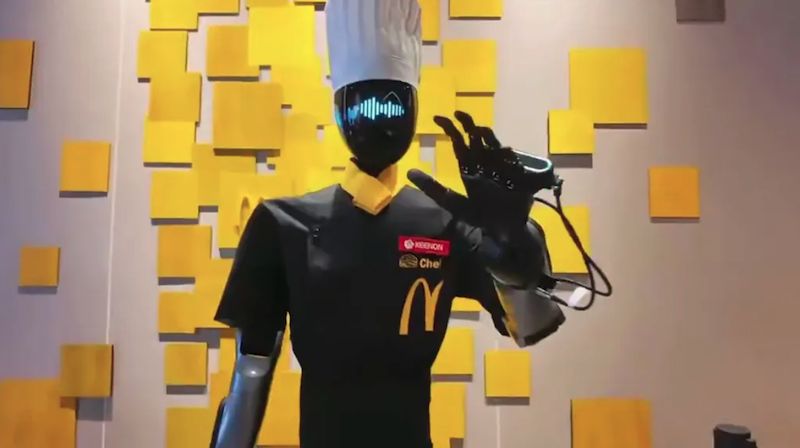
Global fast-food giant McDonald’s is testing humanoid service robots at a restaurant in Shanghai, as part of an early-stage effort to explore automation in customer-facing environments.
According to reports from tech publications including T3 and Digital Trends, the pilot involves robots developed by Keenon Robotics performing a range of front-of-house tasks.
Robots take on customer service roles
The robots are being used to greet customers, provide basic information, deliver food to tables, and collect trays after meals.
The deployment includes both humanoid-style robots and wheeled service units equipped with screens, reflecting a mix of interaction-focused and logistics-oriented designs.
The trial is taking place at a single location in Shanghai and is described as an experimental deployment rather than a full rollout.
Early test of automated restaurant concept
The pilot is part of a broader exploration of how automation could be integrated into restaurant operations, potentially reducing reliance on human staff in both service and back-of-house roles.
However, reports suggest the concept remains at an early stage, with fully automated restaurants still some distance from practical implementation.
The robots demonstrated in the trial appear capable of handling structured tasks such as delivery and basic interaction, but their long-term role in complex service environments remains uncertain.
Part of a wider shift toward service robotics
Keenon Robotics is already known for its delivery robots used in restaurants and hospitality settings, particularly in Asia. The introduction of humanoid systems represents a step toward more interactive and adaptable machines in public-facing roles.
The Shanghai trial reflects a broader trend in robotics, as companies experiment with deploying AI-powered systems outside traditional industrial environments.
Questions remain over scale and impact
While the pilot highlights progress in service robotics, it also raises familiar questions around cost, reliability, and workforce impact.
For now, the deployment appears to be a limited test rather than a confirmed expansion strategy. Neither McDonald’s nor Keenon Robotics has issued a formal announcement detailing the scope or timeline of the program.
Still, the trial offers a glimpse of how humanoid robots could begin to appear in everyday consumer settings – not as replacements for entire workforces, but as experimental additions to existing operations.
A visible step for humanoid robots
For the robotics industry, the significance of the trial lies less in immediate commercial impact and more in visibility.
Humanoid robots have long been demonstrated in controlled environments. Deployments in public-facing settings such as restaurants represent a different challenge – and a different opportunity.
The Shanghai pilot suggests that, while still early, that transition may already be under way.
