Factories are humming again, yet talent is scarce. In the UK alone, 49,000 manufacturing jobs sat vacant in April 2025, a snapshot of the global skills crunch TechRadar.
According to microlearning provider 5Mins.ai, plants that roll out focused compliance training record a 28 percent drop in recordable incidents – proof that smart learning platforms protect both people and production.
Below, we rank the seven best training platforms built for manufacturing. You’ll see how each one handles mobile and offline delivery, certifications, IoT data, and granular analytics so you can choose with confidence.
How we scored each platform
We didn’t eyeball a few screenshots and call it a day. Instead, we built a simple rubric any plant manager could replicate.
First, we spoke with maintenance leads, EHS directors, and HR teams from food, automotive, and electronics plants. Their wish list repeated nine themes: industry-ready courses, airtight compliance tracking, mobile or offline lessons, multilingual UX, SCORM or xAPI for content, hooks for IoT or ERP data, granular analytics, rapid roll-out, and pricing you don’t need a PhD to decode.
Next, we weighted those themes by measurable impact on safety, uptime, and audit readiness. Compliance training alone cuts recordable incidents by roughly twenty-eight percent, so it earns a 15 percent slice of the scorecard, according to 5Mins.ai.
The final matrix looks like this:
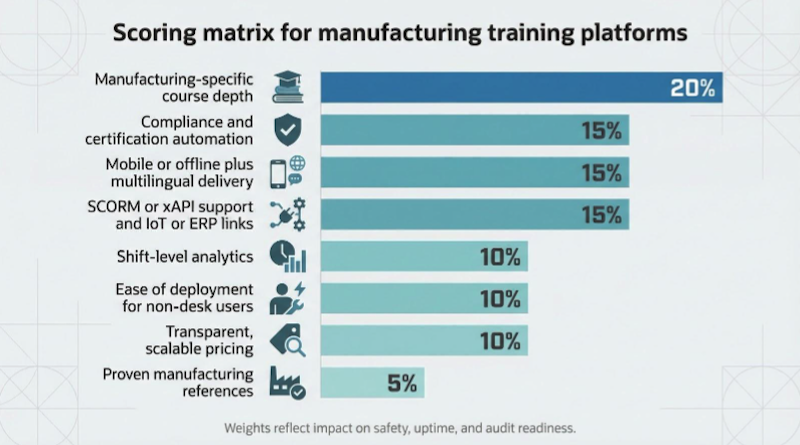
- Manufacturing-specific course depth – 20 percent
- Compliance and certification automation – 15 percent
- Mobile or offline plus multilingual delivery – 15 percent
- SCORM or xAPI support and IoT or ERP links – 15 percent
- Shift-level analytics – 10 percent
- Ease of deployment for non-desk users – 10 percent
- Transparent, scalable pricing – 10 percent
- Proven manufacturing references – 5 percent
Each vendor received a zero-to-ten score per line, multiplied by the weight, then summed into a clean 100-point total. That number drives the ranking you’ll see next.
Why rank at all? Because a plant with one site and thirty operators faces different constraints than a global OEM rolling out training across forty plants. A numeric score lets you adjust the cut-off that fits your reality.
Finally, we double-checked results against hard data, including vacancy reports showing forty-nine thousand unfilled UK factory roles in April 2025, underscoring why fast, scalable upskilling matters.
1. GoSkills LMS: rapid roll-out, real-world safety wins
1. GoSkills LMS: rapid roll-out, real-world safety wins
GoSkills ranks first for one reason: it goes live on the shop floor before your next shift rotation ends.
Implementation seldom needs an IT ticket. Managers create an account, brand the interface, upload a few SOP videos, and invite operators the same afternoon. Because workers sign in with the phones already in their pockets, you avoid the kiosk bottleneck that slows older systems.
Flexibility is the platform’s quiet advantage. Blend polished library courses (think Lean Six Sigma or electrical-lockout refreshers) with your own machine-specific clips, then push both online or offline so a welder in a dead-zone corner still sees the latest safety alert. This capability sits in GoSkills’ LXP layer, which supports mixing online and offline training for every learning path.
Manufacturing teams also praise the clear compliance dashboard. Supervisors open one screen to confirm OSHA modules, renewal dates, and badge status for each production line. That immediacy keeps auditors satisfied and near-miss paperwork minimal.
Finally, GoSkills’ AI course builder trims authoring time from days to minutes. Drop in a PDF of an updated standard and the system drafts a micro-lesson, quiz included, before coffee cools. Speed like this helps GoSkills outperform larger, slower enterprise suites in our scorecard.
2. 360Learning: turn shop-floor know-how into shareable courses
Most learning suites push content top-down. 360Learning flips that script by letting welders, line leads, and quality techs build micro-lessons the moment a process tweak goes live. They hit record, add a quick quiz, and publish to the team before the next pallet ships. Fast peer-to-peer loops like this keep tribal knowledge from disappearing when veterans retire.
Collaboration runs deeper than comments on slides. Each lesson carries an open thread where teammates flag unclear steps or suggest a safer shortcut. Supervisors view those notes in one feed, approve updates, and roll the improved version back out, all without exporting SCORM files or sending dozens of emails. The outcome is a living procedure library that mirrors reality instead of monthly revision cycles.
360Learning’s analytics highlight who teaches as clearly as who learns. Plants use that insight to uncover hidden subject-matter experts and formalize mentoring paths that cut onboarding time from weeks to days. Add AI-powered question banks, automatic translation into multiple languages, and tight Slack or Teams integrations, and you have a social learning engine built for shift-based work.
The trade-off is price. Licensing leans toward enterprise budgets, and admins may spend a few evenings mapping roles and groups if they manage dozens of cells. Once the framework is set, though, content flows from the people who know the job best.
3. Docebo: enterprise-grade AI that never forgets an audit
Docebo meets the needs of large manufacturers that juggle dozens of facilities, multilingual workforces, and regulators who expect pixel-perfect training records.
Its AI engine handles the routine work. New hires land in the correct learning paths automatically, refresher alerts appear before certificates lapse, and predictive dashboards flag at-risk lines so you can fix gaps before an OSHA inspector arrives. Industry reviewers on TrustRadius rank Docebo among the leading compliance LMS options for regulated sectors.
Scale shows up quickly. You can create separate portals for welding, assembly, and corporate staff, each in a local language, yet roll every metric into one cross-plant view. More than twenty-thousand third-party courses plug in beside your SCORM or xAPI content, letting a safety manager pair a vendor’s confined-space module with an in-house lockout demo in minutes.
The trade-off is up-front effort. Mapping roles, single sign-on, and ERP feeds takes planning, and the quote-based pricing fits enterprises better than small job shops. Once tuned, though, the platform quietly syncs data, logs every completion, and gives auditors the breadcrumb trail they need.
4. SAP Litmos: compliance muscle for multinational plants
When the company’s logo already sits on every forklift, choosing Litmos can feel inevitable. The SAP-owned LMS bolts into existing SAP HR and SuccessFactors stacks, so learning data flows alongside headcount, payroll, and turnover metrics with no CSV wrangling.
Litmos shines in regulated environments. Pre-built course packs cover electrical safety, food hygiene, chemical handling, and GDPR. Automated retraining rules remind employees before a certificate lapses, then store proof in an export auditors accept without edits. Administrators can clone one course, attach twenty-eight language versions, and let the system route the right file to the right shift.
Mobile learning holds up on the floor. Operators download lessons to a tablet, walk to a quiet zone near the stamping press, and complete modules offline. Progress syncs once Wi-Fi returns, so no one loses credit because plant walls block the signal.
The compromise is look and cost. The interface still reflects a mid-2010s enterprise style, and pricing sits at the high end, with annual minimums that smaller factories might resist. For multinationals that already run SAP and need strong compliance proof, however, Litmos delivers dependable certainty.
5. Paradiso LMS: one course, thirty languages, zero headaches
Global supply chains rarely speak one language. Paradiso fixes that by building translation into its core. Load an English safety module, choose Spanish, Vietnamese, or twenty-eight other options, and the platform clones the lesson while preserving subtitles, quizzes, and voice-over slots.
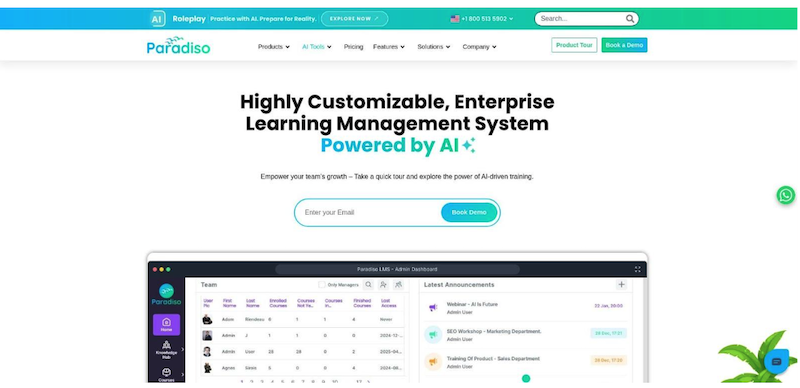
That speed matters when a chemical-handling procedure changes overnight. Instead of emailing PDFs to local HR teams and hoping nothing is lost in translation, you update once and let Paradiso push spotless local versions to every site.
The platform also blends formal learning with informal snippets. Gamified badges, discussion walls, and a built-in course marketplace keep attention high, yet you still track completions in audit-ready reports. Many plants rely on the competency-matrix view to see which sites lag on a specific skill and queue refresher paths automatically.
Paradiso runs only in the cloud and connects with major ERP and MES tools; however, setup sometimes needs vendor assistance, especially when you piece together single sign-on across regions. Pricing lands mid-pack: you pay per active learner plus an optional support tier that scales cleanly for seasonal spikes.
If language fragmentation slows your training program, Paradiso gives every operator lessons in words that feel familiar.
6. ComplianceQuest: when quality events trigger training in real time
Most LMS platforms track learning, and quality systems track defects. ComplianceQuest unites the two so that a single non-conformance automatically launches the refresher course that prevents a repeat.
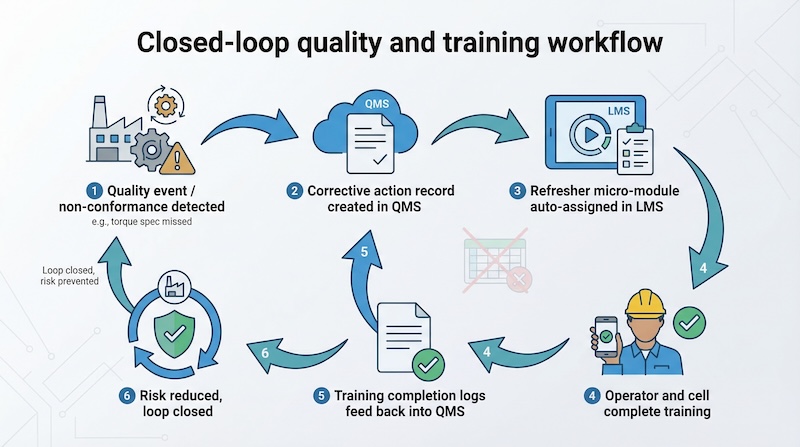
Picture a medical-device line where a torque spec is missed. The moment a corrective-action record hits Salesforce (ComplianceQuest’s foundation), the operator and the entire cell receive a micro-module on proper torque validation. Completion logs feed back into the corrective file, closing the loop without spreadsheets or manual reminders.
Beyond reactive triggers, ComplianceQuest acts as a central document vault. Engineers upload a revised work instruction, and the LMS notifies affected roles, assigns quizzes, and escalates if someone misses the deadline. Dashboards let quality managers sort by plant, line, or supplier to spot systemic skill gaps.
The trade-off is style and price. The interface feels more QMS than modern learning app, and pricing follows a contact-sales model that suits regulated enterprises better than small job shops. For factories where FDA, IATF, or ISO audits decide contracts, the built-in link between quality and learning can outweigh the higher fee.
7. Axonify: bite-sized drills that stick between machine cycles
Axonify was built for employees who grab phones in ninety-second bursts, not desk staff watching hour-long webinars. Its algorithm tracks what each operator knows, then serves a three-question micro-quiz every shift to shore up weak spots. A 2024 study by Axonify reports up to 91 percent knowledge gains for manufacturing frontline teams using this approach.
Because each lesson takes only seconds, you can trigger training from real events. If a sensor flags an abnormal temperature spike on a reflow oven, Axonify can push an instant refresher on thermal safety to that line. The platform already connects with common IoT and MES feeds, so learning becomes part of the response plan instead of an after-action memo.
Offline support checks another box. Operators download daily drills to a rugged tablet, complete them in a dead-zone warehouse corner, then sync results once Wi-Fi returns. Progress rolls into live leaderboards that spark friendly competition across shifts.
Pricing is per active learner, so plants pay only for people who answer questions that month. The trade-off is depth: Axonify excels at reinforcement, not full certification, so most clients pair it with a traditional LMS for long-form courses.
No other tool on this list makes safety reminders as quick or as sticky, which secures Axonify a firm spot in the manufacturing toolbox.
Comparison at a glance
You have met the seven contenders individually. Now see them side by side so you can spot key gaps without rereading every paragraph.
| Platform | Stand-out strength |
Compliance | Offline mobile |
IoT / ERP hooks |
Lang | Pricing |
|---|---|---|---|---|---|---|
| GoSkills | Fast deployment for SMEs |
✔ | ✔ | △ SCORM / xAPI | 14+ | Per learner, freemium |
| 360Learning | Peer-created content loops |
✔ | ✔ | △ API | 20+ | Per user, tiered |
| Docebo | AI & multi-portal scale |
✔✔ | ✔ | ✔ | 40+ | Quote-based |
| SAP Litmos | Audit-ready course packs |
✔✔ | ✔ | △ SAP | 28+ | Annual min |
| Paradiso | Built-in translation |
✔ | ✔ | △ | 30+ | Active learner |
| Compliance Quest | QMS auto- training |
✔✔ | △ web | ✔ Salesforce | 15+ | Quote only |
| Axonify | Micro- reinforcement |
△ LMS | ✔ | ✔ events | 20+ | Per active |
Legend for table above: ✔✔ best in class, ✔ solid, △ limited or integration required.
The table confirms what the deep dives showed. If certification rigor tops your list, Docebo or Litmos lead. Need real-time QMS loops? ComplianceQuest is the front-runner. Looking for multilingual frontline reach? Paradiso offers large-scale translation, while Axonify delivers short, daily drills.
Use this grid as a filter. Cross out columns that do not matter to your plant, circle the ones that keep you up at night, and your shortlist will surface quickly.
Buyer’s checklist: five steps to pick your perfect fit
Step 1. Define the outcome, not the feature
If your top pain point is failed OSHA audits, weight compliance automation highest. If unplanned downtime stems from tribal knowledge, rank peer authoring or microlearning first. Anchor every vendor demo to that problem.
Step 2. Map connectivity
List the systems that already own your plant data, such as MES, ERP, and badge readers. The right LMS plugs straight in or exposes an open API you can script. Anything less means manual CSV purgatory.
Step 3. Stress-test mobile reality
Borrow a line operator’s phone, kill the signal in a concrete stairwell, and run a sample course. If progress disappears, move on. Offline sync is table stakes for factories.
Step 4. Scrub the price
Ask for a full-year quote covering licenses, implementation, and projected growth. Then model low-season headcount and surprise overtime shifts. Usage-based pricing often beats seat-based in volatile plants.
Step 5. Test support when it hurts
Open a ticket during the vendor trial, preferably on a weekend. The response speed you see now is the speed you will get when a certificate expires ten minutes before a customer audit.
Follow these five passes, and the shortlist from the comparison table will narrow to one platform that fits your plant.
What’s next: five trends reshaping factory learning
AI-generated SOP videos in minutes
Early pilots already let engineers film a machine setup once, then watch AI slice the footage into chaptered lessons, transcribe text, and translate captions. Mid-market LMS vendors plan to add this natively by 2027.
AR overlays on the line
Lightweight headsets now project torque specs, part numbers, or hazard alerts while operators work hands-free. Embedding training inside real production steps cuts error rates without removing staff from the line.
IoT-triggered micro-learning
Sensors know when a press cycles outside tolerance. The next logical step is an instant lesson that reminds operators of the checklist that stops the drift. Platforms such as Axonify and ComplianceQuest already support event-based pushes; wider adoption will make “just-in-time training” literal.
Skills passports for mobility
As labor pools tighten, plants will share standardized digital badges that prove a welder’s competency across companies. Several LMS providers are testing blockchain-backed credential layers so talent can move where demand peaks.
Data-driven upskilling roadmaps
Advanced analytics already flag knowledge gaps. Soon, systems will simulate production goals, predict which skills unlock them, and auto-build learning paths tied to return-on-investment metrics the CFO trusts.
Conclusion
Manufacturers face a dual challenge: filling critical skill gaps while keeping their people safe and compliant. The seven platforms above tackle that challenge from different angles – rapid deployment, social learning, enterprise-grade compliance, real-time quality loops, and bite-sized reinforcement. Match their strengths to your plant’s priorities, and you will turn training from a checkbox exercise into a driver of uptime, safety, and growth.
