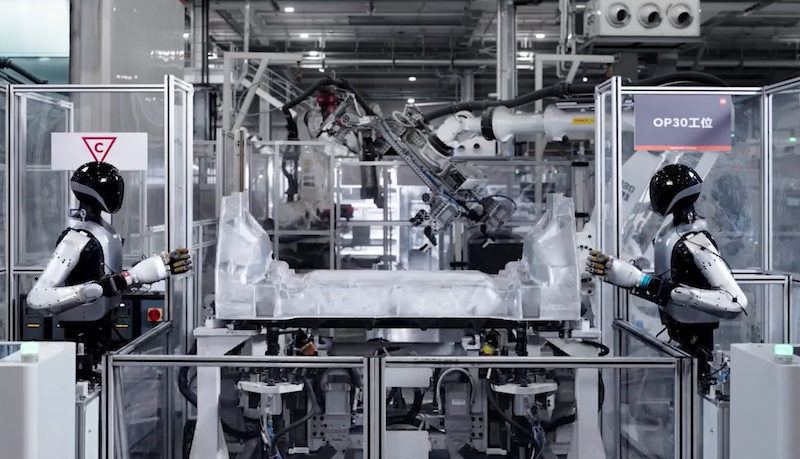
Chinese technology giant Xiaomi – best known globally as one of the world’s largest smartphone makers – is testing humanoid robots in its electric vehicle manufacturing operations, according to a company blog post describing early experiments in a factory environment.
The company says two humanoid robots have been deployed in an automotive assembly workstation where they carried out a repetitive fastening task for several hours.
Xiaomi, which built its reputation in consumer electronics including smartphones, tablets and smart home devices, has recently expanded aggressively into new technologies. In 2024 the company launched its first electric vehicle, the SU7 sedan, marking its entry into the highly competitive EV market.
The latest experiment suggests Xiaomi is also exploring robotics – particularly humanoid robots – as a potential automation technology for future manufacturing.
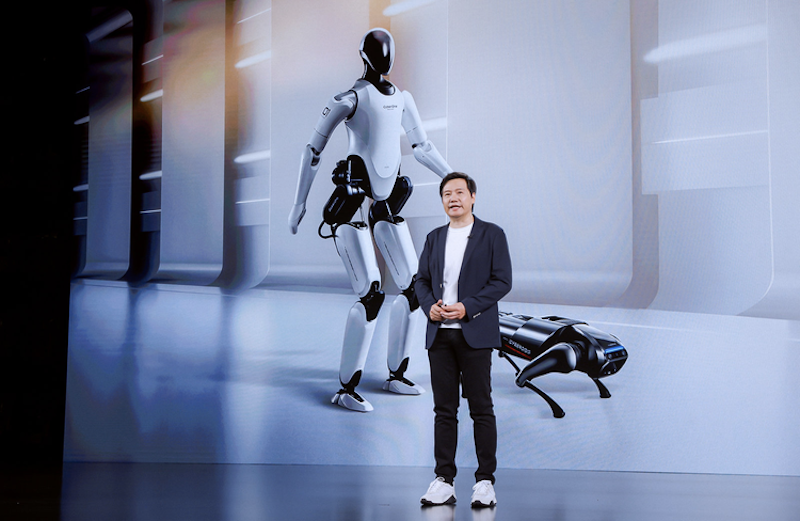
Xiaomi previously unveiled its CyberOne humanoid robot (pictured on screen below), and the company appears to be using related technologies as it experiments with humanoids in its EV factory.
Humanoid robots tested on automotive assembly task
In the experiment described by Xiaomi, the robots were assigned to install self-tapping nuts used in automotive components.
The system reportedly achieved a 90.2 percent success rate during three hours of continuous autonomous operation, while also meeting the production line’s 76-second cycle time requirement.
According to the company, the robots picked self-tapping nuts from an automated feeder and placed them into a tightening fixture before the assembly station completed the fastening process automatically.
The task may sound simple, but Xiaomi says the mechanical details of the component make it challenging for robots.
The inner spline structure of the nut, variations in how it is gripped, and magnetic attraction from the positioning pin can all disrupt alignment and cause installation failures.
As the company explains, factories require “precise and reliable movements, with production cycles accurate to the second”, which presents a major gap between robotics experiments conducted in laboratories and real-world manufacturing.
“In the lab, thousands of failed iterations can be conducted,” the company writes. “Factories demand precise and reliable movements.”
AI models and tactile sensing used for robot control
Xiaomi says the robots rely on several internally developed AI technologies.
These include Xiaomi-Robotics-0, a large vision-language-action (VLA) model designed to enable robots to interpret visual information and execute physical tasks.
Another system, called TacRefineNet, provides haptic perception, allowing the robots to use tactile feedback during manipulation tasks.
The company says the system uses a data-driven, end-to-end control approach combined with reinforcement learning to improve reliability in industrial environments.
The robot also uses multimodal perception, integrating information from cameras, tactile sensors, and joint motion sensors.
Relying on visual perception alone can be unreliable in factory environments due to lighting changes or occlusion, Xiaomi says, while tactile sensing alone can be affected by unexpected contact with surrounding equipment.
By combining both, the robot can better judge the state of the assembly process.

Balancing stability and adaptability
For full-body control of the humanoid platform, Xiaomi says it combines classical optimization control methods with reinforcement learning.
The optimization system ensures stability and safety constraints, while the reinforcement learning controller has been trained using simulations involving millions of disturbances to help the robot maintain balance in unexpected situations.
This hybrid control system allows the robots to respond to disturbances while maintaining stable operation.
Early-stage experiments
Xiaomi describes the nut-installation task as the first step in testing humanoid robots for automotive manufacturing, but acknowledges that significant challenges remain.
The key hurdle for wider deployment is achieving industrial-grade reliability and productivity – specifically improving production cycle time and yield rate.
The company says additional pilot experiments are under way in other factory stations, including:
- a front logo installation workstation
- a toilet bin handling workstation
Further updates on these deployments are expected later.

Growing interest in humanoid robots for manufacturing
Humanoid robots have attracted increasing attention in recent years as companies explore whether human-like machines could perform complex tasks in factories, warehouses, and logistics operations.
Several technology companies – including Tesla, Figure AI, and Chinese robotics startups – are developing humanoid platforms aimed at industrial use.
Xiaomi’s factory trial suggests the company may also be exploring how humanoid robots could eventually assist in its own manufacturing operations as it expands beyond smartphones into vehicles and other advanced technologies.
Xiaomi launched its first production EV, the SU7 sedan, in 2024 and has since expanded its automotive ambitions – even unveiling a futuristic Vision Gran Turismo electric hypercar concept (pictured above) – although it is unclear which vehicle was being assembled in the factory where the humanoid robots were tested.
