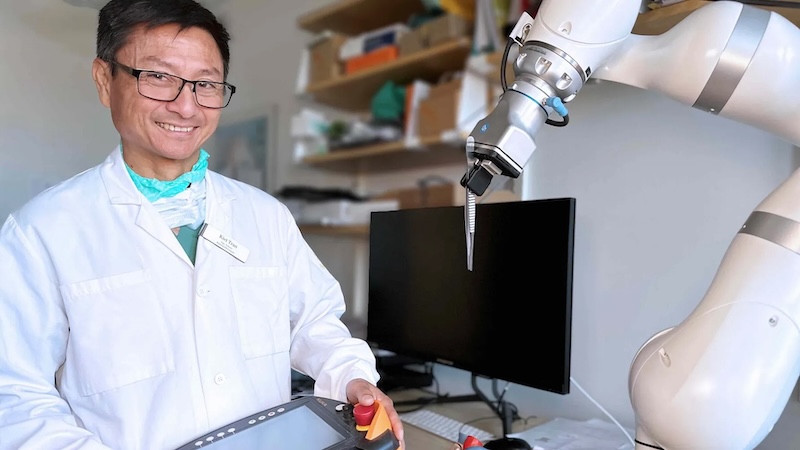
Cognibotics is contributing its motion software to the Vinnova-funded CAISA (Collaborative Artificial Intelligent Surgical Assistant) project as it enters the demonstrator phase.
In CAISA, Cognibotics provides the motion layer between AI-based perception and path planning modules.
In contrast to using the standard robot controller, Cognibotics solution enables the robot to be commanded in different ways as AI and planning modules require – supporting consistent, maintainable, yet dynamic instrument handling in a non-clinical paediatric heart surgery research testbed.
From surgical data to motion demonstrator
CAISA is a collaboration between Region Skåne (Paediatric Heart Centre at Skåne University Hospital), Lund University, Cognibotics and Cobotic. The project is funded by Vinnova with SEK 10 million (approximately $1.1 million) and runs from September 2024 to August 2027.
In the initial phase, several key building blocks have been put in place:
1. Large-scale surgical video dataset for model development
The Paediatric Heart Centre has collected a surgical video database of more than 3,000 hours. This data is used to train AI models that recognise and estimate the pose of instruments, hands, and cardiac anatomy.
2. Full-scale testbed for validation
On the hospital campus, an innovation and testbed facility of approximately 350 m² includes a full operating room environment, with the possibility to work with donated bodies for research. This provides a controlled setting for evaluating robotics and safety functions before any clinical deployment is considered.
3. Clear requirement for a demonstrator
In the Vinnova project description, the creation, testing, and validation of a demonstrator in this dedicated test environment is an explicit goal. The project is now entering this demonstrator phase.
Cognibotics: Motion-control layer for an AI-guided assistant
Within CAISA, Cognibotics focuses on the motion layer that connects multiple “ways of commanding” the robot. Cognibotics provides a unified motion interface where perception, planning, and application logic can drive motion in a consistent, predictable way in the testbed environment.
By bringing experience from high-precision industrial robots into the surgical research context, Cognibotics contributes methods for:
- model-based motion control with attention to environment constraints;
- fine-grained positioning in a confined workspace around the patient; and
- motion behaviours that can support safe, repeatable interactions between human surgeon, instruments and robot.
Phan-Kiet Tran, senior consultant in paediatric heart surgery at Skåne University Hospital and associate professor at Lund University, says: “In CAISA we are combining world-class paediatric heart surgery, advanced AI and Cognibotics’ expertise in motion control.
“The robot must not only ‘understand’ the situation, it also has to move instruments in a way that feels natural, safe and repeatable for the whole team. Cognibotics provides that industrial-grade motion layer, which is essential if an AI assistant is to be used in real operating rooms.”
From industry to future surgical applications
Cognibotics’ motion technology is already used in demanding industrial settings such as high-speed warehouse robots and precision machining. CAISA extends that expertise into the medical research domain, exploring how a similar motion-control foundation can support future AI-guided surgical assistants.
The demonstrator developed in CAISA is strictly a research platform in a non-clinical environment. However, the project aims to build the technical and clinical understanding needed for future systems where AI, surgeons and robots work together more safely and efficiently.
