Robotic intelligence is advancing at an extraordinary pace, with perception and autonomy improving by the day. But as robotics grows into the next global ecosystem, one constraint continues to hold the entire field back: how robot bodies are manufactured.
Today, most advanced robots are still built through slow, often manual assembly of hundreds of precision parts. This makes them expensive to produce, hard to customize for diverse use cases, and difficult to scale.
Allonic believes this manufacturing bottleneck is now the defining limit on what robotics can become.
Founded in Hungary, with a joint US HQ, Allonic is building a new manufacturing platform designed to remove that constraint entirely.
The company has raised $7.2 million in pre-seed funding, led by Visionaries Club and with backing from Day One Capital, to industrialize a fundamentally new way of producing complex, dexterous robotic bodies.
The round is the largest pre-seed financing completed in Hungary to date.
Rebuilding robotics from the manufacturing layer up
While AI breakthroughs have transformed how robots operate, their physical construction has changed little from industrial-era conventions. Robotic hands, arms and manipulators are still put together piece by piece, relying on bearings, screws, cables, and delicate joints that are costly to manufacture and tedious to assemble.
As functional demands increase, so does mechanical complexity – building and scaling the right bodies that combine dexterity, robustness and human-safety is the next defining problem the industry must tackle.
Allonic is attacking this challenge at the manufacturing infrastructure layer itself. Its proprietary production process, known as 3D Tissue Braiding, replaces manual assembly with a fully automated, scalable manufacturing system.
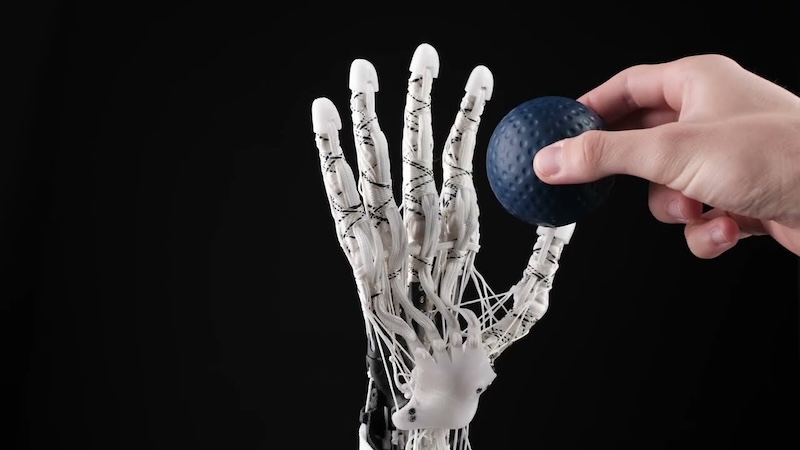
Inspired by how ropes achieve strength through structure rather than rigid parts, Allonic 3D-weaves tailored robotic “tissues” directly over a skeletal core.
Instead of assembling hundreds of individual parts, Allonic’s tendons, joints and load-bearing soft tissues are formed together in one continuous process.
A robotic finger, for example, can be built from a small number of bone-like elements, held together by hundreds of fine fibres that wrap around and anchor into the structure itself, similar to connective tissue in the human body.
This removes the need for bulky fixtures, and eliminates many of the traditional failure points in robotic hardware.
The result is robotic bodies that are strong, compliant, naturally safe, and dramatically simpler to manufacture. Allonic is the only company in the world automating the production of robotics in this way.
From digital design to robotic bodies, automatically
Allonic’s platform combines proprietary hardware and software that allows users to configure high-level robotic designs and translate them automatically into production code, in a process similar to slicing in 3D printing.
Multiple materials can be integrated into a single structure, enabling elastics, wiring and sensing elements to be embedded directly into robotic bodies during production.
Advanced robotic components, or complete limbs, can be manufactured directly from digital designs without managing complex supply chains or distributed fabrication and assembly processes.
By collapsing mechanical complexity into automated production, Allonic’s platform dramatically reduces both the capital and specialist expertise required to build and scale advanced robotic hardware. What once took weeks and thousands of dollars can now be produced in minutes, at a fraction of the cost.
This unlocks a new operating model for manufacturers, startups and researchers: Manipulators can be designed, produced and replaced on demand, reducing downtime and eliminating lengthy maintenance cycles.
At Allonic’s production speed and costs, robotic end effectors can be swapped as easily as disposable gloves, making customized hardware economically viable for the first time.
Unlocking a new class of robots
Since revealing its technology in May 2025, Allonic has already completed its first pilot project in electronics manufacturing, targeting tasks where traditional industrial robots lack the required versatility, but fully generalized robotic platforms are still impractical or prohibitively expensive, particularly at scale.
The company is also seeing strong inbound interest from the humanoid robotics sector and large consumer technology companies – including several “Big Tech” players in the US – which reflects a broader industry recognition that enabling and scaling complex hardware is the next frontier in robotics.
Benedek Tasi, co-founder and CEO of Allonic, says: “A lot of attention is on intelligence and software, but hardware still holds many of the hardest problems.
“The trade-offs between durability and softness, dexterity and strength have always been dictated by the limits of manufacturing.
“We are removing those constraints and building a platform that allows robotics teams to design, build and iterate freely, without hardware cost or complexity holding them back.”
Tasi adds: “Being able to go from idea to physical robot in minutes instead of weeks fundamentally changes how we can think about robotics design. Once that barrier disappears, entirely new classes of robots become possible.”
Building the infrastructure behind the robotics boom
Allonic has already assembled a fast-growing team of 15 world-class engineers, spanning robotics, materials science, and computational software, disciplines rarely combined within a single company.
The pre-seed round was led by Visionaries Club, with participation from Day One Capital, Prototype, SDAC Ventures and TinyVC.
The round also includes more than a dozen angel investors from leading US and European tech companies including OpenAI and Hugging Face, as well as top research institutions such as ETH Zurich and Northwestern University.
Marton Sarkadi Nagy, partner at Visionaries Club, says: “Robotics has reached a tipping point. The gap between sophisticated, AI-driven software and slow hardware manufacturing is now a limiting factor for the entire industry.
“Allonic is the first company I’ve seen to address this problem at the infrastructure layer. By rethinking how robotic bodies are built from scratch, they open the door to faster iteration, lower costs, and robots that will finally be able to move beyond narrow industrial use cases.”
The newly raised capital will be used to accelerate the development of Allonic’s 3D Tissue Braiding platform, expand its engineering and operations teams, and support further pilots and early commercial deployments with industrial partners.
