Neura Robotics, a developer of cognitive robotics and physical AI, has agreed a partnership with Drees & Sommer, an international consulting firm for construction and infrastructure.
Together, the two companies aim not only to plan and operate buildings, but also to design them as learning, interactive systems and as environments that work together with humans and robots in real time.
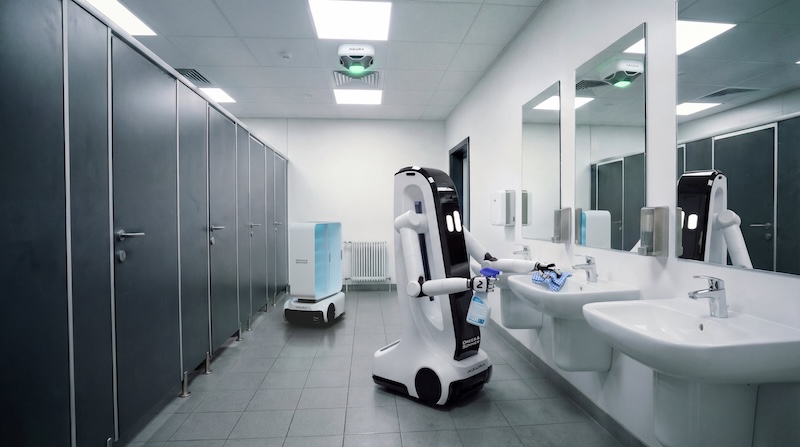
Initially, the companies will focus on solutions for sanitary facilities, an area in which the need for automation, hygiene and availability is particularly acute.
The cooperation reflects a new understanding of architecture and technology: Buildings are becoming adaptive, processes are becoming increasingly automated, safer and more efficient, and robotics integration has been factored in from the outset.
Dierk Mutschler, member of the executive board at Drees & Sommer, says: “We are connecting the physical and the digital worlds, thus creating the conditions for robots to interact better with their environment and with humans in the future.
“This opens up new possibilities for use in nursing and care facilities, production, office buildings and airports.”
Smart buildings need smart actors
David Reger, CEO of Neura Robotics, says: “Very soon, robots will not only be tools, but will be fully accepted as intelligent companions in our buildings.
“They will be networked, self-learning and autonomous, and will clean, service and maintain in precisely those areas in which there is currently a shortage of skilled workers.
“This will create environments that considerably reduce people’s workloads. Robots save time, enhance safety and allow us to concentrate on what really matters.”
Sanitary facilities have been deliberately chosen as the starting point for the joint venture as it is in this area that high usage, hygiene requirements and the shortage of qualified staff make the need most acute.
Cognitive robots can detect contamination, respond to situational requirements, refill consumables and report technical anomalies before failures occur, resulting in more reliable processes, greater cleanliness and enhanced safety in everyday life.
The building as a digital nervous system
At the heart of the collaboration is the concept of the Sensorized Environment: Light, motion, temperature, sounds and other signals are recorded and analyzed in real time and utilized to improve interaction between people, space and robotics.
This creates a ‘digital nervous system’ for the building that allows robots not only to operate within the building, but also to work with it.
“Our robots see, hear and feel, and make decisions independently. They think for themselves instead of simply performing work,” says Reger.
Drees & Sommer is contributing its expertise in the fields of planning, sensor technology, digital twins and IT/OT networks. Neura Robotics will provide cognitive robotics, AI fundamentals and interface expertise.
The result is buildings that not only function efficiently, but also learn, interact and adapt. This represents a new dimension of modern infrastructure.
Veit Thurm, the Drees & Sommer partner responsible for the cooperation, says: “We are no longer talking just about building services equipment, but about cognitive infrastructure.
“Buildings sense their environment, interpret situations and interact with robots, securely, scalably, and with increasing autonomy.”
Main image: Digital assistants in everyday life. Cognitive robots support people in areas where staff are in short supply. © Neura Robotics
