The glass industry is entering a new era of digital precision as a result of an EU-funded DiMAT project, which is helping companies like Hegla-Hanic transform complex production processes into more sustainable operations efficiently driven by data.
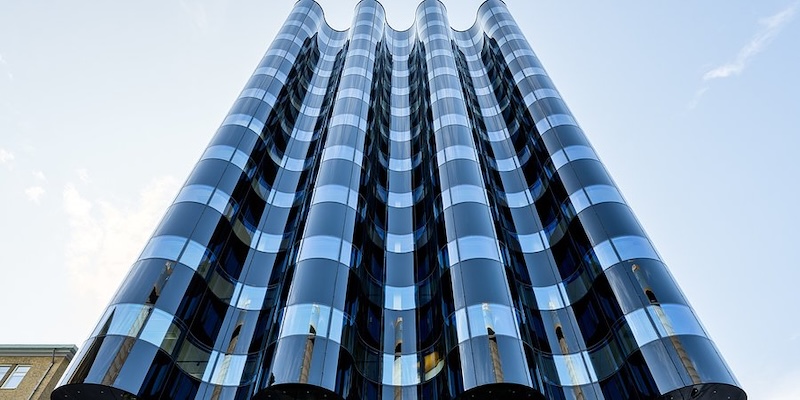
As demand grows for spectacular glass façades and free-formed 3D designs in modern architecture, like the Vaghuset Business Centre in Gothenburg, Sweden, for example, manufacturers face increasing pressure to deliver ever more complex, high-performance glass products.
Hegla-Hanic, part of the Hegla Group based in Beverungen, Germany, is a leader in ERP and MES software for glass manufacturing, and is collaborating with Fraunhofer IMW in the DiMAT project to bring cutting-edge digital tools into the glass forming process.
Their joint efforts that are currently being piloted focus on laser bending, a pioneering manufacturing approach that combines precise cutting, controlled heating and tight dimensional tolerances.
By applying DiMAT’s digital modelling and optimisation suite, Hegla-Hanic is able to capture, analyse and visualise data from intelligent machinery, enabling engineers to predict issues before they arise and fine-tune parameters in real time, while continuously improving this process based on production feedback.
“Digitalisation is the key to unlocking both performance and sustainability in glass manufacturing,” said Milosz Majewski, project lead at Hegla-Hanic.
“With DiMAT, we can connect data directly from machines to our ERP and MES systems, refine production parameters and understand exactly how small changes impact final product quality. This helps us improve efficiency while cutting waste and energy use.”
Currently, Hegla-Hanic and DiMAT are working to ensure seamless interoperability with existing industrial software platforms. The result will be a data-driven, continuously learning production environment where every decision is backed by evidence.
This will be a major step forward in quality assurance for the production of ever-more complex glass structures, while also supporting new jobs through better training.
The DiMAT tools also show advances beyond glass bending. Processes like tempering, essential for producing safety glass, require careful control of heat and cooling parameters.
By establishing correlations between process conditions and glass properties such as flatness or strength, DiMAT enables manufacturers to maintain compliance with industry standards while innovating faster.
“This is about turning complexity into clarity,” said Majewski. “DiMAT helps us see how every variable interacts, so we can design stronger and safer,glass in a morer sustainable way.”
As the glass sector faces increasing demand for energy efficiency, safety and circularity, digital tools like DiMAT provide the intelligence to achieve all three.
Through advanced data modelling and simulation, the platform helps companies shorten development cycles, reduce material use and enhance environmental performance, turning sustainability into a competitive advantage.
