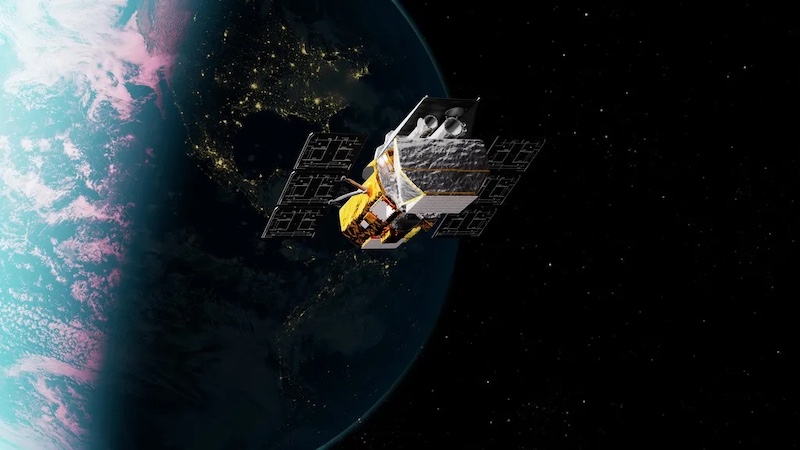
Up in the quiet darkness of low Earth orbit, a satellite known as the “Neil Gehrels Swift Observatory” is fighting a losing battle. Launched in 2004 to chase down the universe’s most violent fireworks – gamma-ray bursts – Swift has faithfully delivered two decades of science.
But now, with its orbit eroding under the subtle drag of Earth’s upper atmosphere, the spacecraft may not survive until its intended twilight. So, NASA has turned to a bold new approach: rescuing a satellite that was never built to be rescued.
However, something has to be done, according to people overseeing the project. Swift is described as “a $500 million space telescope” which is currently at risk of uncontrolled deorbit by late 2026, so the $30 million NASA is spending to rescue it not only seems reasonable, it’s also forward-thinking because new technologies and techniques may emerge for saving other defunct satellites that float around the Earth as debris could either be fixed or disposed of safely.
Shawn Domagal-Goldman, acting director, Astrophysics Division, NASA headquarters in Washington, says: “Given how quickly Swift’s orbit is decaying, we are in a race against the clock, but by leveraging commercial technologies that are already in development, we are meeting this challenge head-on.
“This is a forward-leaning, risk-tolerant approach for NASA. But attempting an orbit boost is both more affordable than replacing Swift’s capabilities with a new mission, and beneficial to the nation – expanding the use of satellite servicing to a new and broader class of spacecraft.”
The threat from above
Orbiting more than 350 km above Earth, Swift has no fuel, no propulsion system, and no docking ports. Over time, solar cycles and increased atmospheric density have accelerated its orbital decay. According to NASA, what might once have been a decades-long decline may now contract into mere years.
In colloquial terms: the telescope is inching downward, and unless something intervenes, it could reenter the atmosphere and burn up. Katalyst Space estimates a 50 percent chance of uncontrolled reentry by mid-2026, rising to 90 percent by year’s end.
That’s when an extraordinary idea began to crystallize: what if, instead of letting Swift die, we send up a robotic savior?
From concept to contract
Earlier this year, NASA issued a call for proposals to explore whether spacecraft servicing – already a tantalizing dream of space engineers – can be more than just theory.
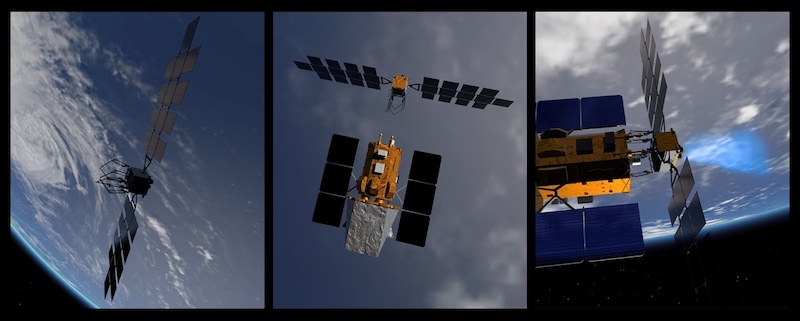
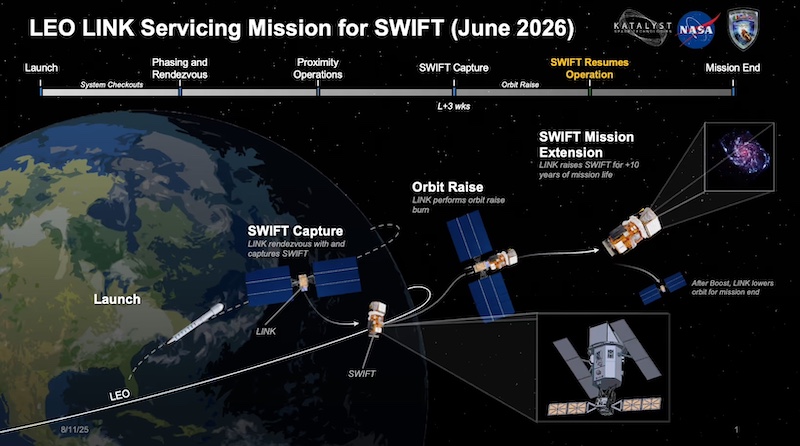
Katalyst Space Technologies, a young company based in Arizona, answered with a plan: build a robotic servicer that can rendezvous with Swift, grapple it (despite its lack of docking hardware), and push it into a safer orbit.
In September 2025, NASA formalized the idea with a contract valued at about $30 million to Katalyst. The timeline is aggressive: the mission is targeted for launch in the spring or early summer of 2026. If all goes well, the mission would mark a first: a commercial robotic spacecraft docking with an unprepared NASA satellite that was never built for servicing.
Ghonhee Lee, CEO of Katalyst, says: “This is about saving a world-class science asset while proving the United States can execute rapid, on-orbit response. We’re demonstrating that when the need arises, we can go from identifying the problem to executing a robotic docking mission in less than a year.”
The complex problem of capture
For missions like Hubble, astronauts (and the Space Shuttle) carried the tools and dexterity to perform repairs or install upgrades. Swift was not built for that. It has no rigid “grapple point,” no external handles, and wasn’t designed with servicing in mind.
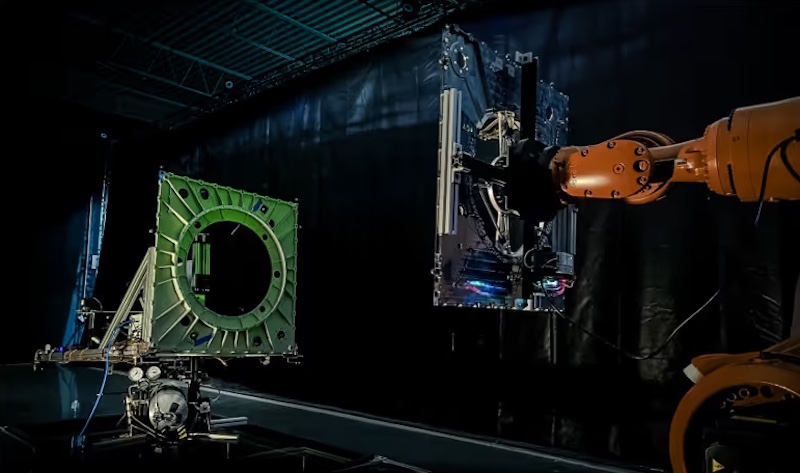
Katalyst’s robotics team plans to exploit the fact that Swift still retains structural features used during launch – small flanges or rims – originally intended for prelaunch handling and alignment.
The servicer will be equipped with robotic arms or capture mechanisms custom-tailored to pinch or grasp those elements, then apply thrust to push Swift outward.
But that raises a host of challenges: how to align precisely, how to approach without perturbing delicate instruments, how to ensure the grip is strong enough without causing structural damage, and how to choreograph the orbit-raising maneuver itself. Any misstep could destabilize the telescope – or worse, spin it into oblivion.
Katalyst is also leveraging this mission to demonstrate broader capabilities known as “tactically responsive space” (TacRS) and “sustained space maneuvering” (SSM) – concepts that underpin strategic and defense uses of space. As the company notes, success here could pave the way for routine servicing of both scientific and national security satellites.
Stakes, risks, and rewards
Why go to such trouble? Because Swift is more than just a fading relic; it’s a scientific workhorse. Over its lifetime it has enabled breakthroughs in gamma-ray astronomy, alerted telescopes across the world to cosmic explosions, and served as a vital tool in multi-messenger astronomy. Its loss would create a gap that might take years or more to fill.
Moreover, the mission is a testbed – a proof of concept that could shift how we think about spacecraft. Rather than designing every satellite to be “end-of-life disposable,” we may increasingly design systems with serviceability in mind—or even retrofit older ones to be rescued later.
Still, the mission is high risk. The snake in the grass isn’t a dramatic failure but the accumulation of micro-errors: slight misalignments, unmodeled flexibility in structures, or unexpected torques.
If the capture fails, or if the servicer misapplies thrust, Swift could tumble or be lost entirely. Skeptics already point out that the schedule is ambitious and the technical difficulties steep.
Yet NASA and Katalyst clearly see this as a turning point. By moving fast, embracing commercial partnerships, and tackling complexity head-on, they hope to demonstrate responsiveness in space that was once the domain of science fiction.
Race against time and gravity
If all goes to plan, by mid-2026 an automated robotic spacecraft will close in on the venerable Swift, grip its flank, and fire its engines – nudging it upward, revitalizing its orbit, and buying years more of scientific time. It’s a race against time and gravity.
And in the process, NASA and Katalyst may awaken a new paradigm: satellites not as single-use platforms, but as rescueable, upgradeable assets. In a future where space is crowded and stakes are high, that may be exactly the kind of flexibility the industry will need.
As Nicky Fox, associate administrator, Science Mission Directorate, NASA headquarters, explains: “This industry collaboration to boost Swift’s orbit is just one of many ways NASA works for the nation every day.
“By moving quickly to pursue innovative commercial solutions, we’re further developing the space industry and strengthening American space leadership.
“This daring mission also will demonstrate our ability to go from concept to implementation in less than a year – a rapid-response capability important for our future in space as we send humans back to the Moon under the Artemis campaign, to Mars, and beyond.”
Main image: Artist’s illustration of NASA’s Neil Gehrels Swift Observatory as it orbits Earth. Credit: NASA’s Goddard Space Flight Center Conceptual Image Lab.
