• Skip to primary navigation
  • Skip to main content
  • Skip to primary sidebar
  • Skip to secondary sidebar
  • About
    • Contact
    • Privacy
    • Terms of use
  • Shop
    • Cart
    • Checkout
    • My Account
  • Advertise
    • Advertising
      • Buy ad space
    • Case studies
    • Design
    • Email marketing
    • Features list
    • Lead generation
    • Magazine
    • Press releases
    • Publishing
    • Sponsor an article
    • Webcasting
    • Webinars
    • White papers
    • Writing
  • Subscribe to Newsletter

Robotics & Automation News

Where Innovation Meets Imagination

  • Home
  • News
  • Features
  • Editorial Sections A-Z
    • Agriculture
    • Aircraft
    • Artificial Intelligence
    • Automation
    • Autonomous Vehicles
    • Business
    • Computing
    • Construction
    • Culture
    • Design
    • Drones
    • Economy
    • Energy
    • Engineering
    • Environment
    • Health
    • Humanoids
    • Industrial robots
    • Industry
    • Infrastructure
    • Investments
    • Logistics
    • Manufacturing
    • Marine
    • Material handling
    • Materials
    • Mining
    • Promoted
    • Research
    • Robotics
    • Science
    • Sensors
    • Service robots
    • Software
    • Space
    • Technology
    • Transportation
    • Warehouse robots
    • Wearables
  • Press releases
  • Events
bretton atos portrait small

Atos launches quantum computer emulator and associated programming language

July 7, 2017 by Sam Francis

By Abdul Montaqim

A company called Atos has built and released what it claims is the world’s first commercially available quantum computer emulator.

In terms of hardware, it uses Intel chips and what might be considered classical computing technology.

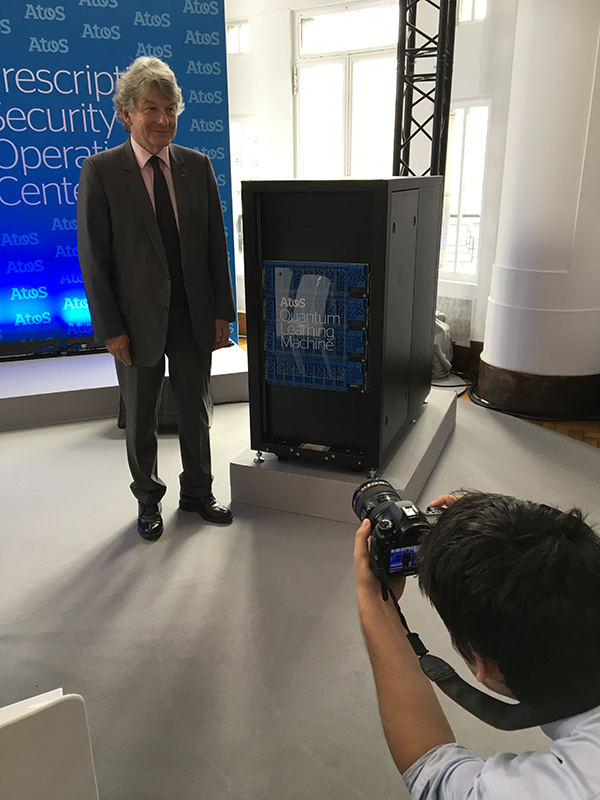
But it’s programmed to simulate a quantum computer. Atos has named it the Quantum Learning Machine, and has even invented a new language for programming it. 

In what some people call “classical” computing, which is all the computers around today, the hardware processes binary digits, or bits, which – like light bulbs – are either in the zero state, which is off, or in the one state, which is on.

Quantum computing uses quantum digits, or qubits. The interesting thing about qubits is that they can be in several states at once – both zero and one at the same time, and many points in-between… simultaneously.

It might be difficult to fathom, but that is the nature of the universe at the quantum scale, apparently. And computer scientists are in a race to utilise these strange quantum phenomena in the building of hardware that is expected to far exceed the computing power of classical computers.

One probably very poor example, or metaphor rather, of the principle of quantum computing is the kitchen which has everything.

Imagine the kitchen – or computer – which has all the ingredients it needs for whatever dish all at the same time. You ask for whatever it is you want for dinner, and it just serves it to you.

A classical computer would have to do the shopping first and then do all the other steps in a methodical, sequential manner to make you whatever it is you want instead of coffee and cigarettes because you’re too starving hungry now.

Maybe quantum computing will lead to the magic microwave oven featured on Star Trek, or even teleportation.

Have a break, have a chit-chat

bernabe atos crop
Pierre Barnabé, chief operating officer, big data and security at Atos

Pierre Barnabé, chief operating officer, big data and security at Atos, says the principles of quantum computing have been known for a long time.

Speaking exclusively to Robotics and Automation News, Barnabé says: “This is a new way of computing that has been known for a long time. Quantum mechanism calculations were designed a long time ago, but now we are in a position to simulate this type of computing, this type of calculation.

“That, of course, offers tremendous accelerations in the way computing is done.

“We are entering the limits of the Moore’s Law, which holds that computing capacity doubles every 18 months or so. We are reaching the physical limits of the atoms, because we are currently at 7 nanometres for the designs of chipsets, and below 2 to 3 nanometres, the circuits are so close that the atoms can jump from one circuit or sector to another on the processor.

“So it’s impossible, physically, to continue in 10 or 15 years with classical circuit designs.

“The breakthrough is to jump into quantum computing solutions, which provide a new type of calculation, a new type of computing, with many states between zero and one.”

Barnabé says 40 qubits has already become a reference for the industry. The machine Atos has built starts at 30 qubits, but can reach 40 qubits or even higher.

“Where our machine is extremely innovative is that we have managed to bring this power of computing within a one-cubic-meter machine.

“It’s the first time in the world you have a machine that size, with that power, reaching 40 qubits of computing simulation.”

Atos is one of the largest information technology services companies in the world, employing around 100,000 people, and has a market capitalisation of almost $15 billion.

Barnabé says the company’s research and development labs all around the world are working to develop applications for the Atos Quantum Learning Machine, as well as develop new programming languages for what is essentially a new computing paradigm.

The plan, says Barnabé, is to be ready when the real, genuine quantum hardware is ready. “We don’t know when that will be.”

He adds that there has been a growing demand from large companies and the industrial sector for computers that can perform millions of “very complex calculations” in realtime.

atos presentation in brussels

Micro-managing the universe at the sub-atomic scale

Atos CEO Thierry Breton says the QLM gives the company an opportunity to gain a crucial advantage in the whole area of quantum computing, the opportunity to invent new computer languages and entirely different ways of programming.

Breton claims the Atos QLM is the “highest-performing quantum simulator in the world”, and reaffirms the company’s ambition to be the industry leader in Europe in the “next major technological evolution”.

He says: “Quantum physics will lead to profound changes notably in cybersecurity, one of the key strategic priorities of businesses today, and we are planning for the impact of these.

“The teams at our Atos Quantum laboratory have made remarkable progress, recognized by an internationally renowned Scientific Council, to provide, today, scientists and engineers from around the world with a simulation environment which enables them to develop quantum algorithms to prepare for the major developments in our industry.”

In a presentation in Brussels, Belgium, at which RoboticsAndAutomationNews.com was present, Breton unveiled what he described as a “turnkey” solution, the industry’s first commercial quantum simulator.

Perhaps even more ambitiously, the company has created a language of its own called aQasm – short for Atos Quantum Assembly Language.

It’s described as a “universal language”, meaning it can enable connectors which carry programs from other quantum simulators, which are yet to be developed.

Moreover, the aQasm language is configurable, says Atos, which has committed to adopting it as the common language for all future developments by the company in the area of quantum computing.

Print Friendly, PDF & Email

Share this:

  • Print (Opens in new window) Print
  • Share on Facebook (Opens in new window) Facebook
  • Share on LinkedIn (Opens in new window) LinkedIn
  • Share on Reddit (Opens in new window) Reddit
  • Share on X (Opens in new window) X
  • Share on Tumblr (Opens in new window) Tumblr
  • Share on Pinterest (Opens in new window) Pinterest
  • Share on WhatsApp (Opens in new window) WhatsApp
  • Share on Telegram (Opens in new window) Telegram

Related stories you might also like…

Filed Under: Computing, News Tagged With: atos, computer, computing, language, quantum

Primary Sidebar

Search this website

Latest articles

  • FORT Robotics extends physical AI safety platform with Nvidia Halos
  • Fieldwork Robotics secures SEED Innovations investment to scale berry harvesting robots
  • Multi-robot demo showcases new UK’s Plymouth subsea test range
  • Tech company AVI-SPL launches autonomous Dallas-Houston freight operations with Volvo Autonomous Solutions
  • RoboDK unveils CAM software that cuts robotic machining deployment time ‘by up to 40 percent’
  • Richtech Robotics launches 24/7 interactive livestream featuring AI robot ADAM
  • Cognibotics selected for €6.5 million in EU accelerator funding
  • CS2 Skin Marketplace Comparison: Which Platform Offers the Best Prices and Security?
  • How Automation is Changing Employee Performance Tracking and Recognition
  • What Can Delay a Car Accident Settlement and How an Attorney Helps

Secondary Sidebar

Latest news

  • FORT Robotics extends physical AI safety platform with Nvidia Halos
  • Fieldwork Robotics secures SEED Innovations investment to scale berry harvesting robots
  • Multi-robot demo showcases new UK’s Plymouth subsea test range
  • Tech company AVI-SPL launches autonomous Dallas-Houston freight operations with Volvo Autonomous Solutions
  • RoboDK unveils CAM software that cuts robotic machining deployment time ‘by up to 40 percent’
  • Richtech Robotics launches 24/7 interactive livestream featuring AI robot ADAM
  • Cognibotics selected for €6.5 million in EU accelerator funding
  • CS2 Skin Marketplace Comparison: Which Platform Offers the Best Prices and Security?
  • How Automation is Changing Employee Performance Tracking and Recognition
  • What Can Delay a Car Accident Settlement and How an Attorney Helps

Copyright © 2026 · News Pro on Genesis Framework · WordPress · Log in

We use cookies on our website to give you the most relevant experience by remembering your preferences and repeat visits. By clicking “Accept”, you consent to the use of ALL the cookies.
Do not sell my personal information.
Cookie SettingsAccept
Manage consent

Privacy Overview

This website uses cookies to improve your experience while you navigate through the website. Out of these, the cookies that are categorized as necessary are stored on your browser as they are essential for the working of basic functionalities of the website. We also use third-party cookies that help us analyze and understand how you use this website. These cookies will be stored in your browser only with your consent. You also have the option to opt-out of these cookies. But opting out of some of these cookies may affect your browsing experience.
Necessary
Always Enabled
Necessary cookies are absolutely essential for the website to function properly. These cookies ensure basic functionalities and security features of the website, anonymously.
CookieDurationDescription
cookielawinfo-checkbox-analytics11 monthsThis cookie is set by GDPR Cookie Consent plugin. The cookie is used to store the user consent for the cookies in the category "Analytics".
cookielawinfo-checkbox-functional11 monthsThe cookie is set by GDPR cookie consent to record the user consent for the cookies in the category "Functional".
cookielawinfo-checkbox-necessary11 monthsThis cookie is set by GDPR Cookie Consent plugin. The cookies is used to store the user consent for the cookies in the category "Necessary".
cookielawinfo-checkbox-others11 monthsThis cookie is set by GDPR Cookie Consent plugin. The cookie is used to store the user consent for the cookies in the category "Other.
cookielawinfo-checkbox-performance11 monthsThis cookie is set by GDPR Cookie Consent plugin. The cookie is used to store the user consent for the cookies in the category "Performance".
viewed_cookie_policy11 monthsThe cookie is set by the GDPR Cookie Consent plugin and is used to store whether or not user has consented to the use of cookies. It does not store any personal data.
Functional
Functional cookies help to perform certain functionalities like sharing the content of the website on social media platforms, collect feedbacks, and other third-party features.
Performance
Performance cookies are used to understand and analyze the key performance indexes of the website which helps in delivering a better user experience for the visitors.
Analytics
Analytical cookies are used to understand how visitors interact with the website. These cookies help provide information on metrics the number of visitors, bounce rate, traffic source, etc.
Advertisement
Advertisement cookies are used to provide visitors with relevant ads and marketing campaigns. These cookies track visitors across websites and collect information to provide customized ads.
Others
Other uncategorized cookies are those that are being analyzed and have not been classified into a category as yet.
SAVE & ACCEPT