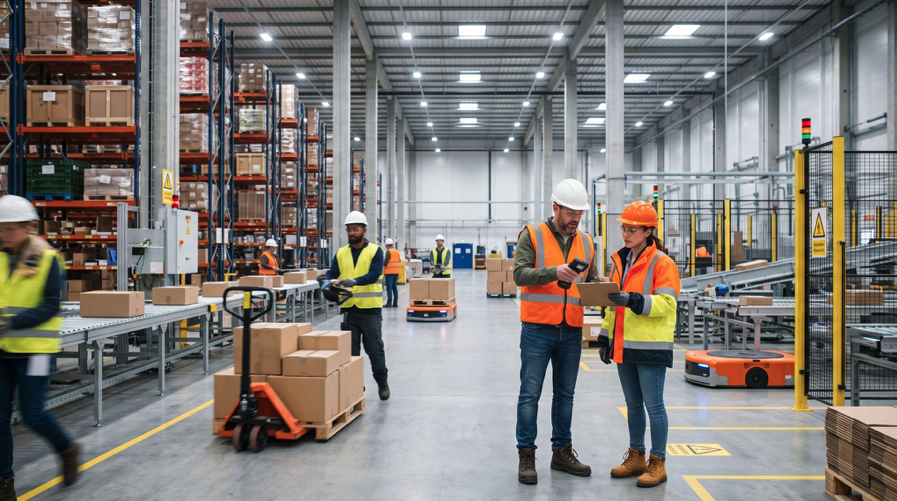
Warehouses have changed faster in the past decade than in the previous fifty years. Automated vehicles, robotic pickers and conveyors now share the floor with people.
Those people still need protecting, and the right high-visibility workwear is central to that. This guide covers the warehouse PPE the job demands. It also shows why automation raises the stakes, not lowers them.
What PPE is required for warehouse work in the UK?
There is no single legal checklist of warehouse PPE in the UK. The right kit comes from a risk assessment of the real tasks and hazards. In practice, most sites need high-visibility clothing, safety footwear and suitable gloves as a baseline.
The law behind this is the Personal Protective Equipment at Work Regulations. Employers must assess the risks and provide suitable PPE free of charge.
Since 6 April 2022, those duties also cover limb (b) workers, meaning casual and agency staff. That matters in warehousing, where agency labour spikes at peak.
Why automation raises the stakes on visibility, not lowers them
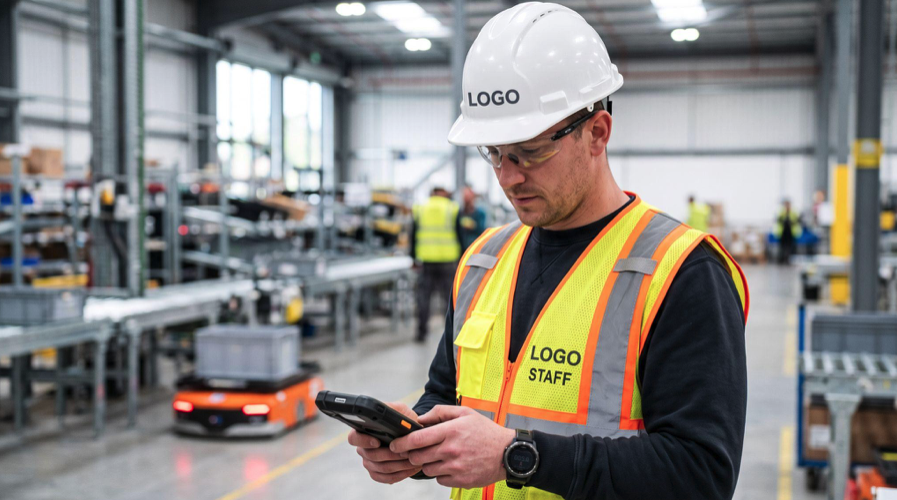
It is tempting to assume automation makes a warehouse safer by removing people. On the floor itself, the opposite is often true. Humans and machines now share the same aisles, and that mix creates fresh risk. A human driver makes eye contact; an automated vehicle only follows its sensors and route.
The national picture is sobering. In 2025/26, HSE provisional figures recorded 24 workers killed after being struck by a moving vehicle. That was the second most common cause of workplace death. Transport and storage alone accounted for 15 worker deaths.
Sharing the aisles with forklifts, AGVs and robots
Modern sites run a mix of manual and automated transport. Forklifts still move constantly, often under time pressure. Alongside them run automated guided vehicles (AGVs) on fixed routes, and autonomous mobile robots (AMRs) that navigate their own path.
These driverless trucks have their own safety standard, BS EN ISO 3691-4. But a standard cannot see a worker who blends into the background.
Keeping people and vehicles apart through layout is the strongest control, as HSE workplace transport guidance makes clear. Marked walkways, barriers and separate doors all reduce contact. Where paths must cross, visibility does the rest. Blind corners and tall racking hide people. Bright clothing helps a driver or sensor register them sooner.
Low light, night shifts and cold storage
Warehouses rarely enjoy bright, even daylight. Many run through dark winter mornings, late evenings, or around the clock under artificial light. Visibility clothing earns its place most in exactly these conditions.
Cold storage adds another problem. Chilled and frozen areas tempt people to pile on extra layers. The danger is covering the certified hi-vis beneath a coat. The visible, reflective layer must always stay on the outside to work.
Hi-vis: the heart of warehouse visibility
High-visibility clothing is the single most important garment in most warehouses. Fluorescent fabric lifts visibility in daylight, while retroreflective tape handles the dark.
In the UK it is governed by EN ISO 20471, which replaced the older EN 471. The standard sets three performance classes, rising with the amount of bright material used.
Matching the hi-vis class to the role, not the habit
Many sites reorder the same hi-vis every year out of habit. A better approach ties the class to the role and zone. Start from traffic routes and vehicle speeds, then match the garment to the people most at risk. A vest may suit a quiet pedestrian zone. A yard marshal near reversing lorries needs the highest visibility available.
Fit and comfort matter too. Hi-vis that is too hot or bulky gets removed or left open. A garment only protects while it is actually worn.
Beyond the vest: the rest of the warehouse PPE picture
Hi-vis is vital, but it is only one part of a warehouse PPE list. A simple plan works from head to toe, matched to the task. The right items depend on what each role actually faces.
Safety footwear is the usual starting point. Dropped stock and wet floors threaten feet, so look for toe protection and reliable slip resistance together.
Hand protection matters more than many assume, with cuts and crush injuries common when handling stock. The right glove balances protection against the dexterity a job needs.
Head, eye and hearing protection depend on the setting. Low beams may justify a bump cap, while cutting or cleaning can call for eye protection. Noisy mechanised lines may need hearing protection after a proper assessment.
Across all of this, durability is the real measure of value. Established names such as Portwest workwear build certified kit for heavy daily use.
A reputable supplier certifies each garment, not just the range. Cheap gear that fails fast costs more over a year. Judging PPE on cost per wear beats the sticker price.
Telling people apart at a glance: branded and role-coded workwear
On a busy automated floor, knowing who is who matters for safety. Branded, colour-coded workwear lets everyone read a role at a glance. A supervisor, a visitor and a contractor can look clearly different. Marshals and first aiders become easy to find in a crowd.
Adding branding to hi-vis needs some care. Logos must not cover the certified reflective area. A good supplier knows exactly where decoration can go. This is where quality branded high-visibility workwear earns its place.
Personalisation is also more accessible than many assume. There is often no minimum order, so even a handful of garments for new starters or visitors is viable. That flexibility suits warehouses that flex their headcount with demand.
A pre-shift visibility and PPE check worth doing
A short, regular check keeps a PPE programme honest. Does the kit people wear still match the current risk assessment? Is every hi-vis garment clean, intact and still clearly reflective? In cold areas, does the bright layer sit on the outside?
Then look at how the kit was bought. Can your supplier certify each garment and proof any branding first? Honest answers reveal where the real gaps are.
Automation will keep reshaping warehouses for years. The machines will get smarter and faster, but people will still share that space. Getting warehouse PPE right is how you keep them safe around the machines.
All images are generated using Gemini AI
