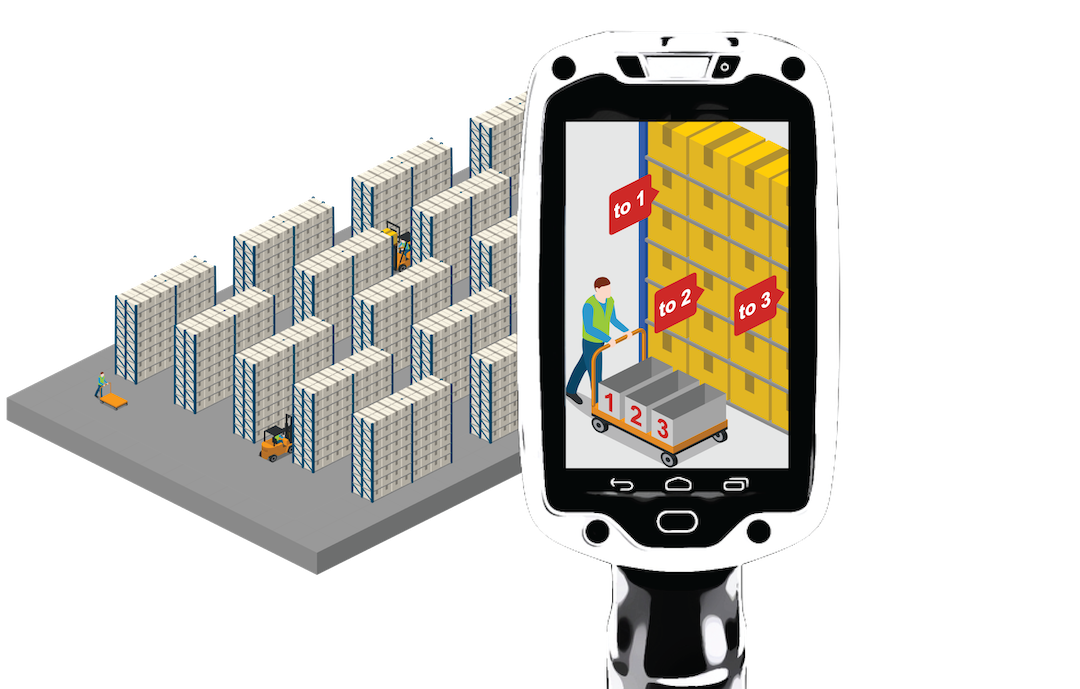
A warehouse manager has robot vendor demos open on one monitor. On the floor below, a picker is working from a paper pick list, checking off lines by hand, and keying confirmations into a terminal in a batch at the end of the shift, whenever there’s a free minute.
The gap between those two pictures is usually where the real return is sitting, and it costs a fraction of what’s on the other monitor.
That picker is often already carrying a phone, a handheld, or a screen mounted on the cart. It’s just running one narrow app, or nothing connected at all.
Most of a picker’s shift isn’t spent picking. Academic research on order-picking operations consistently puts travel between locations at roughly half of total picking time, sometimes more.
The rest leaks out in three specific ways, not a general sense of inefficiency. Routes get designed once, when the warehouse carries half the SKUs it does today, and nobody’s job is to redesign them as the catalog grows, so pickers keep walking a layout that no longer matches how the business sells.
Single-order picking continues where volume has long since justified batching: ten single-item orders picked one at a time means walking the same aisles ten times instead of once. And paper confirmations don’t reach the system until hours after the item actually left the shelf.
In that window, the system still shows stock that’s already gone, which is exactly when a second channel sells the same unit to someone else.
A scanning device in the picker’s hand doesn’t replace picking. It removes those three specific leaks. Optimized routing sequences each pick so the path through the warehouse is shortest, not whatever order the printed list happens to run in.
Batch and cluster picking group several orders travelling the same direction into one trip instead of one order at a time.
Scan confirmation writes the stock update the instant an item is scanned, so the gap between Ventor PRO confirming a pick and the system knowing about it drops from hours to seconds, which is what actually closes the overselling window described above.
Robots earn their cost under specific conditions: high, steady order volume, a reasonably stable assortment, and a labor market where hiring and keeping pickers is genuinely hard.
None of that is a knock on robots – they’re a real answer to a real problem, once it’s the right problem. What doesn’t work is automating a process that’s still messy, because a robot doesn’t fix bad routing or stale stock data, it just repeats whatever process it inherits, faster.
A warehouse that’s already scanning, batching, and syncing stock in real time is a far better robotics candidate than one still confirming picks on paper, simply because it’s automating a process that already works. Fix the process first, then automate one that’s already efficient.
Before the next robot demo, it’s worth asking a narrower question: of the three leaks above – dead routes, unbatched single-order picking, and paper confirmations – which are still costing this warehouse money today? For a lot of operations, closing those is the cheaper step.
It also makes the robot investment pay off faster whenever that step comes, because it hands the robot a process worth automating instead of one worth fixing.
