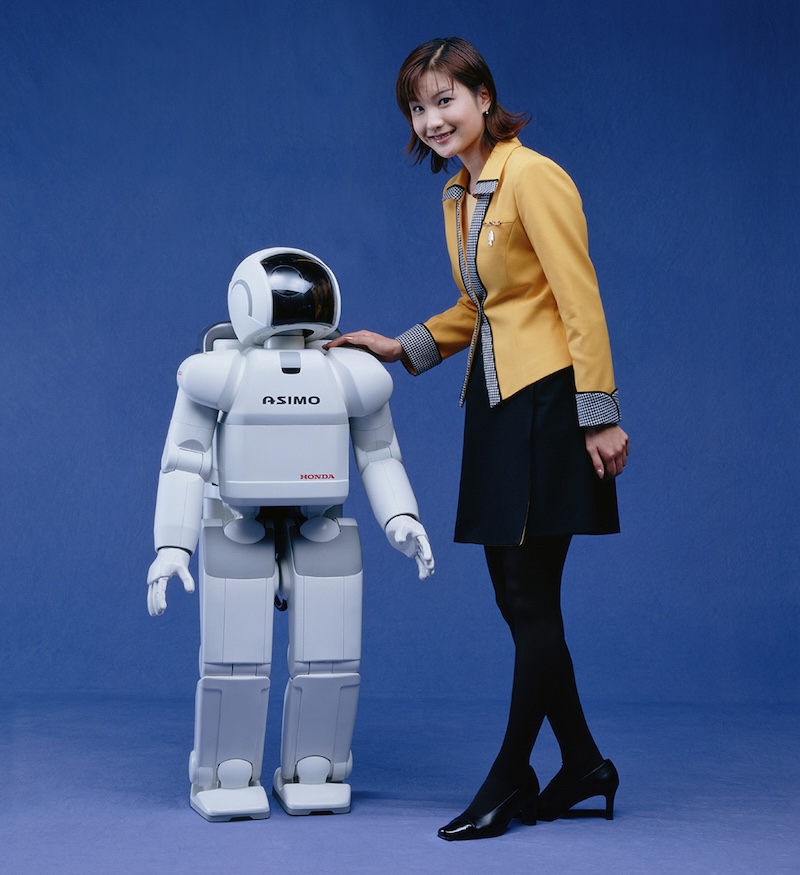
Whatever happened to ASIMO? Honda’s famous humanoid robot (pictured below with what we believe is an actual human female) disappeared from public view several years ago, just before an extraordinary new wave of humanoid development swept through the robotics industry.
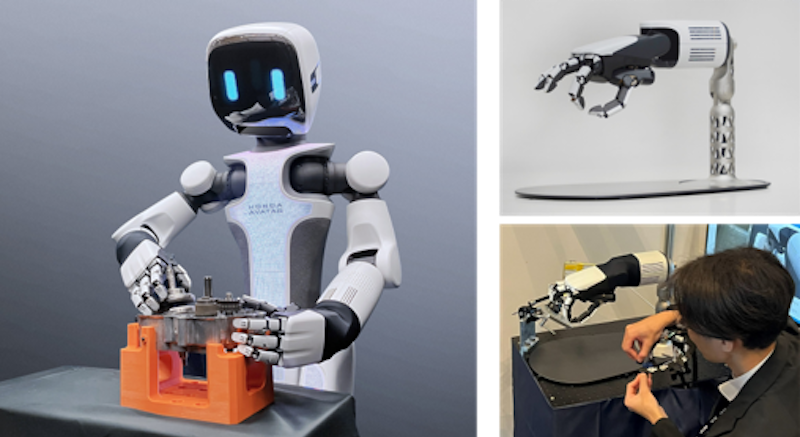
But Honda didn’t abandon humanoid robotics. Instead, much of the technology and expertise accumulated through decades of ASIMO development appears to have migrated into a new generation of research – including the company’s striking Avatar Robot (main picture) and an extraordinarily dexterous new robotic hand.
Honda demonstrated both at Humanoids Summit 2026 in May, where visitors could remotely operate the Avatar Robot and experience the movements of its multi-fingered hand.
The robot is conceived less as an autonomous humanoid worker and more as a physical extension of a human operator. Honda’s long-term idea is that someone could remotely use an Avatar Robot to perform work somewhere they cannot – or should not – physically be.
That could eventually include hazardous environments, remote maintenance and other tasks requiring human judgment combined with robotic reach and manipulation.
And manipulation is where Honda’s latest research becomes particularly interesting.
A hand that can thread a needle
Honda says its new human-scale multi-fingered hand combines dexterity, strength and durability sufficiently well to perform tasks ranging from threading a needle and using scissors to tightening screws and handling heavy objects.
The hand contains 16 actuated joints with maximum continuous joint speeds of 180 degrees per second.
Each fingertip can continuously exert as much as 50 N of force, while six-axis force sensors at the fingertips and 288 tactile-sensor channels distributed across the fingers and palm provide detailed information about physical contact.
Honda has also subjected the mechanism to more than 450,000 durability-test cycles, including 24,000 cycles involving lifting a 5 kg weight.
The result, Honda claims, is a robotic hand that has reached a practical level where it can “work like a human”.
That is a significant claim at a particularly interesting moment for humanoid robotics.
Walking was once the great challenge. Today, increasingly impressive humanoids can walk, run, jump and even perform acrobatics. But making them commercially useful requires something rather less spectacular: reliable hands capable of doing useful work for hours at a time.
From ASIMO to Avatar
Honda has perhaps more history in this field than almost any company now developing humanoids.
It began researching bipedal robots in 1986, long before today’s humanoid boom. Its P2 robot appeared in 1996, followed by P3 and, in 2000, ASIMO.
ASIMO became arguably the world’s most famous humanoid robot.
Its capabilities look relatively modest beside today’s machines. It wasn’t doing backflips or martial arts. Even walking required the sort of careful control that modern humanoids can make look almost trivial.
But that comparison risks forgetting just how far ahead of its time ASIMO was. Honda was demonstrating reliable bipedal locomotion, stair climbing, human interaction and basic manipulation when very few companies were seriously attempting to build general-purpose humanoid machines.
Honda eventually stopped ASIMO development, but the expertise did not disappear.
The company says engineers who worked on ASIMO have subsequently contributed to the Avatar Robot program and its robotic hand. In that sense, Avatar is not so much a sudden return to humanoid robotics as evidence that Honda never entirely left.
The strategy has changed, however.
Rather than immediately attempting to build another fully autonomous, general-purpose humanoid, Honda is separating the problem into technologies that can become useful independently.
The Avatar Robot, for example, keeps a human operator in the decision-making loop while robotic and AI systems assist with the physical execution of movements.
That could provide a more practical route into real-world applications than waiting for a completely autonomous humanoid capable of understanding and handling every situation by itself.
Honda’s quieter robotics empire
Nor is humanoid research Honda’s only involvement in robotics.
Over the years, the company has developed mobility robots and assistive technologies derived partly from ASIMO research, autonomous machines and the Miimo robotic lawn mower, among other projects.
But Avatar is particularly intriguing because of the current explosion of investment in humanoids.
Companies around the world are now trying to solve many of the problems Honda began investigating four decades ago. And the industry’s attention is increasingly moving from the question of whether humanoids can walk to whether they can actually perform useful work.
Honda’s new hand puts the company directly into that conversation.
ASIMO itself probably isn’t coming back. But looking at Honda’s Avatar Robot – complete with two remarkably capable five-fingered hands – it’s becoming increasingly difficult to argue that Honda ever really gave up on the idea behind it.
Expert comment
The challenge now is turning increasingly sophisticated hands into reliable systems that can perform useful work outside controlled demonstrations.
Roy Belak, SVP of robotic grasping at Locus Robotics, says manipulation depends on considerably more than mechanical dexterity alone.
Belak says: “Honda’s recent work reflects broader interest in advancing robotic grasping—from a company with one of the most storied histories in humanoid development.
“The robotics industry has long recognized that grasping sits at the intersection of hardware, perception and cognition, making a sophisticated anthropomorphic hand only part of the equation.
“The hurdle is moving from lab demos to scalable real-world deployments, which depends on reliability, repeatability and quality.
“If those factors are not addressed, downstream costs can prevent widespread adoption. That technical maturity is what turns robotic manipulation into economically viable automation at scale.”
