• Skip to primary navigation
  • Skip to main content
  • Skip to primary sidebar
  • Skip to secondary sidebar
  • About
    • Contact
    • Privacy
    • Terms of use
  • Shop
    • Cart
    • Checkout
    • My Account
  • Advertise
    • Advertising
      • Buy ad space
    • Case studies
    • Design
    • Email marketing
    • Features list
    • Lead generation
    • Magazine
    • Press releases
    • Publishing
    • Sponsor an article
    • Webcasting
    • Webinars
    • White papers
    • Writing
  • Subscribe to Newsletter

Robotics & Automation News

Where Innovation Meets Imagination

  • Home
  • News
  • Features
  • Editorial Sections A-Z
    • Agriculture
    • Aircraft
    • Artificial Intelligence
    • Automation
    • Autonomous Vehicles
    • Business
    • Computing
    • Construction
    • Culture
    • Design
    • Drones
    • Economy
    • Energy
    • Engineering
    • Environment
    • Health
    • Humanoids
    • Industrial robots
    • Industry
    • Infrastructure
    • Investments
    • Logistics
    • Manufacturing
    • Marine
    • Material handling
    • Materials
    • Mining
    • Promoted
    • Research
    • Robotics
    • Science
    • Sensors
    • Service robots
    • Software
    • Space
    • Technology
    • Transportation
    • Warehouse robots
    • Wearables
  • Press releases
  • Events

How 3D Simulation Helps Prevent Car Accidents Before They Happen

June 7, 2026 by Sam Francis

Car crashes rarely feel predictable when you are the one living through one. Yet behind the scenes, engineers, urban planners, and safety researchers have spent years building 3D simulation tools that model exactly how and why collisions happen.

These simulations are changing the way vehicles, roads, and safety systems are designed, and they are starting to change outcomes on real streets.

Why Simulation Matters for Road Safety

A car accident is the product of dozens of variables working together. Speed, reaction time, road geometry, weather, visibility, and vehicle design all interact in ways that are hard to study through observation alone.

Waiting for real crashes to happen and then analyzing them after the fact is slow, costly, and painful for the people involved.

3D simulation flips that process. Instead of waiting for a crash, researchers build a virtual model of a road, an intersection, or an entire highway corridor and run thousands of scenarios through it.

They can test how a driver reacts to a sudden lane change, how stopping distance changes on wet pavement, or how visibility drops at dusk near a curve. Every variable can be adjusted and re-tested without putting a single person at risk.

This matters because human error remains the dominant factor in most collisions. Federal researchers have found that a driver-related issue, such as a recognition, decision, or performance error, is identified as the critical last link in the chain of events in the large majority of crashes studied.

That does not mean drivers are always fully to blame for a wreck, since road design and vehicle limitations often set the trap that a driver falls into. It means that understanding driver behavior under realistic conditions is one of the most effective ways to reduce crashes before they occur.

From Vehicle Design to Road Engineering

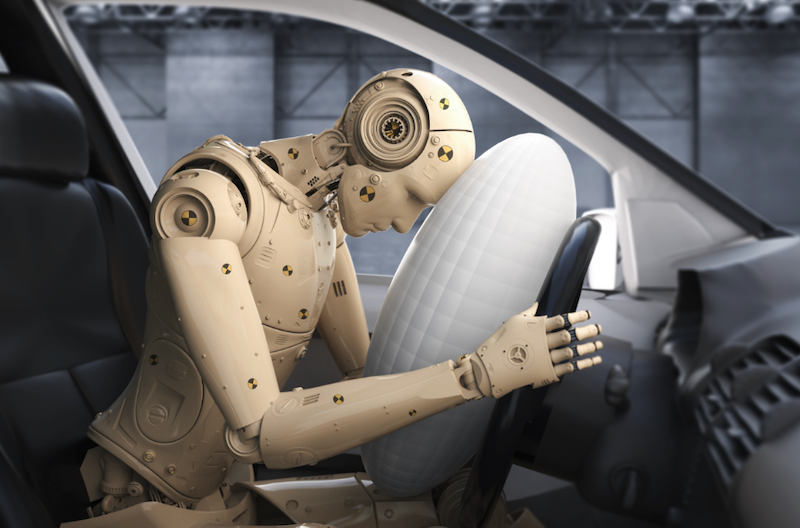
Automakers have used crash simulation for decades to test how a vehicle’s frame absorbs impact energy. Modern 3D simulation goes further. It models occupant movement inside the cabin, airbag timing, and how different impact angles affect injury severity.

This work has directly shaped safety features that are now standard, including improved crumple zones, side curtain airbags, and electronic stability control.

Road agencies use the same underlying technology on a larger scale. A 3D model of an intersection can reveal sightline problems that are nearly impossible to spot from a standard traffic study.

Planners can simulate how a redesigned left-turn lane changes conflict points between vehicles, or how a protected bike lane affects driver behavior at a crosswalk. Houston has leaned on this kind of data-driven planning as it works toward its Vision Zero goal of eliminating traffic deaths.

The city recently secured close to $28.8 million in federal Safe Streets funding to redesign a stretch of Bissonnet with slower lanes and improved crossings, a project informed by crash pattern analysis rather than guesswork.

What the Numbers Show

Simulation only matters if it leads to fewer people getting hurt, and the national data suggests progress is possible when safety interventions are guided by solid analysis.

NHTSA’s early 2025 estimates project roughly 36,640 traffic deaths nationwide, a decline of about 6.7 percent from 2024 and the second-lowest fatality rate per 100 million vehicle miles traveled ever recorded.

That is real movement in the right direction, driven in part by better vehicle engineering, smarter road design, and more targeted enforcement.

Texas tells a more complicated story. Harris County recorded 517 traffic deaths and 2,758 serious injuries in 2025, and the city of Houston alone logged 280 fatal crashes.

Police reports pointed to failure to drive within a single lane as the single largest contributing factor, tied to 89 deaths, while pedestrian right-of-way failures and alcohol-impaired driving each contributed dozens more.

These are not abstract statistics. Each one represents a family dealing with sudden loss or a survivor facing months of recovery and mounting medical bills.

Where Simulation Meets the Legal System

3D simulation is not just a design tool anymore. It has become a standard part of how serious car accidents are investigated and litigated. Accident reconstruction specialists now routinely build 3D models of a crash scene using photographs, skid mark measurements, vehicle data recorder information, and roadway geometry.

These models can show a jury or an insurance adjuster exactly how a collision unfolded, second by second, in a way that photographs and written reports cannot match on their own.

For someone hurt in a serious wreck, this technology can be the difference between a fair settlement and a lowball offer. Insurance companies often try to shift blame or downplay the severity of an impact.

A well-built simulation, grounded in physics and real scene evidence, makes it much harder to dispute what actually happened. This is one of the reasons injured drivers in Houston are increasingly working with Houston car accident lawyers who understand how to use reconstruction technology to support a claim.

Sutliff & Stout has built a reputation as one of the most trusted personal injury firms in the region, known for clear communication with clients and a track record of securing full injury compensation in complicated crash cases.

The Limits of Prediction

It is worth being honest about what simulation can and cannot do. No model can predict the exact moment a distracted driver looks down at a phone or a fatigued trucker drifts out of a lane.

What simulation can do is identify the conditions that make those failures more likely and more dangerous, then help engineers design roads and vehicles that reduce the consequences when a mistake happens.

This shift in thinking, from reacting to crashes to modeling them in advance, is slowly reshaping traffic safety.

Combined with steady declines in national fatality rates and targeted local investment in dangerous corridors, 3D simulation is proving to be one of the more effective tools available for making roads safer before the next accident happens rather than only after.

Final Thoughts

Simulation will never eliminate every crash, since human behavior remains unpredictable and roads carry more traffic every year. But the technology has already reshaped how vehicles are built, how intersections are designed, and how crashes are investigated after the fact.

As cities like Houston continue to lean on data to guide safety spending, and as reconstruction tools grow more precise, 3D simulation stands out as one of the clearest examples of technology working quietly in the background to protect the people who use the road every day.

Print Friendly, PDF & Email

Share this:

  • Print (Opens in new window) Print
  • Share on Facebook (Opens in new window) Facebook
  • Share on LinkedIn (Opens in new window) LinkedIn
  • Share on Reddit (Opens in new window) Reddit
  • Share on X (Opens in new window) X
  • Share on Tumblr (Opens in new window) Tumblr
  • Share on Pinterest (Opens in new window) Pinterest
  • Share on WhatsApp (Opens in new window) WhatsApp
  • Share on Telegram (Opens in new window) Telegram

Related stories you might also like…

Filed Under: Design, Engineering Tagged With: 3D simulation, accident reconstruction, adas, autonomous vehicles, collision prevention, crash simulation, driver assistance systems, driving simulation, road infrastructure, road safety, smart cities, traffic engineering, traffic safety, transportation, vehicle safety

Primary Sidebar

Search this website

Latest articles

  • FORT Robotics extends physical AI safety platform with Nvidia Halos
  • Fieldwork Robotics secures SEED Innovations investment to scale berry harvesting robots
  • Multi-robot demo showcases new UK’s Plymouth subsea test range
  • Tech company AVI-SPL launches autonomous Dallas-Houston freight operations with Volvo Autonomous Solutions
  • RoboDK unveils CAM software that cuts robotic machining deployment time ‘by up to 40 percent’
  • Richtech Robotics launches 24/7 interactive livestream featuring AI robot ADAM
  • Cognibotics selected for €6.5 million in EU accelerator funding
  • CS2 Skin Marketplace Comparison: Which Platform Offers the Best Prices and Security?
  • How Automation is Changing Employee Performance Tracking and Recognition
  • What Can Delay a Car Accident Settlement and How an Attorney Helps

Secondary Sidebar

Latest news

  • FORT Robotics extends physical AI safety platform with Nvidia Halos
  • Fieldwork Robotics secures SEED Innovations investment to scale berry harvesting robots
  • Multi-robot demo showcases new UK’s Plymouth subsea test range
  • Tech company AVI-SPL launches autonomous Dallas-Houston freight operations with Volvo Autonomous Solutions
  • RoboDK unveils CAM software that cuts robotic machining deployment time ‘by up to 40 percent’
  • Richtech Robotics launches 24/7 interactive livestream featuring AI robot ADAM
  • Cognibotics selected for €6.5 million in EU accelerator funding
  • CS2 Skin Marketplace Comparison: Which Platform Offers the Best Prices and Security?
  • How Automation is Changing Employee Performance Tracking and Recognition
  • What Can Delay a Car Accident Settlement and How an Attorney Helps

Copyright © 2026 · News Pro on Genesis Framework · WordPress · Log in

We use cookies on our website to give you the most relevant experience by remembering your preferences and repeat visits. By clicking “Accept”, you consent to the use of ALL the cookies.
Do not sell my personal information.
Cookie SettingsAccept
Manage consent

Privacy Overview

This website uses cookies to improve your experience while you navigate through the website. Out of these, the cookies that are categorized as necessary are stored on your browser as they are essential for the working of basic functionalities of the website. We also use third-party cookies that help us analyze and understand how you use this website. These cookies will be stored in your browser only with your consent. You also have the option to opt-out of these cookies. But opting out of some of these cookies may affect your browsing experience.
Necessary
Always Enabled
Necessary cookies are absolutely essential for the website to function properly. These cookies ensure basic functionalities and security features of the website, anonymously.
CookieDurationDescription
cookielawinfo-checkbox-analytics11 monthsThis cookie is set by GDPR Cookie Consent plugin. The cookie is used to store the user consent for the cookies in the category "Analytics".
cookielawinfo-checkbox-functional11 monthsThe cookie is set by GDPR cookie consent to record the user consent for the cookies in the category "Functional".
cookielawinfo-checkbox-necessary11 monthsThis cookie is set by GDPR Cookie Consent plugin. The cookies is used to store the user consent for the cookies in the category "Necessary".
cookielawinfo-checkbox-others11 monthsThis cookie is set by GDPR Cookie Consent plugin. The cookie is used to store the user consent for the cookies in the category "Other.
cookielawinfo-checkbox-performance11 monthsThis cookie is set by GDPR Cookie Consent plugin. The cookie is used to store the user consent for the cookies in the category "Performance".
viewed_cookie_policy11 monthsThe cookie is set by the GDPR Cookie Consent plugin and is used to store whether or not user has consented to the use of cookies. It does not store any personal data.
Functional
Functional cookies help to perform certain functionalities like sharing the content of the website on social media platforms, collect feedbacks, and other third-party features.
Performance
Performance cookies are used to understand and analyze the key performance indexes of the website which helps in delivering a better user experience for the visitors.
Analytics
Analytical cookies are used to understand how visitors interact with the website. These cookies help provide information on metrics the number of visitors, bounce rate, traffic source, etc.
Advertisement
Advertisement cookies are used to provide visitors with relevant ads and marketing campaigns. These cookies track visitors across websites and collect information to provide customized ads.
Others
Other uncategorized cookies are those that are being analyzed and have not been classified into a category as yet.
SAVE & ACCEPT