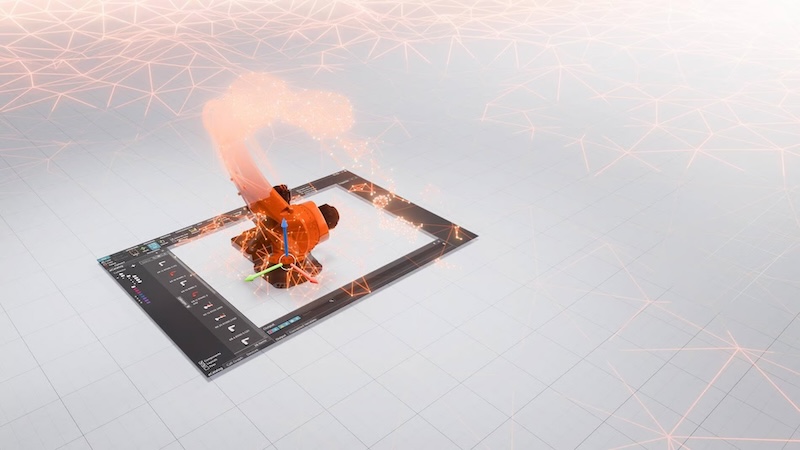
Industrial robot maker Kuka has outlined a new technology direction it calls “Automation 2.0”, centered on integrating artificial intelligence with industrial automation systems to enable more adaptive, autonomous operations.
The strategy, presented at the recent Nvidia GTC event, reflects a broader industry shift toward what is increasingly described as “physical AI” – systems that can perceive, decide, and act in real-world environments rather than simply execute pre-programmed tasks.
From rule-based automation to intent-driven systems
At the core of Kuka’s approach is a transition from traditional, rule-based automation toward what the company describes as “intent-based” systems.
These systems aim to translate high-level human goals into automated actions, reducing the need for detailed programming. Instead of specifying each step in a process, users define an outcome, and the system determines how to achieve it.
According to Kuka, this shift is enabled by advances in AI models, simulation, and compute infrastructure spanning edge devices and cloud-based systems.
Kuka Group CEO Christoph Schell said: “Robots and automation systems are evolving from programmable machines to intelligent collaborators, capable of learning, adapting and operating safely alongside humans.”
He added that new platforms are “bridging traditional deterministic automation, such as rule-based, pre-programmed systems, with intent-based automation, the pathway from concept to deployment is becoming faster, more accurate, more cost efficient and more autonomous”.
Kuka AMP: Software layer for AI-enabled automation
A key element of the strategy is a new software platform called Kuka AMP (Automation Management Platform), unveiled publicly for the first time at GTC.
The platform is designed to sit above existing automation systems, connecting hardware, software, and simulation tools into a unified environment. In practical terms, it reflects a move toward software-defined automation – where orchestration, optimization, and decision-making increasingly take place at the software layer.
Kuka suggests this will allow manufacturers to deploy and scale automation systems more quickly, while also enabling greater flexibility in how production processes are configured and adjusted.
Automation 1.0 remains the foundation
Despite the focus on AI, the company is positioning its new approach as an extension rather than a replacement of existing systems.
Schell said: “As we move toward Automation 2.0 and Physical AI, Automation 1.0 remains essential – for Kuka and for the entire industry. Proven, rule-based automation continues to deliver the stability and productivity our customers rely on, especially in high volume and safety critical environments. We’re not replacing it. We’re expanding it with intent-based and AI driven capabilities.”
This framing reflects a broader reality in industrial automation, where deterministic systems remain dominant in production environments that require reliability, repeatability, and safety certification.
Investment in AI and global expansion
Kuka’s shift toward AI-enabled automation is supported by increased investment in research and development. The company reported €213 million in R&D spending in 2025 – its highest level to date.
The company is also building out its software and AI capabilities geographically, including a center of excellence in Silicon Valley and new research and training facilities in Asia.
China remains a key market, with Kuka reporting that revenue from the region exceeded €1 billion for the first time, highlighting both the scale of demand and the intensity of competition in industrial robotics.
Competing in the era of ‘physical AI’
Kuka’s announcement reflects a wider repositioning across the robotics industry, as vendors seek to combine traditional automation with AI-driven capabilities.
The concept of “physical AI” – linking perception, decision-making, and actuation in real-world systems – is becoming a central theme, particularly as advances in large-scale AI models and simulation begin to influence industrial applications.
For Kuka, the challenge will be translating these capabilities into deployable systems that meet the reliability and cost constraints of manufacturing environments.
While the company describes itself as moving toward becoming a “physical AI company”, the near-term reality is likely to be a hybrid model – where AI augments existing automation systems rather than replacing them outright.
