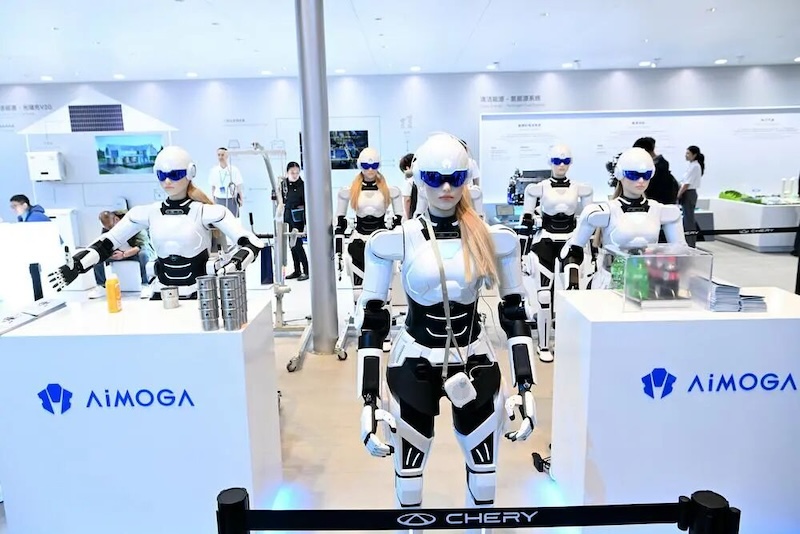
Chinese automaker Chery has begun selling its self-developed humanoid robot to consumers, marking a notable – and somewhat unexpected – step toward the commercialization of embodied AI systems.
According to a report by CNEVPost, Chery’s robotics brand Aimoga has “officially started selling its latest robot products to ordinary consumers,” with its humanoid model priced at 285,800 yuan (approximately $41,830).
The company has launched online sales through its flagship store on JD.com, allowing consumers to “directly purchase these robots, which are capable of autonomous task execution”.
From showroom assistant to consumer product
The move is notable given that the robot was previously positioned primarily as a sales assistant in automotive showrooms.
According to reporting by Lanjinger, the humanoid robot has already been deployed in overseas dealerships, where it performs tasks such as “proactive greeting, vehicle explanation, intelligent question answering, and vehicle demonstration.”
Chery’s robotics unit – referred to as MoJia or Aimoga in different reports – appears to be following a staged commercialization strategy. The company has outlined a three-phase roadmap, beginning with automotive sales environments, expanding into retail and public service settings, and ultimately targeting home use.
Building a distribution network
Alongside the consumer launch, Chery is also developing a broader sales and distribution network.
A report cited by Lanjinger notes: “We are recruiting merchants, and our targets are not limited to car dealerships; we are in talks with companies with upstream and downstream capabilities.”
The company has reportedly signed agreements with more than 300 distributors and is building a hybrid sales model that includes retail stores, automotive dealerships, and supermarket-style experience outlets.
In addition to the humanoid robot, Chery is also offering a quadruped robot dog priced at 15,800 yuan, suggesting a broader push into consumer robotics hardware.
Strategic expansion into robotics
Chery’s entry into consumer robotics reflects a wider trend among Chinese industrial and automotive companies seeking to extend their manufacturing and supply chain capabilities into emerging sectors such as embodied AI.
According to CNEVPost, the company is aiming to “extend its supply chain and manufacturing advantages into the growing consumer robotics sector”.
However, questions remain about the near-term practicality of such systems in home environments, particularly given their current capabilities appear to be centered on conversational interaction and structured demonstrations rather than general-purpose utility.
For now, the commercialization of Chery’s humanoid robot may represent less a breakthrough in consumer robotics and more an early-stage experiment in how such machines can transition from controlled commercial settings into broader public use.
