
Generalist AI has introduced a new robotics model, GEN-1, which the company says marks a significant step toward general-purpose artificial intelligence for physical tasks.
The model is designed as an “embodied foundation model” – a type of AI system that can perceive, reason and act in the physical world – and is trained on large-scale datasets of real-world interactions rather than narrow, task-specific programming.
According to the company, GEN-1 achieves “99 percent success rates” on certain tasks, compared with around 64 percent for its previous-generation system, while completing tasks up to three times faster. The system is also described as highly data-efficient, requiring roughly one hour of robot-specific data to adapt to new tasks.
“We believe it to be the first general-purpose AI model that crosses a new performance threshold: mastery of simple physical tasks,” the company said in its announcement.
Unlike traditional industrial robots, which rely on fixed programming in controlled environments, GEN-1 is designed to operate in more dynamic settings by combining perception, decision-making and motion into a single system.
The company defines “mastery” in robotics as a combination of reliability, speed and what it calls “improvisational intelligence” – the ability to adapt to unexpected situations.
“In unstructured environments, robots must have the ability to creatively improvise solutions in unexpected scenarios – to respond and adapt rather than rely on predefined behaviors,” the company said.
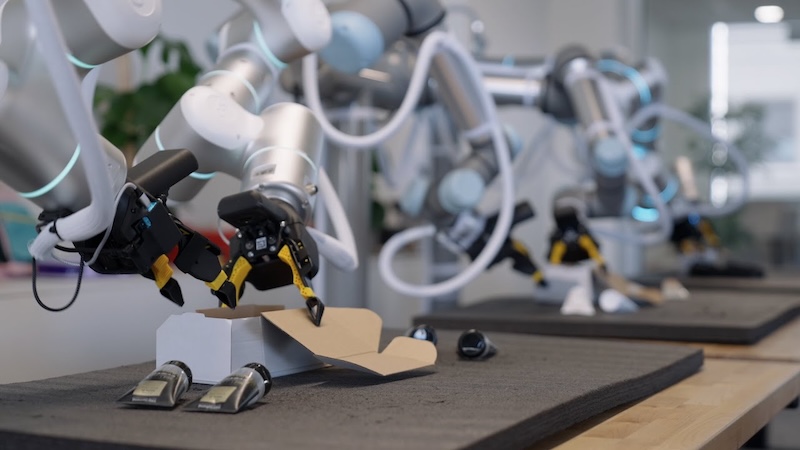
Demonstrations released alongside the announcement show robots performing repetitive tasks such as folding boxes, packing items and assembling components over extended periods without intervention. In some cases, the system reportedly completed hundreds or even thousands of repetitions with minimal errors.
The model builds on the company’s earlier GEN-0 system, which it said demonstrated that “scaling laws exist in robotics”, drawing a parallel with the development of large language models such as GPT. GEN-1 extends this approach by increasing both data and compute, while introducing new training and inference techniques.
A key aspect of the approach is the use of large-scale pretraining on human activity data, collected through wearable devices, rather than relying solely on expensive teleoperation datasets traditionally used in robotics.
While the results suggest progress toward more general-purpose robotic systems, the company acknowledged limitations, noting that not all tasks currently reach production-level performance and that further improvements in speed and reliability are required for broader deployment.
The announcement reflects a wider trend in robotics toward “physical AI” systems that aim to move beyond narrowly defined automation and toward more adaptable, learning-based approaches capable of operating in real-world environments.
Generalist AI said early access to GEN-1 is now available to selected partners as it continues development of the platform.
