Autonomous Solutions, Inc. (ASI) is not a company that regularly dominates headlines, but it has spent more than two decades quietly building and deploying autonomous vehicle systems across industries where automation is already delivering measurable results.
Founded in 2000 and headquartered in Utah, ASI has focused on real-world autonomy – retrofitting and orchestrating fleets of heavy equipment in sectors such as agriculture, construction, mining and logistics.
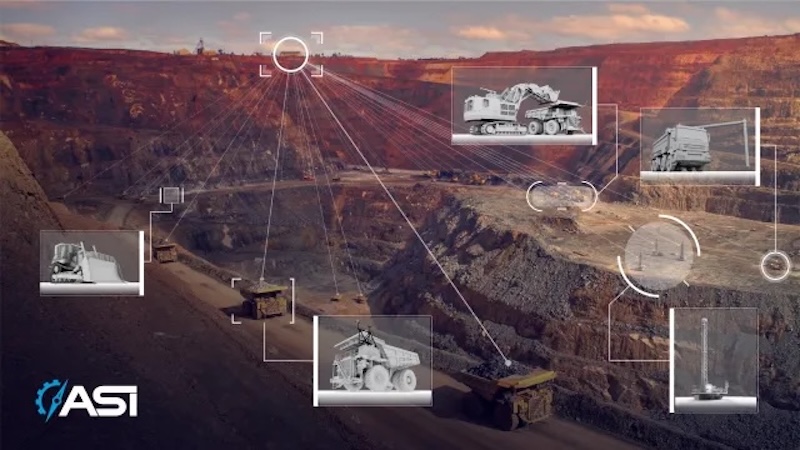
Its Mobius command-and-control platform (image below) enables operators to manage multiple autonomous vehicles remotely, positioning the company as a long-standing player in what is now being reframed as “physical AI”.
That framing is becoming increasingly relevant as attention shifts toward humanoid robots, particularly following a wave of highly choreographed demonstrations from Chinese manufacturers.
While these systems have captured public and investor imagination, ASI’s founder and CEO, Mel Torrie, takes a more measured view of their near-term industrial value.
In this Q&A with Robotics & Automation News, Torrie argues that much of the current momentum around humanoids remains demonstration-driven rather than application-led.
By contrast, he points to autonomous vehicles and specialized equipment as technologies that are already proven, scalable and delivering clear returns across multiple industries.
Torrie outlines where autonomy is working today – from coordinated fleets of agricultural machinery to automated truck movements in logistics yards – and explains why these systems are currently more economically viable than general-purpose humanoid robots.
He also discusses the technical and operational hurdles humanoids still face, including power consumption, safety, and the lack of clearly defined return-on-investment models.
Looking ahead, Torrie does not see autonomous vehicles and humanoid robots as competing paradigms, but as complementary systems that may eventually converge at key points in the workflow – particularly in logistics environments where mobility and manipulation intersect.
The conversation provides a grounded perspective on where industrial automation is today, and where it is likely to deliver value in the near term.

Interview with Mel Torrie, CEO, Autonomous Solutions, Inc.
RoboticsAndAutomationNews.com: There’s been a surge of attention around humanoid robots, particularly from China. From your perspective, are we seeing genuine industrial progress, or more demonstration-driven hype?
Mel Torrie: Real-life applications are messy and require repetitive testing to overcome. What we are seeing from China appears highly scripted, more of a capability demonstration than a showcase of tangible applications for industrial settings.
However, given the attention to humanoid robots, every improvement in movement, spatial awareness, and precise coordination is a major step toward integrating them into industrial work environments.
While the robots produced by China are of high caliber and represent a vast improvement over what existed five years ago, they face safety scrutiny and cultural acceptance before they can be incorporated into workflows.
R&AN: You’ve suggested that automated vehicles and specialty equipment will deliver more immediate value than humanoids. What makes these systems fundamentally more viable today?
MT: Especially in markets like logistics, automated vehicles solve the pain point of reliably moving product from one location to another. Because they have been tested across a multitude of applications and work settings, they demonstrate a clear value proposition across a variety of industries for the ability to integrate with existing systems, scale as operations expand, and offset labor shortfalls.
The capability of humanoid robots is not yet at a level that could make a meaningful contribution to most operations.
R&AN: ASI has focused on autonomy in sectors like agriculture, construction, and logistics. What are the key use cases where autonomy is already delivering measurable returns?
MT: ASI offers clients the clearest, measurable returns when they leverage our Mobius precision command-and-control system to remotely coordinate a fleet of automated vehicles.
In agriculture, from broad-acre fields to complex orchards, this fleet of automated tractors, seeders, and watering vehicles can be safely orchestrated from a central command hub during inclement weather and regardless of sunlight.
In construction, automated vehicles can provide 24/7 support for site preparation and development. This allows human workers to focus on more strategic tasks or influence the build without being on site.
If a build is on a remote or challenging site, automated vehicles can be deployed in advance to build roads, level ground, and prepare the site, enabling more efficient construction once the project fully begins.
For logistics, our Mobius platform shines in fleet yards, where dozens of trucks require high-precision coordination in confined spaces to load and offload materials efficiently.
By automating truck movement in these designated areas, safety hazards and human errors are reduced, leading to fewer maintenance requirements, safer employees, and more precise time management.
R&AN: How do the economics compare between deploying autonomous vehicles versus attempting to introduce humanoid robots into industrial environments?
Currently, the economies are vastly different. When talking about full humanoid robots, not automated picking arms or other task-specific equipment, it doesn’t make sense for most companies to invest in integration right now.
It is simply too expensive, and there are no use cases available to help determine ROI. Autonomous vehicles are more accessible, less expensive, and require less expertise to coordinate and maintain.
Additionally, anxiety around humanoid robots may pose workforce challenges far greater than those posed by automated vehicles or task-specific robots. In the case of ASI, any heavy equipment vehicle, regardless of brand, can be retrofitted, which affords the customer substantial investment savings
R&AN: Many humanoid proponents argue that general-purpose robots will ultimately replace task-specific machines. Do you see that happening, or will specialization remain dominant?
We believe that is possible, but again, the investment and lack of ROI information make it somewhat dicey right now. I expect specialization will remain dominant, especially in high-volume, controlled environments such as large-scale manufacturing, logistics, and food processing, where task-specific machines can deliver unmatched precision and cost efficiency.
R&AN: From a technical standpoint, what are the biggest challenges humanoid robots still need to overcome before they become commercially viable?
Current humanoid robots are somewhat inefficient and consume power too quickly to be used in mass at this time. That will change, of course, but for now, that is one of the biggest challenges.
Once the power issue is solved, and the challenge of intelligence and learning for a specific task or workplace need is overcome, I’d expect to see greater commercial viability and more businesses investing in humanoid robots.
R&AN: Looking ahead, how do you see the relationship between autonomous vehicles and humanoid robots evolving – are these competing approaches, or will they converge in certain applications?
These technologies aren’t competing; they are complementary and already converging. Automated vehicles excel at moving people and goods through specific, routed environments. Humanoids own the last few feet, such as the loading dock, the front door, or a specific room.
It’s impossible for either autonomous vehicles or humanoids to be interchangeable. The handoff between the two is an opportunity for convergence. An autonomous vehicle delivering a package is only as useful as what happens when it arrives.
A humanoid bridges that gap by navigating stairs, interacting with people, and completing the task. The most powerful logistics ecosystems will accept that they must deploy both.
