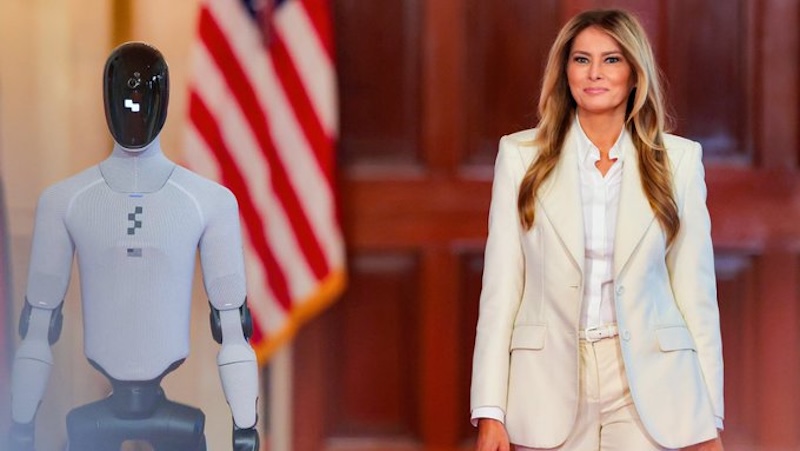
First Lady Melania Trump introduced an American-built humanoid robot at the White House this week, marking a rare moment where advanced robotics took center stage in a diplomatic setting.
The demonstration featured Figure 3, a humanoid system developed by Figure AI, and was presented during a global summit attended by representatives from 45 countries.
According to a White House press release, the event formed part of the “Fostering the Future Together” initiative, focused on artificial intelligence, education, and economic development.
Mrs. Trump acknowledged the robot directly during her remarks, saying: “Welcome to the White House. Figure 3, thank you for joining me at Day-2 of Fostering the Future Together. It’s fair to state, you are my first American-made humanoid guest in the White House.”
The appearance of a humanoid robot in such a setting reflects growing interest among policymakers in the role of robotics alongside artificial intelligence, particularly in areas such as education, workforce development, and human-machine interaction.
Humanoids move into the policy spotlight
While industrial robots and automation systems have long been part of economic strategy discussions, humanoid systems have remained largely confined to research labs and pilot deployments.
Mrs. Trump’s remarks suggest that may be changing.
“The future of AI is ‘personified’ – it will be formed in the shape of humans. Very soon, artificial intelligence will move from our mobile phones to humanoids that deliver utility,” she said.
She added that humanoid systems are well suited to real-world environments because they are designed around human spaces and interactions: “Since our environment is designed for people, humanoid systems are uniquely suited to navigate and operate within our world. They ‘fit’ well.”
The framing positions humanoid robots not just as experimental technology, but as potential tools for everyday applications – a shift that aligns with broader industry efforts to commercialize general-purpose robotics.
Robotics and AI in education
A central theme of the summit was the role of AI and robotics in education.
Mrs. Trump outlined a vision in which humanoid systems could act as personalized learning assistants, describing a hypothetical AI-powered educator named “Plato”.
“Imagine a humanoid educator named ‘Plato.’ Access to the classical studies is now instantaneous – literature, science, art, philosophy, mathematics, and history – Humanity’s entire corpus of information is available in the comfort of your home,” she said.
According to Mrs. Trump, such systems could adapt to individual learning needs in real time: “Plato will provide a personalized experience, adaptive to the needs of each student. Plato is always patient, and always available.”
The concept reflects a growing trend in both AI and robotics toward more interactive, human-facing systems designed to augment learning and productivity rather than replace it.
Encouraging AI literacy and curiosity
The First Lady has previously emphasized the importance of AI literacy for younger generations.
In a separate initiative earlier this year, she encouraged students across the United States to engage with AI tools as part of their education and career development.
“The Age of Imagination is a new era, powered by artificial intelligence, where one’s curiosity can be satisfied almost magically, in seconds,” she said.
She also highlighted the importance of maintaining human judgment alongside technological capability: “Although artificial intelligence can generate images and information, only humans can generate meaning and purpose. Choose to let your imagination drive your intellectual progress. But never use AI as a quick solution.”
This message aligns with broader concerns among educators and policymakers about balancing the opportunities presented by AI with the need for critical thinking and responsible use.
Industry and government alignment
The White House summit brought together government officials and private-sector leaders as countries increasingly view artificial intelligence and robotics as both economic drivers and strategic priorities.
Participants included representatives from multiple nations, alongside companies such as Meta, Microsoft, OpenAI, Google, and others involved in AI and digital infrastructure.
Mrs. Trump emphasized the importance of collaboration between public and private sectors, suggesting that innovation, regulation, and investment must work together to scale emerging technologies.
“We can accelerate civilization’s march forward when enterprise delivers innovation, government creates scale, and our capital markets finance the distribution of these emerging technologies,” she said.
A signal for the future of humanoid robotics
The presentation of a humanoid robot at the White House does not in itself signal widespread deployment. However, it does indicate a shift in how such systems are being perceived at the highest levels of government.
For companies developing humanoid robots, the moment represents increased visibility and potential validation, particularly as discussions move beyond technical feasibility toward real-world applications.
For policymakers, it highlights the growing intersection between robotics, artificial intelligence, and economic strategy.
And for students and professionals entering the workforce, the message is clear: familiarity with AI and emerging technologies is becoming increasingly important for future career development.
As Mrs. Trump framed it, the current period represents “The Age of Imagination” – a phase in which technological capability is expanding rapidly, and where the ability to understand and apply these tools may shape both individual opportunity and national competitiveness.
‘Safety is paramount’
The First Lady confirmed that there will be more humanoids in the world in the future. But she cautioned that “safety is paramount”.
RealSense, a pioneer in AI-powered computer vision, is at the forefront of robotics development. RealSense VP of marketing and robotics expert Mike Nielsen says advanced perception is the key for humanoids to operate autonomously and safely.
Nielsen says: “In our view, robust environmental perception and contextual understanding are foundational to safe robotic behavior: robots must be able to detect people and objects, understand scene dynamics, and respond predictably in real time.
“We refer to this as the ‘visual cortex’ of physical AI. We have invested in core technologies that improve safe human-robot interaction and collaboration by enabling robots to see more accurately and interpret their surroundings, which is essential for deployment in real-world environments.”
Main image: Melania Trump walks presents the Figure humanoid at the White House. Image courtesy of NBC Boston
