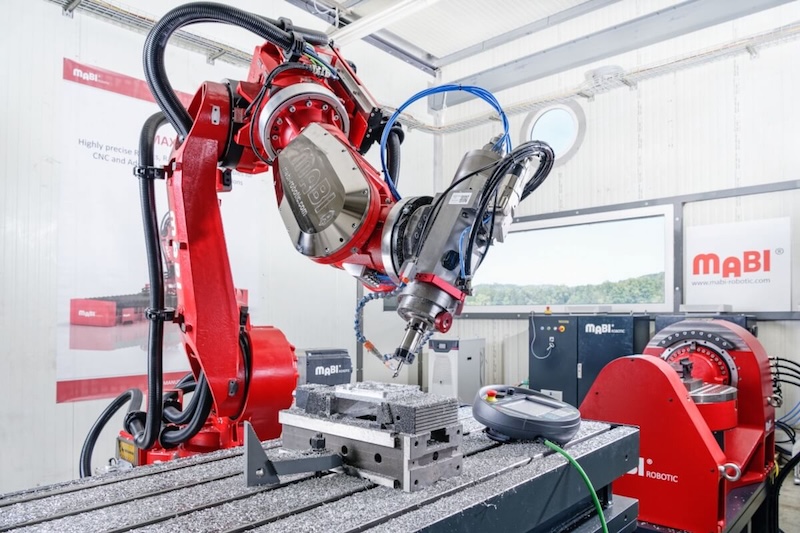
Anyone walking through a modern factory today will quickly notice that production no longer looks the same as it used to. Robotic systems are now often found working alongside machines and conveyor belts.
Particularly eye-catching are movable gripping arms that can pick up components, rotate them, or place them in a specific position. In many factories, a robotic arm is no longer a technical experiment, but a normal part of everyday work.
Many tasks that used to be done by hand are now performed automatically. Components are moved by robots, machines are loaded, or parts are transported to the next station. For employees, this means one thing above all: less physically demanding routine work and more monitoring and control of processes.
Precision as a decisive factor
Even small inaccuracies can have a major impact in production. If a component is not positioned exactly or a workpiece is clamped slightly out of place, this can cause problems later on during assembly.
This is precisely where one of the strengths of automated systems lies. A robotic arm can perform movements repeatedly in exactly the same way. Once the sequence has been programmed, the robot repeats it reliably – no matter how often.
This is particularly important for tasks such as milling, drilling, or inserting workpieces into machines. Modern systems monitor every movement. Sensors and encoders constantly measure where the robot is and how its joints are moving. This allows a component to be aligned very precisely before it is further processed.
Use in various industries
Robotic gripping systems are now found in many industries. Their use in the automotive industry is particularly well known. There, robots weld car body parts, move heavy components, or apply paint. Many of these tasks are very monotonous or physically demanding—making them ideal for machines.
Automated systems are also used in electronics production. Very small components often have to be positioned precisely on circuit boards. A robotic arm can pick up these parts and place them accurately without any loss of precision over time.
Another major area of application is logistics. In large warehouses, robotic systems pick products from shelves, sort packages, or stack goods on pallets. Modern grippers can handle a wide variety of objects – from small packages to larger cartons.
At the same time, new robotics solutions are being developed. Some companies are testing humanoid robots that are designed to work directly with humans on the factory floor. BMW, for example, is experimenting with such systems in production environments. The idea behind this is simple: robots could take over simple transport or handling tasks and relieve the burden on employees.
Robotics outside of industry
The technology behind robotic gripping systems is now also being used in other areas. An interesting example comes from the University of Sheffield.
There, researchers have developed an unmanned vehicle equipped with two robotic arms that could be used in dangerous situations. The system is intended, for example, for disaster areas or chemical accidents where rescue workers cannot immediately work safely.
The vehicle can be controlled remotely. Doctors use virtual reality technology for this purpose. The robotic arms can be used to carry out initial examinations, such as measuring temperature, blood pressure, or heart rate. In certain cases, an automatic injector can even be used to administer painkillers.
The prototype was developed within a few months. It shows that technologies from industrial robotics are now also reaching completely different areas of application.
Cooperation between humans and machines
Despite all these developments, automation does not mean that humans will disappear from production. In many companies, the role of employees is changing.
Robots take over repetitive or physically demanding tasks. Humans, on the other hand, are more involved in monitoring, maintenance, and quality control. They intervene when procedures change or a process needs to be adjusted.
In modern production lines, humans and machines often work in the same area. To ensure that this works safely, sensors constantly monitor the environment. Cameras, laser scanners, or pressure sensors detect when someone approaches the work area. In this case, the machine slows down or stops completely.
For many companies, this also means new requirements for their workforce. In addition to practical know-how, technical understanding and the ability to use digital production systems are becoming increasingly important. Skills in data analysis, system diagnostics, and basic robotics programming are also becoming valuable in daily operations.
Training and continuous learning therefore play an increasingly important role in modern industrial workplaces. This does not mean that industry is becoming dehumanized – it is simply changing.
