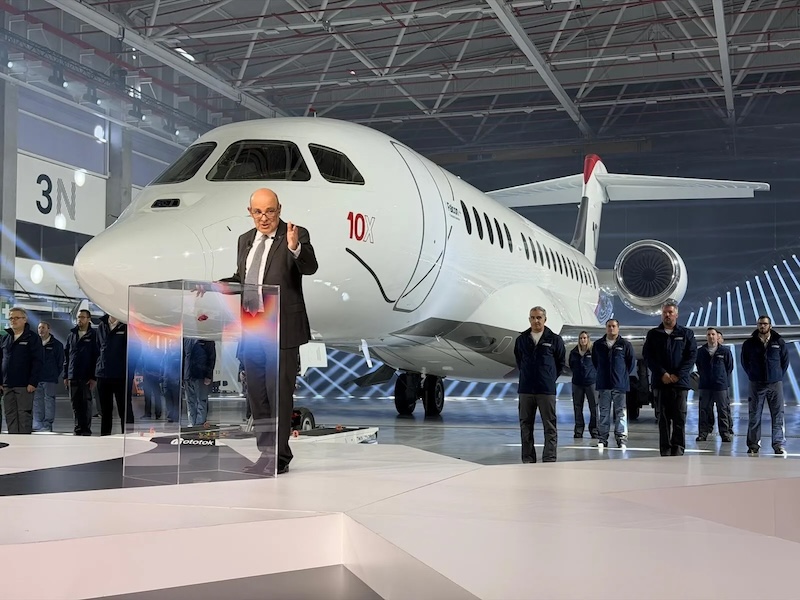
Advanced composites manufacturer Hexcel says it supplied key structural materials for the wing of Dassault Aviation’s newly unveiled Falcon 10X, a next-generation ultra-long-range business jet featuring what the company describes as “business aviation’s first all-composite wing”.
The aircraft was rolled out at Dassault’s Bordeaux-Mérignac facility in France before an audience of more than 400 customers, partners, and aviation industry leaders, marking a major milestone in the Falcon 10X development program.
Hexcel was selected in 2022 to provide structural prepreg composite materials for the entire wing of the aircraft, highlighting the growing importance of lightweight carbon-fiber composites in modern aircraft design.
“Our partnership with Dassault exemplifies how Hexcel’s expertise in lightweight, advanced carbon fiber composites drive the next generation of high-performance aircraft,” said Tom Gentile, chairman, CEO and president of Hexcel. “We are proud to support Dassault in ensuring the durability, efficiency, and competitive edge of the Falcon 10X throughout its service life with a full composite wing.”
The Falcon 10X is Dassault’s most ambitious business jet program to date and introduces what the company claims is the first fully composite wing in the business aviation segment.
Composite wings allow engineers to reduce structural weight while improving stiffness and aerodynamic efficiency – key factors for aircraft designed to travel ultra-long distances while maintaining high performance.
And while composite wings have become standard on many modern commercial aircraft, they are still relatively rare – or nonexistent – in business aviation, where structural designs have traditionally relied on metal alloys.
According to Hexcel, the Falcon 10X wing structure uses its M21E/IMA carbon-fiber prepreg system, developed in collaboration with Dassault’s engineering teams. The material is designed to deliver a combination of weight savings, fatigue resistance, and structural rigidity required for next-generation aircraft.
Dassault says the Falcon 10X will offer a maximum range of 7,500 nautical miles and a top speed approaching Mach 0.925 (approximately 700 mph), enabling long-haul routes such as New York to Shanghai or Los Angeles to Sydney.
The aircraft also introduces a new fuselage design with one of the largest cabins in business aviation, along with advanced avionics and digital flight-control systems derived in part from Dassault’s military aircraft programs.
“Dassault Falcons have always been at the vanguard of business aviation,” noted Dassault president and CEO Eric Trappier, “and the 10X is no exception, embodying the very best technology available today. From the user perspective, the equation is simple: an objectively better experience.”
Following the rollout, the Falcon 10X program will move into the next phase of development, including an extensive flight-test campaign ahead of entry into service.
For Hexcel, the aircraft underscores the expanding role of advanced composite materials across aerospace. Carbon-fiber structures are increasingly used in both commercial and business aviation programs as manufacturers seek to improve fuel efficiency, structural performance, and long-range capability in new aircraft designs.
