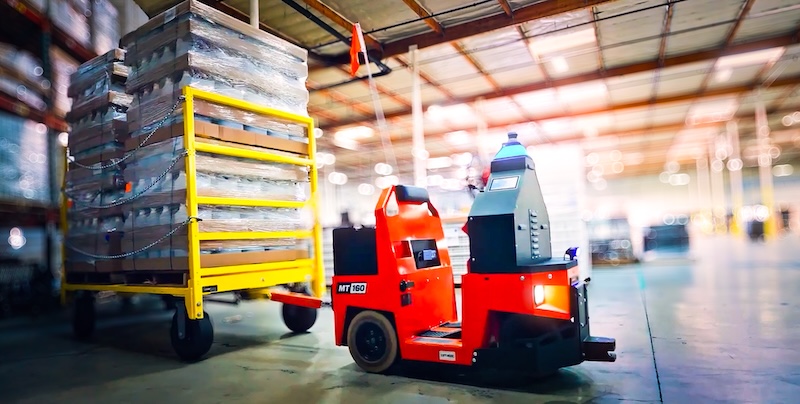
Cyngn says it is continuing to see “commercial momentum” for its autonomous vehicle solutions, driven by expanding customer deployments, increased utilization across existing sites, and accelerating sales activity entering 2026.
According to Marty Petratis, Cyngn’s VP of sales, the company is on track to sell more in Q1 of 2026 than all of last year based on current bookings and pipeline, although the company doesn’t provide unit sales figures.
Cyngn has seen a steady build in customer demand as enterprise manufacturers move from pilots into production deployments of its DriveMod Tugger. These deployments typically begin by automating a single repetitive material transport route within a facility.
Once reliability and operational value are demonstrated, customers frequently expand autonomy into additional workflows, routes, and vehicles across the same site.
“This is the natural progression of capital equipment adoption in industrial environments,” said Petratis. “Enterprise manufacturers require time to evaluate operational fit, establish internal budgets, and secure capital approvals. What we are now seeing is the result of those processes completing across several major customers.”
The company’s commercial progress follows a period of platform and deployment activity. In 2025, Cyngn tripled the number of DriveMod Tuggers ordered compared to the prior year.
Autonomous activity across customer facilities also expanded substantially as deployments matured, with total autonomous operating time increasing more than 113 percent in the second half of the year.
Cyngn has also continued to advance its technical foundation. The company recently announced progress in its collaboration with Nvidia through the development of a simulation environment built on Nvidia Isaac Sim, enabling faster validation of new autonomy capabilities and accelerating the timeline from development to commercial deployment.
Cyngn attributes this improvement to the rapid internal adoption of automation and AI-enabled workflows across its operations, which have allowed teams to scale output without necessarily expanding headcount.
“We are seeing the impact of applying automation not just in our customers’ facilities, but inside Cyngn as well,” said Petratis. “Our teams are able to move faster, execute more activity and support more opportunities.”
Cyngn’s autonomous vehicle technology continues to be deployed across industrial environments including manufacturing plants and distribution facilities, where repetitive internal logistics workflows are prime candidates for automation.
Cyngn continues to focus on scaling deployments of its DriveMod Tugger platform and expanding the role of autonomous vehicles in everyday industrial operations.
“It’s an exciting time,” said Petratis. “2026 is already shaping up to be a great year.”
