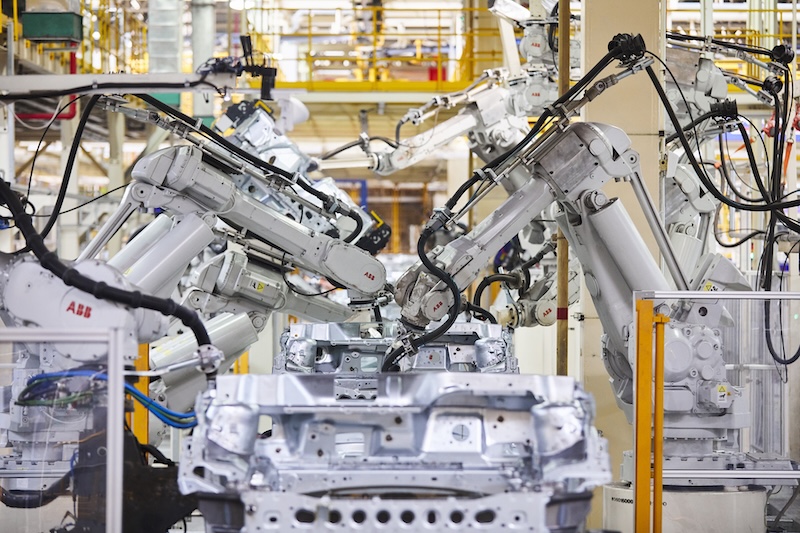
Automotive manufacturers worldwide are showing growing confidence in their ability to build electric vehicles efficiently and at scale, according to ABB Robotics’ latest Automotive Manufacturing Outlook Survey, as EV production becomes a more established and predictable manufacturing discipline.
“This year’s survey presents a more positive picture of EV manufacturing than we have seen in previous years,” said Joerg Reger, managing director of ABB Robotics automotive business line.
“Key indicators such as manufacturing time, cost and integration show that EV production is increasingly becoming a known quantity.
“This is supported by sustained investment in automation, such as ABB Robotics’ delivering more autonomous and versatile robotics (AVRTM), capable of creating a leap in productivity and flexibility by combining key skills to autonomously plan and independently perform diverse, complex tasks in real time.”
The global survey, conducted in partnership with Automotive Manufacturing Solutions, shows that manufacturers in all major regions expect EV output to rise in 2026 compared with 2025, signaling continued commitment to electrification at the manufacturing level despite uneven consumer demand in some markets.
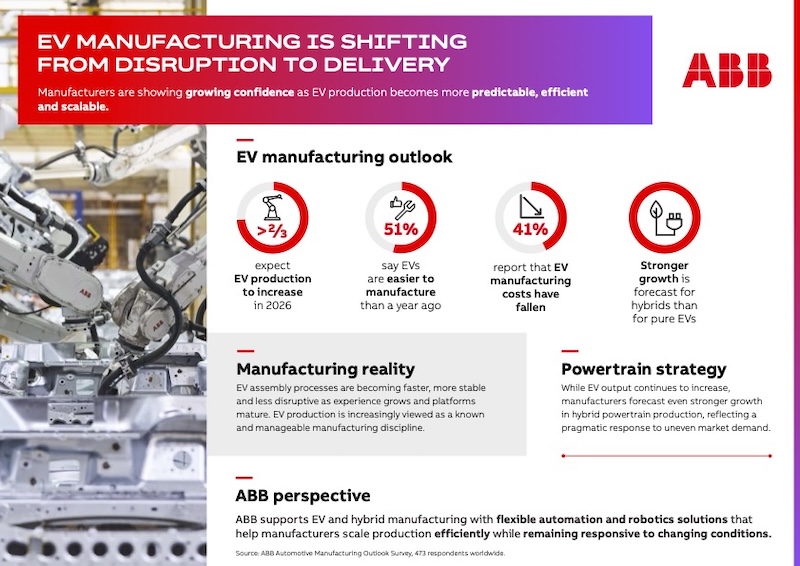
Confidence has also improved around the practical delivery of EV programs. Fifty-one percent of respondents say EVs and their key components are now easier to manufacture than a year ago, compared with just eight percent who believe they have become harder to build.
This suggests that EV assembly processes are becoming faster, more stable and less disruptive as experience grows, supported by developments in automation.
Cost trends reinforce this picture. More than four in ten respondents (41 percent) report that EV manufacturing costs have decreased over the past 12 months, while a further 39 percent say costs have remained stable. Only 21 percent report rising costs, pointing to improving efficiency as EV platforms and supply chains mature.
However, the survey also highlights a measured, demand-led approach to powertrain strategy. While EV production is expected to continue increasing, manufacturers predict even stronger growth in hybrid powertrain manufacturing over the same period.
This indicates that many producers view hybrid technologies as an important stepping stone, enabling them to balance electrification ambitions with real-world customer demand and operational flexibility.
“Manufacturers are no longer asking whether they can build EVs – they are focused on how to build them efficiently, profitably and alongside other powertrains,” added Reger. “Investment in robotics, automation and flexible manufacturing is a key driver behind this growing confidence, helping producers scale EV output while remaining responsive to changing market conditions.”
As EV manufacturing continues to evolve, the survey findings point to an industry that is steadily converting ambition into operational confidence, underpinned by automation-led approaches to efficiency, flexibility and long-term competitiveness.
This year’s survey gathered insights from 473 automotive industry decision-makers representing vehicle manufacturers and suppliers across the value chain worldwide.
