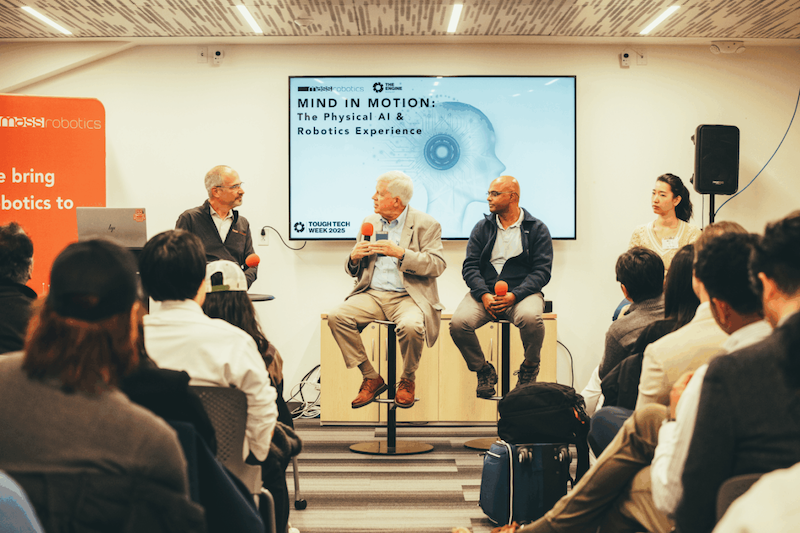
MassRobotics, Amazon Web Services (AWS), and Nvidia have announced the second cohort of the Physical AI Fellowship, a program designed to support robotics startups developing artificial intelligence systems for real-world machines.
The virtual program provides technical guidance, computing resources, and access to a global robotics ecosystem to help startups develop and scale “physical AI” technologies. The initiative builds on the inaugural fellowship cohort launched in late 2025.
The 2026 cohort includes nine startups working across sectors such as agriculture, construction, renewable energy, industrial automation, logistics, teleoperation, robotics data infrastructure, and humanoid robotics.
The companies selected for this year’s program are Burro, Config, Deltia, Haply Robotics, Luminous Robotics, Roboto AI, Telexistence, Terra Robotics, and WIRobotics.
The fellowship is intended to help companies move from prototype-stage robotics technologies toward enterprise deployments by providing engineering support and infrastructure from industry partners.
Tom Ryden, executive director at MassRobotics, says: “We’re excited to launch our second Physical AI Fellowship cohort and continue working alongside industry leaders like AWS and Nvidia to help startups scale real-world physical AI solutions.
“We look forward to showcasing the cohort at the Robotics Summit & Expo in May and connecting them with the broader community during Boston Tech Week.”
Participants receive engineering support from scientists at the AWS Generative AI Innovation Center, cloud infrastructure, and AWS credits. They also gain access to Nvidia’s startup ecosystem program, Nvidia Inception, which provides technical training, developer tools, and access to AI computing infrastructure.
Jason Bennett, vice president and global head of startups at AWS, says: “Physical AI represents one of the most transformative opportunities in robotics, and startups are leading the way in bringing these intelligent systems from lab to market.
“This fellowship is designed to remove technical and resource barriers that slow innovation by embedding our scientists and engineers directly with cohort companies, providing substantial cloud credits and AI services, and connecting them to enterprise customers who are eager to deploy these solutions.”
Nvidia said the initiative reflects growing demand for intelligent machines across industrial sectors.
Howard Wright, vice president of startup ecosystem at Nvidia, says: “Startups are an incredibly powerful catalyst for innovation. By taking early bets on emerging technologies, they transform bold ideas into scalable businesses.
“As physical AI brings intelligence to machines, factories, and infrastructure, these innovators will drive greater efficiency and productivity across the global economy.”
The program also offers access to Nvidia’s robotics tools and frameworks, including the Nvidia Isaac robotics platform and Cosmos foundation models.
