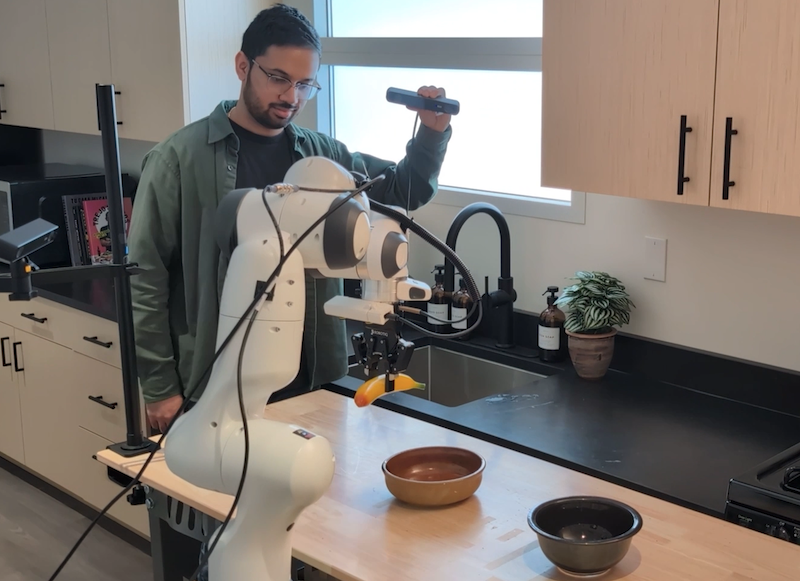
The Allen Institute for Artificial Intelligence (Ai2) says it has achieved a milestone in robotics by demonstrating that robots trained entirely in simulation can perform tasks in the real world without additional training or real-world demonstrations.
The result challenges a long-held assumption in robotics that systems trained in virtual environments must still be fine-tuned with physical robot data before they can operate reliably in real environments.
According to Ai2, its researchers showed that sufficiently large and diverse simulated training environments can produce robot control models capable of transferring directly to real machines – a concept known as “zero-shot sim-to-real transfer”.
Alongside the results, the institute is releasing two open-source tools designed to support this approach: MolmoSpaces, a large-scale simulation ecosystem for embodied AI, and MolmoBot, a robot manipulation model trained entirely on synthetic data.
MolmoSpaces provides the virtual environment in which robots are trained. The platform contains more than 230,000 indoor scenes, 130,000 object models, and more than 42 million annotated robotic grasp poses, allowing researchers to simulate millions of potential interactions between robots and everyday objects.
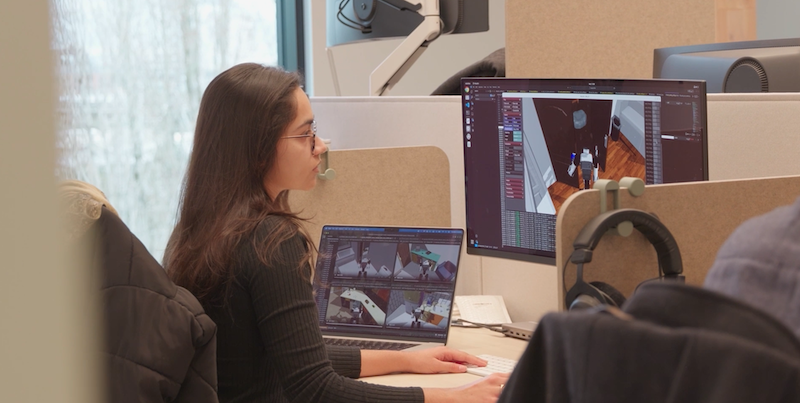
The system uses physics-based simulation engines to model realistic object dynamics and robot interactions, including articulated objects such as drawers, cabinets, and doors.
MolmoBot is the robot control model trained inside that environment. Using data generated from MolmoSpaces, it learns manipulation tasks such as pick-and-place operations, opening doors, and interacting with articulated objects.
In tests, MolmoBot successfully transferred its simulated training to real robotic systems, including a Franka FR3 robotic arm and a Rainbow Robotics RB-Y1 mobile manipulator. The system performed manipulation tasks on previously unseen objects and environments without any real-world fine-tuning.
The training pipeline generated 1.8 million simulated robot trajectories across more than 100,000 environments and 30,000 unique objects, producing large datasets far faster than traditional robot data collection methods.
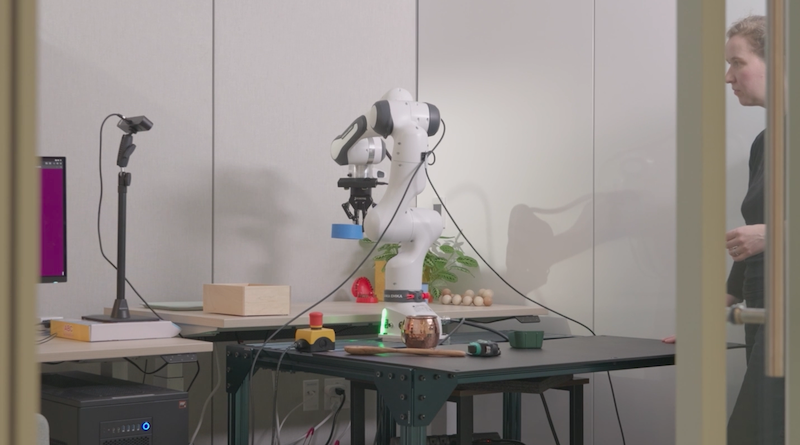
Because simulation can run massively in parallel on GPUs, the approach can produce robot experience far faster than real-world experimentation. In the study, researchers generated more than 130 hours of robot experience for every hour of computing time, enabling rapid iteration on training data and robot tasks.
The findings suggest that the primary bottleneck in robotics development may shift from collecting physical robot demonstrations to designing richer simulated environments.
This approach aligns with a broader trend in robotics and AI research toward “simulation-first” development, in which robots are trained extensively in digital environments before deployment in the physical world.
If validated more broadly, the technique could reduce the cost and time required to develop robot manipulation systems – potentially accelerating progress toward general-purpose robots capable of operating in homes, factories, and other real-world settings.
Ai2 says both MolmoSpaces and MolmoBot will be released as open tools to allow researchers and developers to build on the work.
