Artificial intelligence systems known as “AI agents” are becoming increasingly capable of carrying out complex digital tasks with minimal human supervision, according to a new research project from the Massachusetts Institute of Technology.
The 2025 AI Agent Index, compiled by MIT researchers, analyzes 30 prominent agentic AI systems and documents how they are built, deployed, and used across software ecosystems.
According to the project, “agentic AI systems are increasingly capable of performing complex tasks with limited human involvement,” reflecting a shift from simple chat-based assistants toward systems that can interact directly with software tools, websites, and enterprise platforms.
The study highlights how these agents now operate across a variety of digital environments. Some agents can manipulate web pages directly – clicking, typing, and navigating websites automatically – while others interact with corporate software platforms such as customer relationship management (CRM) systems.
For example, browser-based agents can autonomously perform tasks on the web once given a prompt, while enterprise agents can trigger workflows inside business software when events occur, such as receiving an email or detecting a database update.
According to the report, browser agents can “manipulate web pages through click/type/navigate actions”, while enterprise workflow agents often act through system integrations such as CRM connectors that update records or trigger automated processes.
Some agents can also operate at the operating-system level. Developer-focused tools may execute commands directly on computers, including editing files or running terminal instructions through command-line interfaces.
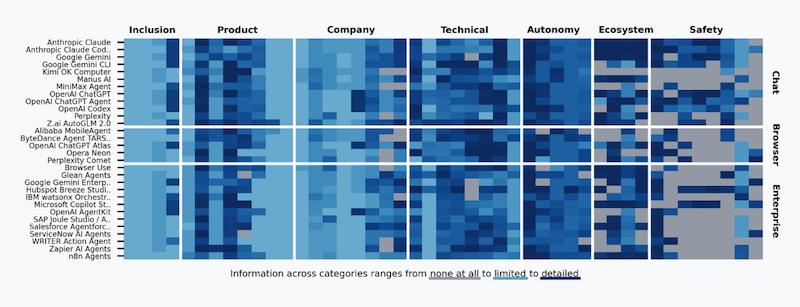
The researchers categorize agents into three broad types: chat-based assistants, browser agents, and enterprise automation platforms. Chat agents remain the most common, accounting for 12 of the 30 systems studied, while 13 are enterprise workflow platforms and five operate primarily through browser interfaces.
The study also finds that autonomy levels vary significantly between these categories. Chat-based assistants typically operate with lower levels of autonomy, executing a single action in response to a prompt before waiting for further instructions.
By contrast, browser agents often operate at the highest autonomy levels. Once initiated, they may complete entire sequences of actions without further human input.
Enterprise agents occupy a middle ground. While users typically configure them manually, once deployed they can run automated workflows triggered by external events.
Beyond documenting capabilities, the project also identifies major transparency gaps across the agent ecosystem. The researchers examined 1,350 information fields across the 30 systems and found 198 fields with no publicly available information, particularly in areas related to safety and ecosystem interaction.
The study also notes that most agents rely on a small number of underlying AI model families, including systems from OpenAI, Anthropic, and Google.
As agent technology continues to expand into web browsing, software automation, and enterprise operations, the researchers argue that better documentation and evaluation standards will be needed to keep pace with the rapidly evolving capabilities of these systems.
The MIT researchers do not identify a single dominant AI agent platform. Instead, the study suggests that the real power in the emerging agent ecosystem lies in a small group of foundation model providers – primarily OpenAI, Anthropic, and Google – whose models underpin most of the agents now being deployed across the web and enterprise software.
