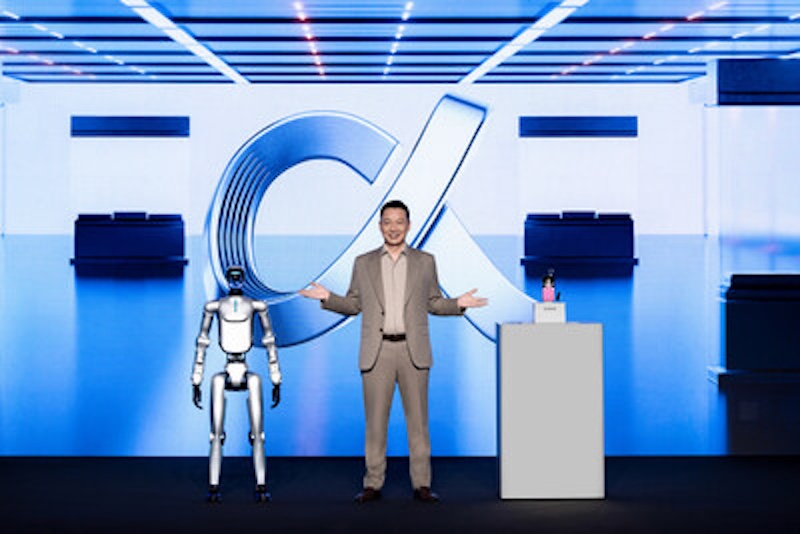
Honor has unveiled its first humanoid robot as part of a broader push into artificial intelligence devices at Mobile World Congress 2026 in Barcelona.
The company, best known for its smartphones, used the event to present a range of AI-powered products, including a concept “Robot Phone,” a new foldable handset and several computing devices. But the appearance of a humanoid robot on stage signaled the company’s intention to move beyond traditional consumer electronics into embodied AI systems.
According to Honor, the robot forms part of its wider strategy to develop intelligent machines that can operate in real-world environments and interact with people in more natural ways.
Smartphone maker enters robotics
The humanoid robot was introduced alongside the company’s vision for what it calls Augmented Human Intelligence (AHI) – an approach that combines hardware, AI and sensors to create devices capable of perceiving and responding to the physical world.
At the launch event, the company said its robots are being designed for several practical applications, including retail assistance, workplace inspection and companionship.
The move represents a notable step for a firm traditionally focused on mobile devices, suggesting that expertise in smartphones and connected consumer electronics could be applied to emerging robotics platforms.
Honor said the integration of its existing device ecosystem could allow future robots to recognize users and adapt to their needs more quickly than conventional systems.
CEO outlines broader AI strategy
James Li framed the announcement within the company’s broader AI roadmap, known internally as the Alpha Plan.
“With Human-centric as our lighthouse, we navigate the growth of AI through the two beams of IQ and EQ, bringing three forms of intelligence together,” Li said.
“We are exploring the new paradigm of AI devices with Alpha Phone; hosting the new paradigm of AI ecosystem with Alpha Store; and building the new paradigm of a silicon-carbon civilisation with Alpha Lab. With three waves of the Alpha Plan, we now have all the components in place and we are driving this journey at full warp speed.”
‘Robot Phone’ concept explores embodied AI
Alongside the humanoid robot, Honor previewed a concept smartphone known as Robot Phone, which the company describes as a new type of mobile device designed around embodied AI interaction.
Unlike conventional smartphones, the device incorporates mechanical movement and spatial awareness capabilities intended to make interactions more expressive.
The concept includes motion-based camera tracking, gesture-like responses and AI-powered object recognition. Honor said the device can follow users during video calls, respond with body-language-like gestures such as nodding, and even move rhythmically to music.
To enable these capabilities, the company developed a miniature mechanical architecture with a four-degree-of-freedom gimbal system and micro-motor designed to deliver controlled movement inside a smartphone-sized device.
Honor said the system also supports features such as AI object tracking and rotational video capture to create cinematic-style recordings.
Foldable phone and AI devices also launched
Alongside the robotics demonstrations, the company introduced its latest foldable smartphone, the Magic V6, which features an ultra-thin design and a high-density silicon-carbon battery.
Additional devices unveiled at the event included the MagicPad 4 tablet and MagicBook Pro 14 laptop, both designed to integrate AI capabilities and work across multiple devices within the company’s ecosystem.
Expanding into embodied AI
Together, the humanoid robot, Robot Phone concept and new hardware products illustrate Honor’s attempt to extend AI beyond software features and into physical devices capable of interacting with the real world.
The company said this approach could eventually lead to consumer-grade robots that combine mobile computing technology with embodied intelligence.
Honor has not yet provided details on commercialization timelines for the humanoid robot, but the unveiling suggests the smartphone maker is positioning itself to compete in the emerging market for intelligent robots and AI-powered devices.
