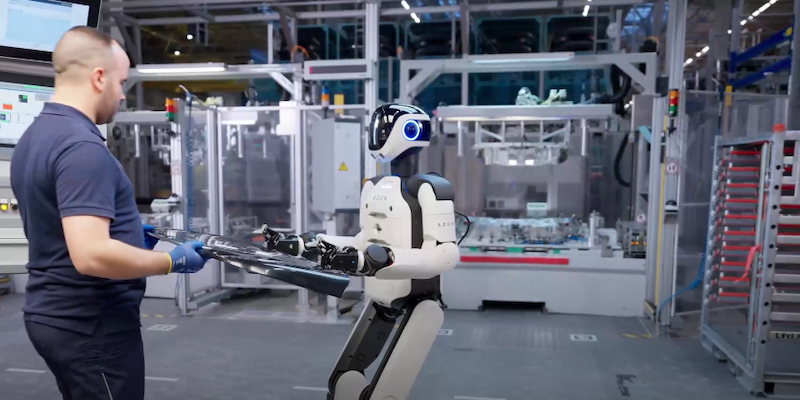
The BMW Group is preparing to test humanoid robots in its car production in Europe for the first time, as the company accelerates its push to integrate artificial intelligence directly into factory operations.
The pilot project will take place at the company’s Leipzig plant in Germany, where engineers will test how humanoid robots can work alongside existing manufacturing systems in series vehicle production. The robots will also be evaluated for use in battery assembly and component manufacturing.
The project is part of BMW’s broader effort to introduce what it describes as “Physical AI” – the combination of digital artificial intelligence with physical machines such as robots operating in real industrial environments.
“Digitalisation improves the competitiveness of our production – here in Europe and worldwide. The symbiosis of engineering expertise and artificial intelligence opens up entirely new possibilities in production,” said Milan Nedeljković, member of the board of management of BMW AG responsible for production.
The initiative follows an earlier pilot project in the United States, where BMW tested humanoid robots at its Spartanburg plant. Lessons from that deployment are now being used to expand the company’s exploration of Physical AI in Europe.
AI already embedded across BMW’s production system
Artificial intelligence is already widely used throughout BMW’s manufacturing operations.
Applications range from digital twin simulations in virtual factories and AI-enabled quality control systems to intralogistics supported by autonomous transport robots. Intelligent systems now play a role in nearly every stage of production.
A key enabler has been BMW’s effort to consolidate previously fragmented data systems. The company has replaced isolated data silos with a unified production data platform, ensuring that information across the production network is standardized, consistent and available in real time.
This unified data architecture allows digital AI agents to perform increasingly complex tasks autonomously while continuing to learn from operational data. Combined with robots, these agents form the basis of BMW’s concept of Physical AI.
“Our aim is to be a technology leader and to integrate new technologies into production at an early stage. Pilot projects help us to test and further develop the use of Physical AI – that is, AI-enabled robots capable of learning – under real-world industrial conditions,” said Michael Nikolaides, senior vice president production network and supply chain management at BMW Group.
He added that the company’s first US deployment demonstrated that humanoid robots can function beyond controlled laboratory settings.
“The successful first deployment of humanoid robots at our BMW Group plant in Spartanburg in the USA proves that a humanoid robot can function not only under controlled laboratory conditions but also in an existing automotive manufacturing environment.”
Digitalisation and artificial intelligence form the backbone of BMW’s broader BMW iFACTORY strategy, which aims to create flexible, future-proof manufacturing systems.
Humanoid robots as a complement to existing automation
BMW says humanoid robots are not intended to replace existing automation technologies but to complement them.
Robots with human-like form factors can potentially take on tasks that are monotonous, physically demanding, or safety-critical. The company believes these systems could help relieve employees from repetitive work while improving working conditions on the factory floor.
At the same time, BMW is expanding its internal capabilities to evaluate and deploy these technologies more systematically.
The company has established a new Center of Competence for Physical AI in Production, designed to consolidate expertise in robotics and artificial intelligence across its global manufacturing network.
“At our new Center of Competence for Physical AI in Production, we are pooling our expertise to make knowledge on AI and robotics widely usable within the company,” said Felix Haeckel, team lead for the initiative.
“In recent years, we have built up an international team of experts that, in addition to in-house research and programming, is dedicated to the gradual integration of AI into the existing production system. At the same time, our team in Munich is driving its own robotics research to set up, support, and further develop pilot projects in the field of Physical AI at our plants.”
BMW’s structured evaluation process for robotics partners begins with theoretical assessments before moving to laboratory testing using real production scenarios. Technologies that perform well in the lab are then deployed for initial testing at BMW plants before progressing to full pilot projects.
First European pilot with humanoid robot
The Leipzig deployment is being carried out in collaboration with Hexagon, a long-standing BMW technology partner.
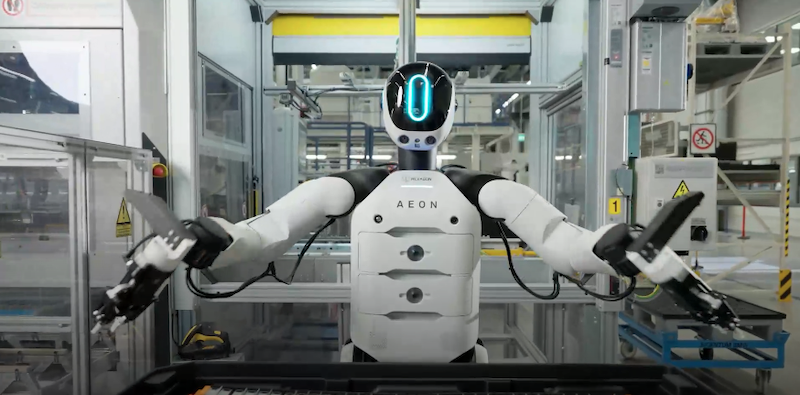
Hexagon’s robotics unit in Zurich unveiled its humanoid robot AEON in June 2025. After completing theoretical evaluation and laboratory testing, the robot was first trialled at BMW’s Leipzig plant in December 2025.
Further testing is scheduled to begin in April 2026, with a full pilot phase expected to start in summer.
“We are delighted to deploy a humanoid robot for the first time in a pilot project at a plant in Germany,” said Michael Ströbel, head of process management and digitalisation for order to delivery at BMW Group.
“Following evaluation by our Center of Competence for Physical AI in Production, tests were carried out in the laboratory and at Plant Leipzig at the end of last year. This year, our focus is on step-by-step integration into our production system to explore a wide range of applications.”
Ströbel said the pilot would examine how humanoid robots could perform multiple functions in manufacturing.
“The emphasis is on researching multifunctional use of the robot in various production areas such as battery manufacturing for energy modules and component production for exterior parts. With Hexagon, we have found a proven long-standing partner with a highly innovative approach to humanoid robotics for this project.”
The AEON robot’s human-like design allows different tools and grippers to be attached to its arms, enabling it to perform a range of tasks while moving on wheels around the production environment.
“We are very pleased to be working with the BMW Group to advance the use of humanoid robots in real-world environments,” said Arnaud Robert, president of Hexagon Robotics.
Lessons from the first humanoid robot deployment
BMW’s first humanoid robot deployment took place in 2025 at its Spartanburg plant in South Carolina, in collaboration with Figure AI.
During the 10-month pilot, the robot Figure 02 assisted in the production of more than 30,000 BMW X3 vehicles. Working ten-hour shifts from Monday to Friday, it performed the precise removal and positioning of sheet-metal components for welding – a task requiring both speed and millimetre-level accuracy.
Over the course of the pilot, the robot moved more than 90,000 parts and completed around 1.2 million steps in approximately 1,250 operating hours.
The project demonstrated that humanoid robots can safely perform repetitive precision tasks in an automotive production environment.
BMW engineers also gained insight into how quickly robotic motion sequences trained in laboratory settings could be transferred into stable shift operations. Integration with the company’s existing BMW Smart Robotics ecosystem was achieved using standardized interfaces.
The body shop was selected for the trial because of its high level of automation and the experience of employees in integrating new technologies.
Material supply in the area is already largely handled by automated smart transport robots, and BMW says early communication with employees helped ensure acceptance of the new technology. According to the company, the humanoid robots quickly became a normal part of day-to-day operations during the test phase.
BMW and Figure are now evaluating additional use cases for the next-generation Figure 03 robot.
