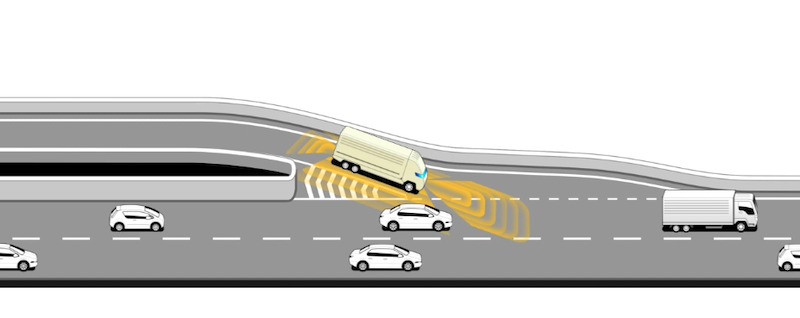
Mitsubishi Heavy Industries Machinery Systems is preparing to test a new infrastructure-based system designed to help autonomous vehicles merge safely onto busy highways in Tokyo.
The company, part of the Mitsubishi Heavy Industries Group, has signed a joint research agreement with Metropolitan Expressway Company to conduct a demonstration of ramp-merging support technology on Tokyo’s Metropolitan Expressway.
The trial is scheduled to take place between September and November 2026 near the Yoyogi entrance (inbound) on Metropolitan Expressway Route 4, also known as the Shinjuku Line.
Testing autonomous merging in dense traffic
The experiment will evaluate how infrastructure systems can assist autonomous vehicles when merging onto heavily trafficked urban highways – one of the more difficult scenarios for automated driving.
Tokyo’s Metropolitan Expressway presents particularly challenging conditions. Traffic volumes are high, merging sections are short, and the roadway geometry includes continuous curves and height differences between on-ramps and the main highway.
The project aims to help develop infrastructure technologies that support autonomous driving by providing vehicles with information from roadside systems, rather than relying solely on sensors mounted on the vehicle itself.
Building on earlier expressway projects
Metropolitan Expressway launched the research initiative by inviting proposals from industry participants. Mitsubishi Heavy Industries Machinery Systems was selected following its earlier work delivering a merging support information system on a section of the Shin-Tomei Expressway.
For the Tokyo demonstration, the company will coordinate with automobile manufacturers and other project participants to prepare the test environment.
MHI Machinery Systems says it plans to apply technologies developed during the Shin-Tomei project, along with sensing and communications capabilities originally built for toll collection and electronic toll collection (ETC) systems used in Japan and overseas.
Infrastructure support for next-generation mobility
The trial reflects a broader shift toward infrastructure-assisted autonomous driving, where roadside systems provide additional data to vehicles about traffic conditions and road geometry.
MHI Machinery Systems says it aims to support the development of “safe and convenient next-generation mobility” by focusing on infrastructure technologies that transmit information from roads to vehicles.
Following the Tokyo trial, the company plans to continue participating in demonstration projects and work with roadway operators to expand deployment of merging support systems.
